



This article is an excerpt from FREOPP’s policy handbook, “Affording the American Dream.”
Policymakers should:
- Enact institutional risk-sharing, which would force institutions that accept Title IV funding to bear direct responsibility for their graduates’ economic outcomes.
- Set caps on loans and federal aid by a degree program’s projected Return on Investment (ROI), so programs whose graduates produce strong earnings and high repayment rates qualify for higher borrowing limits, whereas those with poor outcomes do not.
- Condition state funding of public universities and any subsidies on student outcomes and positive-ROI programs, which would align both student and taxpayer investments with actual economic value.
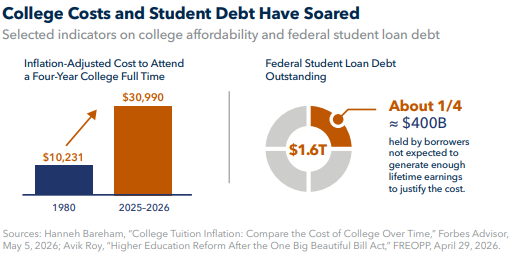
America’s colleges and universities are facing an affordability crisis. In 1980, the average inflation-adjusted price to attend a four-year college or university full-time was $10,231 for tuition, fees, and room and board. By the 2025–26 academic year, that figure reached $30,990: a real-term increase of roughly 203 percent.1 In fact, college tuition has risen faster than any other household expense since 1983, outpacing health care, housing, and gas.2 Meanwhile, total outstanding federal student debt surpassed $1.6 trillion in 2024, with roughly one-quarter owed by borrowers whose degrees are not expected to generate enough lifetime earnings to justify the cost.3
This affordability crisis is deeply troubling because rising costs put college out of reach for many low-income families. For generations of Americans, a college degree served as a clear engine of upward mobility. With ingenuity, hard work, and determination, students could earn a credential that all but secured their place in the middle class or beyond.
At least, that was the promise of the Higher Education Act (HEA) of 1965: to expand access by making college more affordable.4 Signed into law by President Lyndon Johnson as part of the Great Society, the HEA sought to democratize postsecondary education by establishing the first federal grant program for undergraduate tuition, a federally guaranteed loan system, and a framework of aid to colleges and universities that remains active today. The law was meant to ensure, Johnson noted, that “a high school senior anywhere in this great land of ours can apply to any college or any university in any of the 50 states and not be turned away because his family is poor.” 5
Unfortunately, the opposite happened. College costs have skyrocketed over the past four decades because Title IV of the HEA—the provision governing student aid—never tied funding to student outcomes. As FREOPP Chairman Avik Roy explains
The student was the nominal beneficiary of the grant or loan, but the money passed through his or her hands without stopping. Whether the student could repay the loan, whether the degree he or she obtained would be worth anything in the labor market, and whether the college had any stake in the answer to either question were never addressed in the original statute because none of these questions were the ones the bill’s drafters were asking.6
Since 1965, federal aid to colleges and universities has continued to expand, driving up costs while remaining entirely disconnected from student outcomes. During the 1970s, Congress broadened grant and loan programs without evaluating whether these subsidies translated into meaningful wage gains for students. The problem worsened in 1980 with the creation of the Parent PLUS Program, which extended federal loans to parents on behalf of their children with no borrowing caps or traditional underwriting.7 Then, in 2005, Congress introduced Grad PLUS. Replacing the previous $18,500 annual graduate borrowing limit, this program allowed students to borrow up to an institution’s full cost of attendance without any income check, employment verification, or debt-to-income evaluation. Similar toParent PLUS, borrowers only had to show they did not have “adverse credit history.” 8 By the time the federal government fully took over student lending in 2010, borrowing had become the primary source of tuition financing for graduate programs, along with many undergraduate programs.9
Title VIII of the One Big Beautiful Bill Act (OBBBA) tried to bring these unchecked costs back under control. It phased out the Grad PLUS program and imposed annual ($20,000) and aggregate ($65,000) limits per dependent on Parent PLUS. The law also replaced the federal government’s complex array of income-driven repayment plans with two streamlined options.10
Most significantly, the OBBBA wrote a direct, earnings-based accountability test into federal statute. The law now revokes Title IV eligibility for any program whose graduates fail to meet certain earnings benchmarks. For undergraduate programs, the baseline is the median earnings of working adults aged 25 to 34 in the institution’s state holding only a high school diploma. For graduate and professional programs, the benchmark is the lowest of three candidate medians: state working adults with a bachelor’s degree; state working adults in the same field with a bachelor’s degree; or U.S. working adults in the same field with a bachelor’s degree. Finally, the OBBBA introduced the Workforce Pell Grant, extending Pell Grant eligibility to short-term occupational programs lasting between 8 and 15 weeks (150 to 600 instructional hours).11
Still, the federal government can go further to solve the college affordability crisis. It should enact reforms, such as:
- Strengthen the earnings-based accountability benchmarks written into the OBBBA As originally designed, the law sets the threshold for Title IV eligibility extremely low; undergraduate programs need only show median graduate earnings of $36,000 to $45,000 four years after completion.12 Congress should replace this floor with a new benchmark based on net ROI. FREOPP’s Return on Investment in Higher Education methodology, for example, calculates ROI by weighing post-graduation earnings against forgone income during enrollment, discounting future earnings to present value, and considering the earnings a similar worker could expect without the credential. This methodology shows that approximately 23 percent of bachelor’s degrees and 50 percent of master’s degrees produce a negative ROI.13 Developing a benchmark modeled on FREOPP’s formula would deny Title IV eligibility to these underperforming programs, which leave students and taxpayers financially worse off.
- Enact institutional risk-sharing Under the current system, colleges and universities are guaranteed federal tuition revenues upfront while transferring 100 percent of the risk of non-repayment onto students and taxpayers. Instead, institutions that accept Title IV funds should bear direct responsibility if their students fail to repay their loans.
As Roy has proposed, Congress should create a risk-adjusted, risk-sharing formula to ensure that institutions serving economically disadvantaged populations are not unfairly penalized under this policy framework:
- The secretary of education should build a federal database that connects every Title IV recipient to their entering characteristics—such as Pell status, family income, first-generation status, and field of study—with their long-term outcomes (completion rates, loan balances, and 4-, 6-, 8-, and 10-year post-graduation earnings).
- Next, the secretary should develop a risk-adjustment formula. Under this formula, “a Pell-eligible, first-generation student from a ZIP code in the bottom decile of median family income receives,” Roy explains, “a high risk score; a non-Pell student from an affluent ZIP code receives a low risk score.” It can then be used to calculate an expected aggregate repayment value for every institution based on how its students perform compared to similar students nationally.
- The federal government would then be able to compare each institution’s repayment performance against its risk-adjusted benchmark. Colleges and universities that exceed expectations should receive rewards, while those that fall short should be penalized.14
- Set ROI-based loan caps While the OBBBA placed limits on graduate borrowing, it failed to impose meaningful caps on undergraduate student loans. Instead of relying on fixed statutory limits—set at $5,500, $6,500, and $7,500 depending on whether the student is a freshman, sophomore, or upperclassman—the federal government should tie annual loan caps to a program’s projected ROI.15 Under this approach, programs whose graduates produce strong earnings and high repayment rates would qualify for higher borrowing limits, whereas those with poor outcomes would not.
- Impose basic underwriting requirements The federal government should also establish an underwriting requirement—or mandate an eligible co-signer—for the Parent PLUS program. Indeed, this remains the only federal loan program without any serious ability-to-repay standard.16
It is unlikely, however, that federal solutions alone will solve the college affordability crisis. State governments should seek to curb runaway costs as well. States can take several steps, including:
- Tie state appropriations to graduates’ labor-market outcomes State legislatures should condition appropriations for public universities on former students’ earnings and career success, rather than mere enrollment numbers. Doing so would align taxpayer investments with actual economic value.17
- Exercise strict oversight over Workforce Pell approval Governors should use the statutory authority granted under the OBBBA to establish a rigorous, data-driven screening process, authorizing Workforce Pell eligibility only for programs tied to high-skill, high-wage, and in-demand occupations.18
- Direct in-state tuition subsidies toward positive-ROI programs States should tie state-funded tuition discounts to program ROI. Degree programs that generate positive lifetime net present value for students should receive the full in-state tuition differential, the full merit scholarship, and the full need-based grant aid the state offers, while those that generate a slightly negative lifetime ROI should receive partial subsidies. By contrast, programs that generate a lifetime ROI well below zero should receive no subsidies.19 This would ensure that taxpayer dollars support only those degrees that leave students financially better off.
- Curb credential inflation in state hiring States should review job descriptions across public positions, identify those where a college degree is listed but not necessary, and replace the requirement with skills-based hiring processes.20
Since the passage of the HEA in 1965, federal aid to colleges and universities has been disconnected from student success, driving tuition inflation while insulating institutions from real accountability. Meaningful reform, however, is achievable at the federal and state levels. By enacting institutional risk-sharing, strengthening earnings-based accountability benchmarks, setting ROI-based loan caps, imposing underwriting requirements, and aligning state funding of public colleges and universities with economic outcomes, policymakers can hold institutions responsible for their graduates’ financial futures. These reforms would ensure that American postsecondary education once again serves as an engine of upward mobility for students, particularly those on the bottom rungs of the economic ladder.
Endnotes
- Hanneh Bareham, “College Tuition Inflation: Compare the Cost of College Over Time,” Forbes, May 5, 2026, https://www.forbes.com/advisor/student-loans/college-tuition-inflation/#:~:text=In%201980%2C%20the%20price%20to%20attend%20a,the%20average%20annual%20cost%20sitting%20around%20%2430%2C990.
- J.P. Morgan, “Tuition Inflation,” https://am.jpmorgan.com/us/en/asset-management/adv/investment-strategies/college-planning-essentials/viewer/college-costs/cpe-ccinflation/.
- Avik Roy, “Higher Education Reform After the One Big Beautiful Bill Act,” The Foundation for Research on Equal Opportunity, April 29, 2026, https://freopp.org/whitepapers/higher-education-reform-after-the-one-big-beautiful-bill-act/.
- Roy, “Higher Education Reform.”
- Lyndon B. Johnson, “Remarks at Southwest Texas State College Upon Signing the Higher Education Act of 1965,” November 8, 1965, https://www.presidency.ucsb.edu/documents/remarks-southwest-texas-state-college-upon-signing-the-higher-education-act-1965.
- Roy, “Higher Education Reform.”
- Roy, “Higher Education Reform.”
- Ben Cecil, “How We Got Here: The Rise and Fall of the Grad PLUS Loan Program,” Third Way, December 4, 2025, https://www.thirdway.org/memo/how-we-got-here-the-rise-and-fall-of-the-grad-plus-loan-program.
- Roy, “Higher Education Reform.”
- Roy, “Higher Education Reform.”
- Roy, “Higher Education Reform.”
- Roy, “Higher Education Reform.”
- Preston Cooper, “Does College Pay Off? A Comprehensive Return On Investment Analysis,” The Foundation for Research on Equal Opportunity, May 8, 2024, https://freopp.org/whitepapers/does-college-pay-off-a-comprehensive-return-on-investment-analysis/#6c4b.
- Roy, “Higher Education Reform.”
- Roy, “Higher Education Reform.”
- Roy, “Higher Education Reform.”
- Avik Roy, “A State Agenda for Higher Education Reform,” The Foundation for Research on Equal Opportunity,” June 4, 2026, https://freopp.org/whitepapers/a-2026-state-agenda-for-higher-education-reform/.
- Roy, “A State Agenda.”
- Roy, “A State Agenda.”
- Roy, “A State Agenda.”