



Executive summary
Originally conceived to help families pay the costs of college, 529 savings accounts (529s) have evolved to cover many education-related expenses at the primary and secondary levels. 529 plans are tax-advantaged savings accounts that allow families to invest after-tax dollars for future education expenses, with earnings growing tax-free and withdrawals exempt from federal taxes when used for qualified education costs. American families collectively own 17 million 529 accounts with assets exceeding $500 billion, making it a key vehicle for supporting American education throughout a student’s career.
This report reviews the history of 529s and federal reforms expanding their allowable uses over the past 30 years, presents data about their usage and public support, and examines socioeconomic gaps in 529 ownership and the implications for equal opportunity, particularly in K-12 education. The report also examines several current state policies, including whether tax rules align with federal tax laws regarding allowable uses, tax incentives for contributions, and other contribution policies. Importantly, the report also provides policy recommendations to ensure that children from lower socioeconomic backgrounds benefit from these accounts.
The evolution of 529s has revealed both strengths in the program and opportunities for greater expansion, including:
- Congress has transformed 529 accounts into lifelong learning accounts that allow owners to save after-tax dollars that grow tax free. Funds can be spent on a broad range of education expenses including K-12 tuition, homeschooling costs, tutoring and other outside-of-school enrichment activities, college tuition, and job training in adulthood. Eventually, funds even can be transferred into retirement accounts. 529 accounts are popular with American families who can afford to use them.
- But surveys have consistently shown significant gaps in 529 account usage between socioeconomic levels, which is unsurprising since the accounts typically require a family to save funds out of pocket to make contributions.
- Evidence indicates that public and private sector initiatives to provide contributions into 529 accounts of children benefit students and their families and promote equal opportunity in education.
Based on these findings, I recommend the following:
- State policymakers should align their state rules to ensure that 529 account owners and beneficiaries can take advantage of new federal rules allowing funds to be spent on a broad spectrum of education choice options.
- States should provide tax incentives to encourage contributions into 529 accounts, including both by individuals and employers.
- Civil society, including philanthropists and employers, should contribute seed investments or matching grants into 529 accounts to promote equal opportunity and help economically disadvantaged children.
Ensuring that all American families can access 529 accounts should be a priority for policymakers to ensure lifelong learning and educational choice. Policymakers should leverage 529 accounts by helping all children use them to save and choose the best education and job training opportunities throughout their lives.
Background on 529 accounts and expanding allowable uses
In the late 1980s, four states—Florida, Michigan, Ohio, and Wyoming—established programs to help families save for their children’s college expenses. These college savings plans prompted Congress to construct Section 529 of the Internal Revenue Code to recognize these plans and use after-tax dollars to save for college. The 2001 tax reform bill amended the rules to clarify that funds withdrawn to make qualified expenditures were not subject to federal taxes, though the rules would initially sunset in 2010. Once established as a savings vehicle for post-tax funds to grow tax free, 529s became a popular mechanism for American families to save for higher education expenses. In 2006, Congress made permanent the tax-free savings allowed under 529s.
In 2017, Congress passed the Tax Cuts and Jobs Act, which included a significant change to how American families can use 529 accounts. The law expanded the definition of qualified education expenses to allow up to $10,000 annually per beneficiary to be spent on K-12 tuition. Prior to this change, elementary and secondary expenses were not allowed under federal law. Two years later, Congress further expanded 529s to cover apprenticeships in the SECURE Act. This law also authorized some 529 funds to be spent on student loan repayments.
In 2022, Congress continued to expand how 529s can be used for long-term retirement savings. The SECURE 2.0 Act amended 529 rules to allow beneficiaries to transfer $35,000 in unused 529 accounts into Roth IRAs, which also allow post-tax funds to grow tax-free and without being subjected to federal taxation when withdrawn in retirement. This rollover option was established to address the problem of people potentially saving too much in these accounts and facing potential tax penalties if they do not use the funds on higher education expenses.
In 2025, Congress passed the One Big Beautiful Bill Act, further expanding allowable uses to a broader range of elementary and secondary education expenses, including certain tutoring costs, books, curriculum and other materials, testing fees, online learning programs, and fees associated with dual enrollment in postsecondary institutions. The law also increased the annual amount that can be spent on K-12 expenses from $10,000 to $20,000 per beneficiary.
Beyond K-12 education, 529 funds can also be used on a broader range of expenses in adulthood, including on certain apprenticeship programs to support job training. In addition, up to $35,000 in 529 funds can be rolled over into Roth IRAs in a beneficiary’s lifetime, which also means that these accounts can provide a tax-free mechanism for long-term retirement savings. Federal rules also allow 529 account owners to transfer the benefits to a child or dependent, meaning that unspent funds could be reserved and used to benefit a future child’s education.
In 2026, 529 funds can be used for a broad range of costs. Dollars invested in a 529 could be used to help a child attend a private school, access tutoring, pursue homeschooling, or prepare for college. These funds can also be used to access early college coursework through dual enrollment. After high school, beneficiaries can pay for tuition, related higher education expenses, or registered apprenticeship programs. Unspent funds can be rolled over into tax-free retirement savings accounts, which allow for long-term wealth building and to support economic security in older age. Since funds saved in a 529 account can also be transferred to other beneficiaries, such as a person’s child, 529 accounts offer a broad range of uses and have the potential to enable full spectrum education choice across generations.
Growth in 529 account ownership
Section 529 authorizes two kinds of programs: savings plans and prepaid tuition plans. 529 savings plans let families invest funds into professionally managed investment portfolios that grow tax-free and can later be used to pay for qualified education expenses. Prepaid tuition plans allow contributors to pay the current cost of tuition at certain postsecondary institutions to pay for tuition in the future.
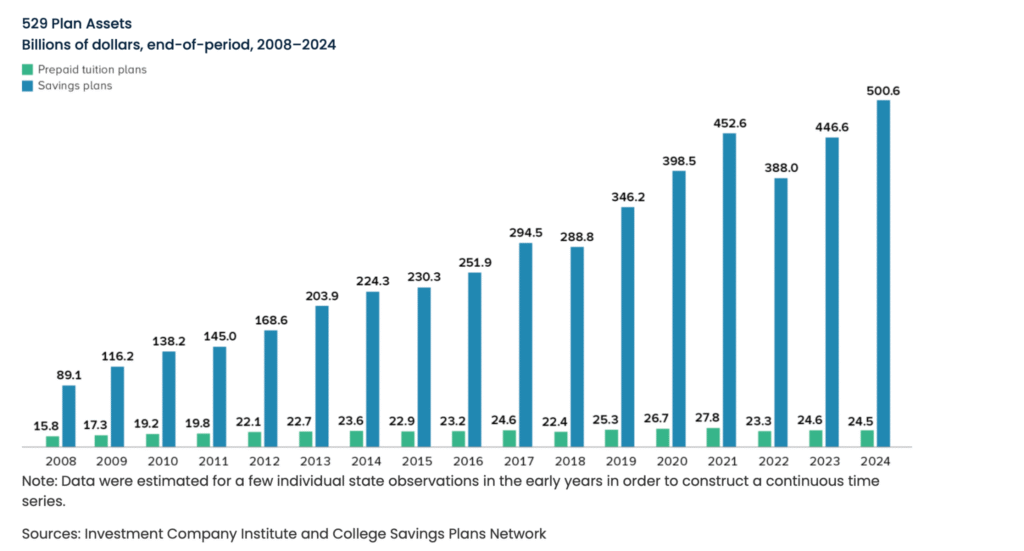
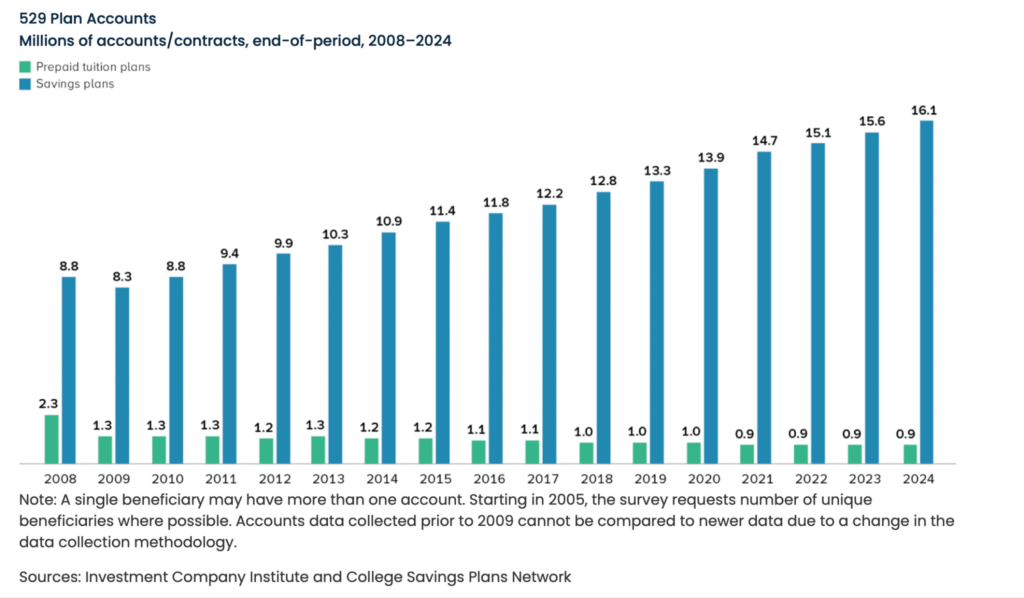
According to data collected by the Investment Company Institute and College Savings Plans Network, growth in the number of accounts owned and the value of those accounts has grown dramatically since 2008. Americans own 17 million accounts collectively with more than $500 billion in assets as of 2024. The overwhelming majority of these accounts—16 million—are savings plans.
529s are generally popular but many parents remain unfamiliar
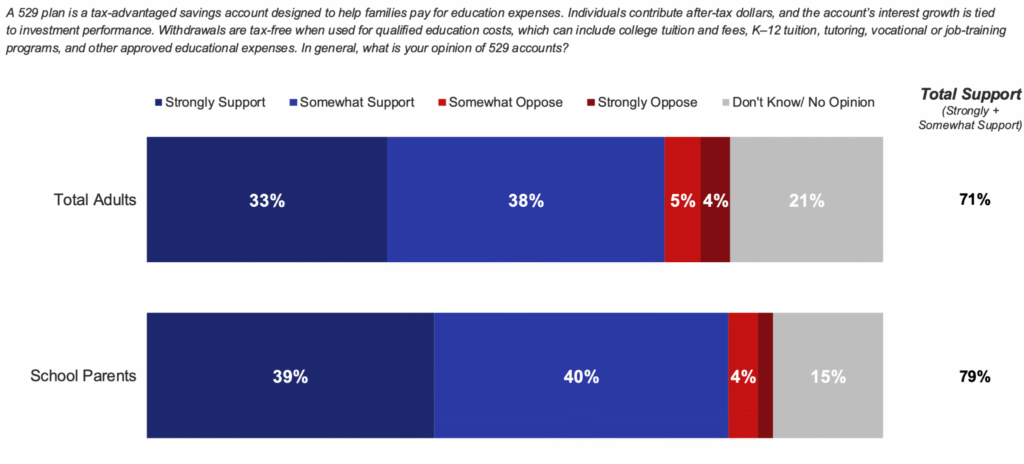
Americans broadly support the opportunity to use 529 plans to save for education expenses. A 2025 Morning Consult survey sponsored by Ed Choice revealed that 79 percent of parents and 71 percent of adults support 529s when they are provided information about the plans.
Support for 529 plans among adults and parents of school-age children
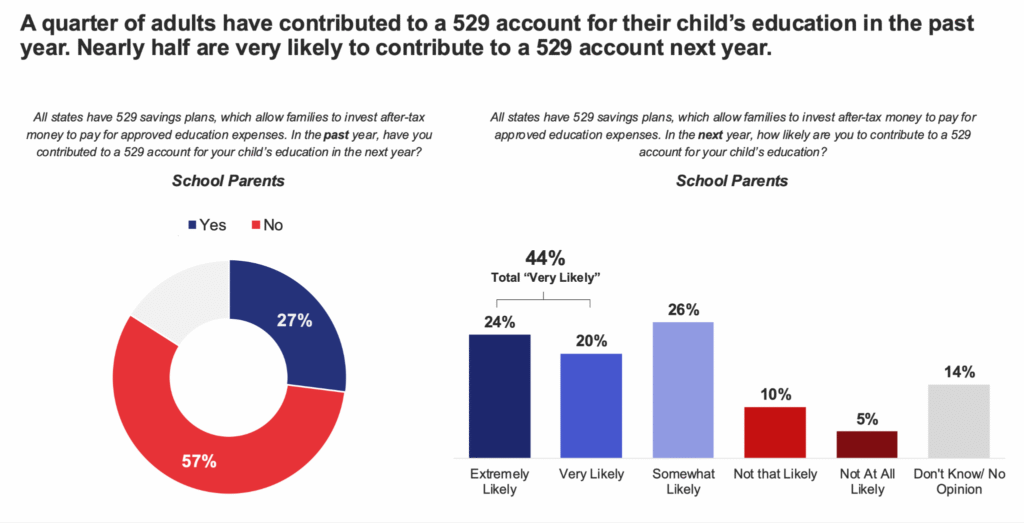
The poll also found that 27 percent of parents had contributed to a 529 account over the past year and that 44 percent of parents indicated that they were very likely to contribute to a 529 account over the next year.
Unfortunately, the survey data also showed that Americans from lower socioeconomic backgrounds were somewhat less supportive of 529 accounts. Thirty percent of Americans with incomes below $50,000 did not know about or had no opinion of 529 accounts. See the full demographic breakdown below.
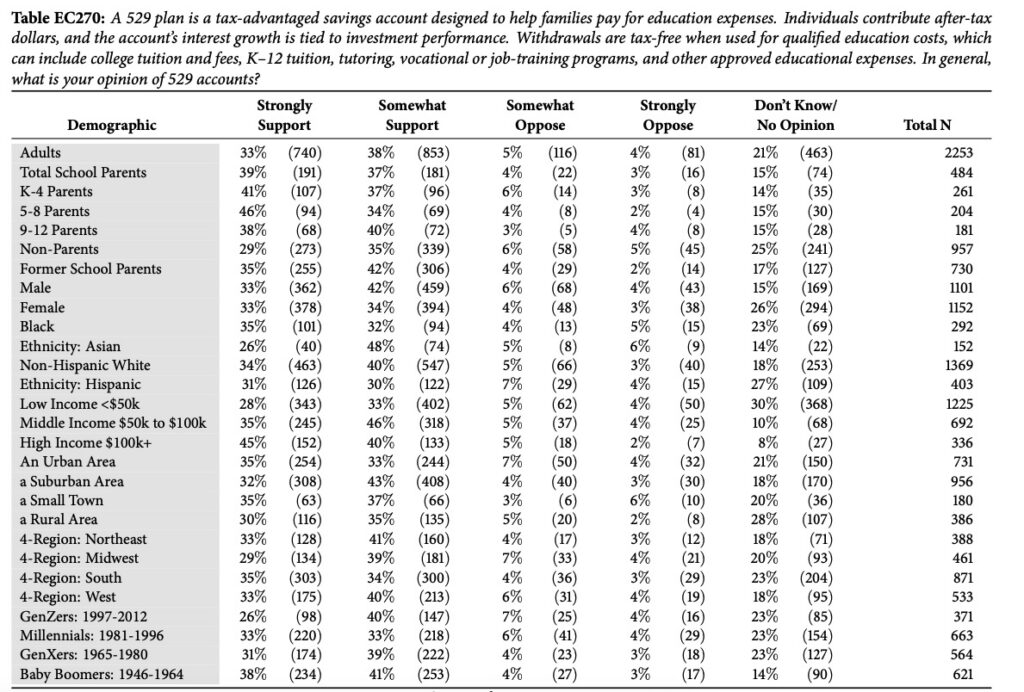
The survey was based on information provided to parents and adults about 529 plans. But a Morning Consult survey last year sponsored by Edward Jones showed that more than half (52 percent) of Americans did not know what 529 plans were and that only 14 percent had or planned to use them. This earlier survey also found that a majority of respondents were not aware that 529 accounts could be used for expenses beyond college with 65 percent unaware that accounts can be used for K-12 expenses and 72 percent unaware that funds can be spent on apprenticeships. This strongly suggests that states and educators need to better promote 529 plans.
Socioeconomic Gaps in 529 Account Access and Usage
Surveys have consistently shown significant gaps in 529 account usage between socioeconomic levels. This is unsurprising given that 529 accounts typically require a family to save funds out of pocket to make contributions. For many families, saving long-term for college, job training, or K-12 expenses is simply something that they cannot afford to do.
A Government Accountability Office (GAO) report found that less than three percent of American families owned 529 accounts as of 2010. The report also showed that families that owned 529 accounts on average had substantially more assets and wealth than those without. Similarly, a 2016 Federal Reserve analysis of Survey of Consumer Finances (SCF) data showed that 2.5 percent of American households owned 529 accounts in 2013, but that ownership among those living below median income or from households below median wealth level was 0.3 percent.
Expanding 529 account uses without assisting lower-income families increases inequality
The ongoing expansion of 529 accounts to allow families to use after-tax funds saved in them has the potential to exacerbate education inequality. For example, Thomas Toch and Brooke LePage with FutureEd wrote in 2021:
“Ultimately, tax breaks on savings accounts whether for colleges or primary and secondary schools are a middle- and upper-class benefit. Recognizing that it’s not an effective way to help lower income students get an education is important to remember as pressure grows to raise the caps on contributions.”
They are right that children from lower socioeconomic backgrounds are unlikely to benefit from the tax advantages offered by 529ssince their families likely do not have much after-tax income. However, as I wrote at the time, this overlooks the potential for government and civil society interventions to provide seed or matching contributions into 529 accounts owned by children from low-income families. Fortunately, there is a national movement to provide seed investments and matching contributions to help lower-income children use 529 accounts.
Ownership of 529 accounts benefits children and their parents
A growing body of research shows that children’s savings account (CSA) programs can shape outcomes for both children and parents. In one of the most influential studies, Washington University researchers conducted a randomized experiment in Oklahoma in 2007, holding a lottery and awarding $1,000 investments to randomly selected children. Years later, they found that these investments increased children’s college savings, raised parents’ expectations, and improved children’s social-emotional development compared to their peers. In December 2020, the GAO reviewed the available evidence about child savings account programs that provide seed investments into accounts, finding that:
“[T]he 34 studies we reviewed suggest positive short-term effects in each of the areas most frequently assessed: program enrollment or participation, savings accumulation, expectations of attending college, family members’ well-being, children’s social-emotional development, and academic achievement. The majority of CSA program research included in our review examined two large-scale CSA demonstrations designed to assess the effectiveness of CSA program strategies.”
Such positive results should encourage similar programs across the country to jumpstart parental savings among disadvantaged families.
529 account access and education inequality
Children’s savings accounts have the potential to encourage Americans to save and pay for a broad range of K-12, postsecondary, and job training expenses, and even to save for retirement. But 529s could also exacerbate inequality if poorer American families cannot benefit from these options. For example, one of the most significant gaps in education opportunities is the difference in outside-of-school learning opportunities. Economists have reported that wealthier families on average spend about seven times more than low-income families on their children’s educational enrichment outside of school.A RAND analysis found that summer learning losses contributed to the socioeconomic academic achievement gap between richer and poorer students.
One potential way that states and local school districts could leverage 529 accounts would be to reallocate certain government expenditures, such as public education spending, to provide deposits into lower-income children’s 529 accounts. For example, with national average per-pupil expenditures in public schools totaling more than $16,000 per year, states and school districts could provide five percent of that funding to low-income children to help them save and pay for current or future education expenses through 529 accounts.
Reviewing state policies related to 529s
Federal laws, including the 2025 One Big Beautiful Bill Act, govern how 529 savings funds can be used. However, state policies also affect how 529 funds can be saved and used in several ways. To determine whether a given state is maximizing choice, we can ask several questions to find the answer.
Does the state have a personal income tax?
According to the Tax Foundation, eight states have no state income tax: Alaska, Florida, Nevada, New Hampshire, South Dakota, Tennessee, Texas, and Wyoming. In addition, Washington only has an income tax for federal capital gains. For these states, individuals who withdraw funds from 529 accounts under federal law will not be subject to any state level taxation. Naturally, states do not need to make their laws more friendly to 529s if they do not tax that income in the first place.
Do the state’s income tax laws match federal allowable expenditures?
States may decide whether to recognize and match federally allowed 529 expenses or tax interest earned in those funds. If they do not, funds withdrawn from 529 accounts that are tax-free under federal law may be subject to state income taxes.
According to the Tax Foundation, “Eighteen states and the District Columbia have “rolling” conformity with the Internal Revenue Code, meaning that they will conform to relevant provisions of the new federal law automatically, while nineteen must update their fixed-date conformity statutes to adopt the new provisions.” However, following changes to 529 laws in 2017, some states passed legislation to clarify that their state income tax laws did not align with the new federal allowable uses, specifically on K-12 tuition. According to Saving for College, California, Colorado, Connecticut, Hawaii, Illinois, Michigan, Minnesota, Montana, Nebraska, New Mexico, New York, Oregon, and Vermont do not recognize K-12 tuition as a qualified 529 expense. Imposing state taxation on after-tax dollars saved in 529 accounts punishes families, including working parents, who pay taxes to support public schools while also paying for private school tuition for their children. Federal data show that 21 percent of children enrolled in private schools are from poor or near poor socioeconomic backgrounds.
Does the state offer an income tax deduction or credit for 529 contributions?
States also can establish an income tax credit or deduction to encourage contributions into 529 accounts. Savings for College lists more than 30 states and the District of Columbia that provide personal income tax benefits for 529 contributions. In addition, at least eight states provide incentives for employers to make contributions into employee-owned 529 accounts.
Does the state penalize or recapture tax benefits for withdrawals for K-12 tuition?
States can implement penalties or recapture policies related to state tax deductions or credits taken if funds are withdrawn for unallowed expenses. Saving for College listed nine states that offered a tax deduction or credit for 529 contributions required that those tax benefits be recaptured if spent on K-12 tuition as of February 2025.
Does the state provide seed or matching contributions into 529 accounts?
Some states have established programs to provide seed contributions into children’s 529 accounts or that offer matching contributions to encourage parents to contribute. According to the National Conference of State Legislatures (NCSL), “at least 14 states had created programs to provide initial grant deposits to parents who open 529 accounts,” since 2015. The table below presents a compilation of analyses of state-by-state policies related to 529 accounts, drawing from information collected by the Institute on Taxation and Economic Policy, FinAid, 2022 and 2025 Saving for College analyses, and NCSL. State 529 policies vary widely across tax treatment and eligible uses, though simplified comparisons may mask substantial differences in deduction size, eligibility rules, and conformity with federal law. This analysis is not comprehensive and these policies are subject to change. In addition, states have not clarified new policies related to the expanded allowable uses included in the OBBBA.
In addition to state policies, private charitable contributions have made significant contributions into children’s 529 accounts in some states. In Maine, for example, the Alfond Scholarship Foundation provides $500 seed contributions into children’s 529 accounts. A similar state-operated program in Pennsylvania provides seed grants funded by the Henry L. Hillman Foundation.
Employers can also play an important role helping their employees save for their children’s education expenses. In 2024, the New York Times reported that “[f]ifteen percent of employers with 500 or more employees now help workers fund 529 plans, either by letting them deposit their own money through paycheck deductions or by providing employer contributions or matching funds.”
The opportunity for the public education sector to contribute to children’s 529 accounts
Reallocating public education sector funding to seed lower-income children’s 529 accounts is a promising option to expand opportunity. .While many public schools face resource scarcity challenges, local, state, and federal revenues for the K-12 public education sector are vast. With average per-pupil spending in public schools totaling more than $16,000, the average student attending public schools in the United States from kindergarten through adulthood may have $200,000 or more spent on her public schooling. Public schools could provide children with contributions into 529 accounts to help children access tutoring or enrichment or to save for future college and job training expenses. Public schools could structure 529 contributions in a manner to encourage attendance and reverse widespread, chronic absenteeism. Some public schools could offer a contribution into a child’s 529 account to provide an incentive for enrollment, since nationwide public school enrollment is projected to decline and participation in private school choice programs is increasing.
Recommendations for state policymakers
- State policymakers should align their state rules to ensure that 529 beneficiaries can take full advantage of federal rules. To provide maximum benefit of these programs, state policies should conform with federal allowances for 529 funds. Students and 529 beneficiaries in all states should have the opportunity to use funds saved in their 529 accounts on a broad range of education choices now allowed under federal law. Families living in certain states should not face additional taxation, penalties, or benefit recapture if they wish to spend their 529 account funds on federally recognized expenses.
- State policymakers should provide income tax incentives to encourage contributions into 529 accounts. More than 30 states and D.C. already provide tax benefits for 529 account contributions. At least eight states provide incentives for employers to make contributions into employee owned 529 accounts. Other states with state income taxes should establish similar deductions or partial credits to encourage these contributions. This will benefit working parents and lower-income families by making it easier to save in these accounts.
- State policymakers should create additional initiatives to contribute funds into 529 accounts of children from lower socioeconomic households to promote equal opportunity. More than a dozen states currently provide seed or matching grants into 529 accounts to encourage families to save for K-12, college, and job training expenses. In addition, state policymakers should consider other incentives such as additional tax credits or to allow for a share of a child’s public school funding to be deposited into a 529 account. For example, traditional public schools and charter schools should be allowed to offer deposits into 529 accounts to encourage enrollment or to incentivize certain behaviors (such as consistent attendance and to address chronic absenteeism). Moreover, public schools could choose to provide these contributions to encourage students to attend their school in an era of declining public school enrollments. States and school districts could consider additional incentives such as providing 529 contributions for students that finish their elementary and secondary education faster than their peers and provide a share of the related taxpayer savings through a deposit into their 529 account. States that offer state-funded education savings account programs should allow for a share of funds to be rolled over into 529s.
Recommendations for civil society
- Philanthropists could help encourage contributions into 529 accounts by providing seed or matching contributions. Maine’s Alfond Scholarship Fund could be a model for philanthropists across the country. However, other philanthropists could focus on providing seed investments specifically for children who otherwise would not be able to use 529 accounts to save and pay for education expenses.
- Employers should help employees establish and contribute to employees’ 529 accounts. A growing number of employers across the country facilitate their employees’contributions into 529 accounts, including establishing programs to make investments through paycheck withholding and automatic contribution. Eight states currently offer tax benefits for contributions into 529 accounts and more could follow. Employers in these states should take advantage of these opportunities to help their employees save for their children’s education.
Conclusion
Many American families are using 529 accounts to save for their children’s education. Following the enactment of the One Big Beautiful Bill Act, 529 accounts can now be used on a broad range of K-12, postsecondary, and even certain job training programs. Americans own more than 16 million 529 accounts with more than $500 billion in assets. But 529 accounts are primarily used by wealthier families who have the means to save. To promote equal opportunity, state policymakers and the private sector, including the philanthropic community and employers, should establish policies or programs to contribute funds into the 529 accounts of children living below median income and wealth.