



Executive Summary
After decades of federal inaction on reforming America’s broken social welfare system, it’s time for states to address a pernicious structural flaw in that system that destroys opportunity: benefit cliffs.
Benefit cliffs occur when an earnings increase–sometimes as little as an additional $1 per hour–results in the abrupt, disproportionate loss of hundreds or thousands of dollars in household resources. Benefit cliffs make it economically rational and psychologically understandable for poor people to reject opportunity. These cliffs penalize professional growth and create enormous disincentives to work, causing people to refuse to climb the economic ladder. They unfairly trap people in poverty and turn the American Dream into a mirage.
Since the federal government has neglected to implement reforms that would smooth or eliminate these cliffs, states are increasingly looking for opportunities to address benefit cliffs, with more than a dozen states implementing or introducing legislation to date. Their approaches generally fall into one of four categories:
- Navigate cliffs with financial planning
- Expand benefits to mitigate cliffs
- Eliminate cliffs by guaranteeing income
- Jump the cliff through professional advancement
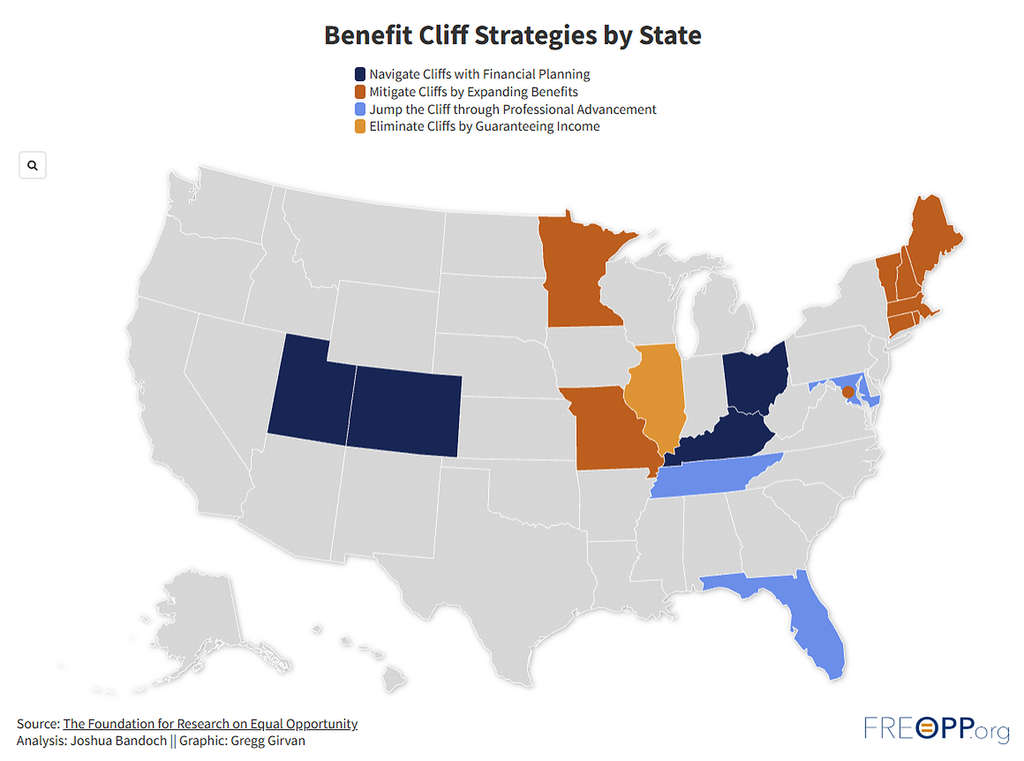
Additionally, a recent report has proposed a fifth approach: pilots to restructure welfare programs to combine major benefits into a single trackable support system, phase assistance down gradually to avoid benefit cliffs, and pair aid with work, education, and case-management expectations.
Through the analysis in this report, we will see that any of these approaches by themselves are unlikely to solve benefit cliffs. Instead, states should adopt a comprehensive approach that directly addresses the cliffs and empowers people with the skills, knowledge, and resources necessary to experience upward mobility. States should:
- Restructure welfare programs where possible to streamline benefits and eliminate or reduce benefit cliffs.
- Provide financial literacy training to help individuals understand the financial implications of professional advancement, including navigating benefit cliffs, and provide them with the financial knowledge necessary to build wealth.
- Align asset limits to remove a barrier to building a personal financial safety net.
- Empower individuals through work, including robust work requirements for all work-capable individuals without small children.
- Expand evidence-based workforce development, especially apprenticeships.
Introduction
America’s social welfare system is in desperate need of reform. Too often, it functions as a snare net, trapping our low-income neighbors in poverty. Programs that appear to be helping participants by providing them money for food, housing, and other assistance, are structured in ways that harm them. These programs disincentivize the very behaviors like work and marriage participants need to thrive.
We now spend over $1.5 trillion annually (nearly $1.2 trillion federally, and an estimated $341 billion in state spending)2 on means-tested welfare programs to reduce poverty. As of 2019, the Department of Health and Human Services reported that 30 percent of the population (99.1 million people), including almost half of children (49 percent), received benefits from at least one means-tested program.3
Despite all this spending, the federal poverty rate has hovered between 11% and 15% for decades.4 Researchers have rightly pointed out that the federal poverty rate does not count non-cash benefits.5 A 2025 Congressional Budget Office report acknowledged that poverty is lower when things like tax credits and in-kind government benefits are accounted for.6 While they are better off materially than if they did not receive these benefits, the earned income of low-income individuals has remained relatively stagnant.
Our social welfare programs aren’t designed to empower people to rise out of poverty. They’re designed to make poverty survivable, which has the unintended consequence of hampering upward mobility and keeping them trapped in poverty. They do this by discouraging work through “benefit cliffs” and other work disincentives like high earning loss rates.
A benefit cliff is a structural flaw in the federal welfare system whereby an earnings increase—sometimes even just an additional $1 per hour—results in the abrupt, disproportionate loss of hundreds or thousands of dollars in household resources. Rather than tapering off gradually at a consistent rate that incentivizes people to earn more money, federal programs such as Supplemental Nutrition Assistance Program, Medicaid, and subsidized child care7 have income points where benefits reduce abruptly, either from a particular program (such as child care) or from benefits from multiple programs being reduced.
The losses can be financially crippling. In Illinois, research from the University of Chicago and the Federal Reserve Bank of Atlanta calculated the child care benefit cliff to be $25,000, and occurs when income increases from $54,000 to $55,000.8 This family would reasonably calculate that an income increase would be severely harmful for a long time. They would decline the pay raise or avoid it altogether, forgoing professional development and upward mobility.
Benefit cliffs can cause financial well-being to plateau, too. Federal Reserve Bank of Atlanta research found “a hypothetical single adult, one child (aged three) family living in DC would receive no financial gain from a wage increase between $11,000 and $65,000 of earned income” due to benefit program structures.9 This family would rightly wonder: Why bother? Many don’t.
Benefit cliffs are a widespread problem. Research from 2025 by the Center for Social Development at Washington University in St. Louis found that nearly one in four (22 percent) public assistance recipients reported taking at least one negative action to avoid losing benefits, such as declining a job offer, turning down a raise or promotion, or working fewer hours.10 Since people often underreport such things, it’s possible the actual numbers are even higher.
Benefit cliffs are so pernicious because they make it economically rational and psychologically understandable for poor people to reject opportunity. They deny themselves and their family upward mobility and the opportunity to realize their American Dream simply to avoid a disproportionate decline in benefits.
Three simple principles outlined in a 2025 report published by the American Enterprise Institute entitled, “Stranded by the Safety Net: How to Fix the Benefit Cliff Problem,” should guide benefit cliff reform:
- The safety net should prioritize policies that support work and marriage as a proven way to escape poverty and achieve upward mobility.
- Assistance for those capable of work should be temporary and targeted, though the safety net should offer sustained support for those unable to provide for themselves due to disability or age.
- Federal and state funding for the safety net must be grounded in fiscal responsibility, reflecting the government’s duty to be a good steward of public resources.11
These principles focus on bringing opportunity and upward mobility to welfare recipients and should drive reform at any level.
The best way to solve benefit cliffs would be through federal legislation that adheres to these principles. An example of federal legislation that would align with these principles is the Upward Mobility Act. Introduced in 2026 by Senator Jon Husted, it would proceed through five state pilot programs that experiment with ways to solve benefit cliffs comprehensively across a range of welfare programs.12 The goal of the pilots would be to provide evidence of and support for comprehensive federal reform.
Unfortunately, with no federal action to address benefit cliffs on the horizon, it’s imperative for states to act. Which is precisely what they’re doing.
Over a dozen states have enacted or proposed programs or pilots to mitigate or overcome benefit cliffs. States actually have more authority than many may realize to address benefit cliffs. While they cannot fully restructure federal programs, they can and are acting to try to help low-income Americans overcome this barrier to opportunity.
This report will explore and analyze what states and localities can and should do to address benefit cliffs through the lens of what they’re already doing, or have proposed doing within existing authorities. We will also evaluate additional approaches states should consider within their existing authority, especially the newly-proposed RISE pilots.
States and localities are attempting to address benefit cliffs in one of four ways, generally speaking; to which we add RISE pilots as a fifth approach available to states:
- Navigate cliffs with financial planning
- Expand benefits to mitigate cliffs
- Eliminate cliffs by guaranteeing income
- Jump the cliff through professional advancement
- Restructure programs to smooth or eliminate cliffs
These approaches are not mutually exclusive. States can and have adopted elements of more than one. Still, a state’s approach generally is driven by one of them, with others supplemental.
Through our analysis, we will see that only some of the pilots and permanent programs are likely to expand opportunity for low-income Americans, while others are likely to have harmful economic consequences for them. What’s more, a comprehensive approach to benefit cliffs that draws on multiple approaches will ultimately prove more effective.
Many of the existing programs are occurring as pilot programs. Pilots are a promising approach because it allows states to test the efficacy of a program with a small number of participants before considering expanding it. Pilots are low-cost, low-risk, high-reward. All pilots should be conducted rigorously as randomized controlled trials (RCTs) with robust data, especially on outcomes. Without the use of RCTs, we cannot properly discern the impact of an intervention (in this case, the pilot program) versus a control group that does not participate in the intervention. Pilots with RCTs are valuable even when they produce negative consequences, because we learn an approach is counterproductive and avoid expanding it to harm a larger number of people.
Other state programs are already permanent. When data are released, we will be able to assess their efficacy.
It is worth noting that at least in public discussion of the projects, none of the programs enacted, and most of the proposed programs (with the exception of RISE pilots), appear to have been crafted based on modeling of the benefit cliffs in a particular state. This means that the programs generally are not targeted at the specific cliffs individuals face, but rather are more general in their approach.
The Psychology of Benefit Cliffs
What exactly makes benefit cliffs so pernicious? The economic harms are clear. When a family is staring at losing $25,000 in child care benefits, for example, climbing the economic ladder and experiencing that loss is indeed economically irrational.
It’s the psychological harms that are far worse.
“Prospect theory,” developed by psychologists Daniel Kahneman and Amos Tversky, shows that most human beings are loss averse. “When directly compared or weighted against each other, losses loom larger than gains.”13 How much larger? Up to five times, according to other research.14 If someone takes $1,000 from you, simply giving you that amount back doesn’t make you feel whole again. They’d have to give you more, up to $5,000.
The prospect of losing benefits to low-income people also looms large. The psychological worries of losing benefits need to be taken seriously and factored into proposed solutions. Losing benefits without a clear path to replacing them and climbing the economic ladder is rightly scary for low-income people. They risk losing child care, health care, housing, food assistance, cash assistance, and other forms of assistance. That’s a lot to lose.
That’s why a comprehensive approach focused on both smoothing cliffs and empowering people with skills and knowledge is essential: people need to believe a better future lies ahead and that they can and will continue to climb the ladder and make themselves and their family better off. Otherwise, they face real losses with sufficient gains on the horizon.
What’s more, being punished for hard work and getting a job, earning a raise, or securing a promotion is psychologically debilitating. These achievements should be sources of celebration, not harm. Punishing these good behaviors doesn’t just disincentivize them. It actively discourages people from engaging in the behaviors needed to improve themselves.
Punishing someone for a virtue—in this case, hard work—is far more noxious than punishing them for a vice.
Approach 1: Navigate Cliffs through Financial Planning
If welfare recipients understand the financial implications of earning more money, and have better knowledge of how to deal with those consequences, they can navigate benefit cliffs more effectively through sound financial planning. When participants know where cliffs are and can develop a plan for dealing with them, they can be better prepared to continue climbing the economic ladder despite the impending loss of benefits. Utah, Ohio, Kentucky, and Colorado have placed this approach at the center of their attempts to address benefit cliffs.
Achieving financial literacy is crucial to achieving financial independence. A study of 113 countries showed financial literacy reduces the chances someone falls into poverty.15 When someone is in poverty, financial literacy is crucial to helping them exit it. Bad financial decisions, such as not having emergency savings or accumulating high-interest rate debt, can trap someone in poverty. Financial literacy is also necessary to financial stability, building wealth, and experiencing material prosperity.
Before examining specific approaches, it is worth highlighting that the Federal Reserve Bank of Atlanta has developed the CLIFF (Career Ladder Identifier and Financial Forecaster) tool to help people navigate benefits cliffs. States can leverage this already-existing resource. In fact, some localities and private employers already are.
CLIFF has three distinct tools tailored to meet an individual’s needs in different career stages: the Snapshot, the Dashboard, and the Planner.
- Snapshot: “compares a client’s current financial situation to alternative scenarios” such as an increase in wages or working more hours.16 The tool is meant to help participants understand how actions will help them achieve financial stability.
- Dashboard: “details the long-term financial implications of a new career. The Dashboard shows income and public assistance over a 20-year-plus horizon.”17
- Planner: “helps clients when they’re ready to map out details of a career move. With the Planner’s flexibility, counselors can work with clients to build a customized education plan, career plan, and budget.”18 Participants get an individualized financial portrait for today, as well as a path to a financially better tomorrow.
Through these tools, CLIFF offers a comprehensive analysis of an individual’s financial situation, how increased income would impact it, and a plan for upward mobility.
In 2025, Utah established the Utah Navigation and Financial Planning for Self-Reliance pilot program. The three-year pilot, funded through the Temporary Assistance for Needy Families (TANF) program, has three objectives:
- Improve participants’ awareness of how potential changes in their earned income impact their public assistance benefits through enhanced financial planning resources;
- Improve participants’ ability to transition off government benefits and into self-sufficiency through work with community-based coaching and mentorship from local nonprofits with a proven track record;
- Gather real time administrative data on participants’ income, benefits, program utilization, household composition, and other factors that may impact eligibility, as well as the impact of the tested interventions in this pilot, to identify areas of future reform.19
This program uses the flexibility states have under TANF to provide individuals with important financial knowledge.
Ohio has created two benefit cliff pilot programs focused on promoting independence through financial literacy.
The Benefit Bridge Employer Pilot Program is a two-year program established in 2023. It is an employer-initiated program whereby they apply for grants up to $100,000 to create and run programs meant to help participants transition off of benefits by providing training and a wage increase. Participants must already receive assistance from SNAP, Ohio Works First, Medicaid, or a publicly funded childcare program. Employers must use a benefit cliff calculator “to determine the hourly wage required to replace the assistance received through these programs.”20 Employers can offer a “one-time training incentive and wage increase that would replace the assistance received through these programs.”21 Employers must submit proof that employees completed the program within three months. And they must commit to paying the increased wage beyond the grant period.22 A financial literacy course must be included in the training.
The Benefit Bridge pilot program, established in its 2022-2023 budget, allows counties to create 18-month programs focused on financial literacy and work supports.23 It is funded through TANF and state funds. Most of the programs focus on individuals who have lost SNAP or child care benefits. As described by United Way of Greater Cleveland, the pilot “takes a holistic, human-centered approach to helping workers transition off public assistance.” The core of the program “is a care team of a peer mentor with lived experience, a case worker, and individualized support such as a mental health counselor,” alongside financial literacy training.24
Counties are trying a variety of approaches with their pilots:
- Allen County: Offers supportive services such as child care, rent, transportation assistance, car repairs, and utility assistance.25
- Cuyahoga County: Participants make an 18-month commitment to spend at least 1-3 hours per week meeting with coaches, completing financial literacy training, and working towards 12 pre-determined goals such as getting a new or better job, raise, promotion, or paying down debt. Participants also receive $250 for each of the goals they achieve.26
- Hamilton County: Requires money management classes and peer mentoring, and offers other services such as training certifications and interview coaching.27
- Lucas County: Offers participants an array of services, including training and certifications, peer mentoring, financial literacy, and legal and mental health services.28
- Marion County: Identifies five program pillars (family stability, well-being, money management, education and training, career and employment). Program details are not provided online.29
- Perry County: Provides case management, a financial literacy course, career or educational training, and transportation assistance.30
- Portage County: Provides “life skills, career skills, mentoring, and financial literacy, ensuring that working participants have the support and stability they need to maintain employment, gain skills to move into higher paying positions, and become self-sufficient.”31
While each pilot includes an emphasis on financial literacy and case management, beyond that there is notable variety. Some provide training, which is aligned with the “jump the cliff” approach. Others provide additional financial support, aligned with the “expand benefits” approach.
This variety is a feature, not a bug. By piloting an array of programs in counties across the state with similar demographics, Ohio will provide valuable information about the relative efficacy of programs.
Ohio has also directly extended the benefit cliff in SNAP. The state expanded eligibility for SNAP from 130% of the federal poverty line to 200%. This addresses a benefit cliff the state calculated can be up to $371 per month, or $4,452 annually. Benefits now phase out more gradually, but a cliff remains when the individual reaches the income limit.32
In 2022, Kentucky passed a financial planning-focused approach to benefit cliffs in the form of HB708, Chapter 174. It required the state’s Cabinet for Health and Family Services to create the Family Resource Simulator, a benefit cliffs calculator, and an online jobs database available to the general public.33 It also established a Benefit Cliff Task Force.34 The Task Force’s recommendations center on expanding benefits across a range of categories, including child care, health care, housing, and SNAP. It also recommended increasing some work supports and job training.35
Also in 2022, Colorado’s Workforce Development Council partnered with the Federal Reserve Bank of Atlanta to craft and launch a CLIFF tool for the state.36 The Council’s Managing Director, Lee Wheeler-Berliner, stated the goal of the tool as follows: “CLIFF will help workers understand that there are ways forward, ways in which they can provide for themselves and their families, even after losing public assistance.”37 The state’s tool remains active.38
Private employers have also utilized the CLIFF tool to help workers navigate benefit cliffs and achieve self-sufficiency. Goodwill Industries of the Southern Piedmont, Goodwill of North Georgia, and Atrium Health administered a pilot program with 172 participants. They participated in at least one CLIFF coaching session. Most were females without dependents, employed full-time, and lower-income, with a median income of $33,397. 40% reported experiencing a benefit cliff. After participating in training, 90% reported having an individualized plan related to “financial budgeting, learning about eligible public assistance programs, improved financial literacy and planning, and exploring career opportunities.” Most participants reported being willing to accept a raise even if it resulted in losing public assistance.39 They were willing to take a temporary financial hit feeling confident that in the long run they’d earn enough to jump over the cliff.
The Goodwill pilot provided some recommendations for implementing the program more broadly, including ensuring that training facilitators knew the CLIFF tool well, established trust with employees, and understood their goals before analyzing their situation and making recommendations. For example, unemployed and low-income earners were interested in learning about employment opportunities to improve their income, whereas employees who had recently received a pay raise, or expected one soon, wanted to understand how it would impact their public assistance benefits.40 The report did not provide analysis of participants’ financial and employment outcomes after participating in the pilot.
These public and private pilots will help determine the role financial knowledge plays in mitigating benefit cliffs.
That said, there are reasons for concern that this approach by itself does not necessarily empower low-income individuals with the skills they need to achieve upward mobility. To be sure, acquiring financial literacy and understanding the implications of increased income on an individual’s benefits is undoubtedly important, both for navigating benefit cliffs and for achieving financial security and accumulating wealth.
Nonetheless, this approach faces at least two drawbacks. First, it does not equip participants with the tools they need to climb the income ladder. Second, in some situations, it could even reveal a daunting path forward for program participants, so daunting that they decide to stay put rather than advance. If an Illinois parent were to see that the loss of $25,000 in child care benefits would occur by accepting a raise, this approach could give them good reason to reject it and stay put. In fact, seeing such large cliffs could even provide the impetus for some to expand benefits as a way to fill the large gap.
Approach 2: Expand Benefits to Mitigate Cliffs
Expanding benefits to mitigate cliffs is a second approach states have adopted. The idea behind this approach is that participants need additional financial assistance as they climb the economic ladder. States have adopted, attempted to implement, or proposed programs or pilots along these lines. We will consider them on a sliding scale, from less expansive to more expansive. These approaches are not mutually exclusive, and states have implemented multiple of them:
- Increasing asset limit: Families are allowed to accumulate a larger amount of assets before it is counted against program eligibility.
- Income disregards: Some portion of additional earned income is not counted against eligibility for welfare programs.
- Smooth the cliff by extending benefits: States eliminate or reduce the severity of a benefit cliff by extending benefits beyond the current point where they decline sharply.
- Benefit replacement: States provide financial supplements to replace benefits as they taper off.
- Stable benefits: The state extends benefits to ensure they remain stable as income increases.
- Cash payouts: Participants receive a cash payment (usually one-time) upon completion of a program. These have generally been added on to one of the above approaches.
As benefits expand, some of the approaches include other income supplements, such as rental assistance, career advancement support, and family support. As we will see below, New England states have been the most active in addressing or attempting to address benefit cliffs, primarily through the “expand benefits” approach.
To the extent these approaches are tried, it is critical that they adhere to the third reform principle outlined above: “Federal and state funding for the safety net must be grounded in fiscal responsibility, reflecting the government’s duty to be a good steward of public resources.” These programs should be paid for through TANF (as pilots, and evaluated for their ability to reduce benefit dependence), cost-savings elsewhere, or a combination thereof. Otherwise, they will strain state budgets, sometimes enormously.
Many welfare programs have asset limits. If participants have net assets above a specific amount, they are not permitted to receive benefits. The purpose of the limits is to prevent resource-rich individuals from acquiring public assistance. For example, SNAP administering agencies should be checking against lottery winnings. The state of Maryland recently discovered that it had paid more than $9,000 in SNAP benefits to someone who had won $2 million in the lottery.41
At the same time, too-low asset limits discourage low-income families from saving money that’s necessary for attaining basic financial stability and having their own financial safety net. Dave Ramsey, the famous financial advice giver, identifies saving 3-6 months of expenses in a separate fund as Step Three of his seven “baby steps” to financial security. That is preceded by Step One, which is to save $1,000 for emergency expenses.42 States should increase asset limits to more reasonable limits when possible.
SNAP’s asset limit in principle is $3,000 for households, except where at least one person is age 60 or older, or disabled, in which case the limit is $4,500.43 However, states can increase both asset and income limits through Broad-Based Categorical Eligibility (BBCE), which allows participants to qualify for SNAP if they receive non-cash benefits from TANF or state-based programs. As of June 2026, only six states still have asset limits on SNAP, according to the Department of Agriculture.44 A report from the American Enterprise Institute outlines important concerns with BBCE.45 Since they can only be addressed federally, we set them aside here.
The Low-Income Home Energy Assistance Program (LIHEAP) also has asset limits and varies widely across states, from as low as $3,000 to as high as $25,000.46
Higher asset limits would enable families to accumulate multiple months of savings, which serves as their own personal safety net, and give them additional confidence to reduce their government benefits. When permitted to do so, states should increase asset limits to at least $6,000, and perhaps as high as $10,000, and index them for inflation.47 Asset limits remain important, because we do not want a system where someone with substantial assets and no income can access welfare benefits.
Asset limits are also present in many state-run programs. States should audit how they align with higher limits in federal programs.
Vermont has passed reforms to a primarily state-funded assistance program to promote personal savings and financial stability. The program is called Reach Up. The 2017 legislation, Act No. 29, increased the asset limit from $2,000 to $9,000 for both initial and continuing eligibility. It also excludes earnings deposited into a qualified child savings account such as the Vermont Higher Education Investment Plan when determining eligibility for the Child Care Assistance Program., as well as money put into retirement accounts.48
Vermont’s Reach Up also provides monthly cash payments and services and case management to help participants reach employment, financial, and other goals.49 Through the Reach Ahead program, the state also offers additional food benefits for families exiting TANF. They can receive $50 for food for the first 12 months, and $5 per month for the next 12 months.50 This aligns with the benefit replacement or expansion approaches discussed below, and risks higher financial expenses depending on the number of program participants.
Income disregards are another approach states have adopted to smooth benefit cliffs. The idea is that to further incentivize individuals to climb the economic ladder, their benefits should be reduced at a slower rate by not counting some or all of their new, higher level of earned income towards their benefit eligibility. Maine and New Hampshire have adopted income disregards as part of their strategy to address benefit cliffs.
In 2019, Maine passed HP1259, “An Act To Secure Transitions to Economic Prosperity for Maine Families and Children.” The bill creates temporary income disregards on monthly earnings for TANF. They are as follows:
- “One hundred percent of all earned income for the first 6 months of employment during a period of continuous receipt of assistance that is not interrupted by a break in assistance of more than 2 months;
- Seventy-five percent of all earned income beginning in the 7th month of employment during a period of continuous receipt of assistance that is not interrupted by a break in assistance of more than 2 months;
- One hundred and eight dollars and 50% of the remaining earnings that are less than the federal poverty level beginning in the 13th month of employment during a period of continuous receipt of assistance that is not interrupted by a break in assistance of more than 2 months;
- In the event of a break in assistance of more than 2 months, for any new period of assistance, $108 and 50% of the remaining earnings; and,
- All actual child care costs necessary for work, except that the department may limit the child care disregard to $175 per month per child or $200 per month per child under 2 years of age or with special needs.”51
The bill replaces any food assistance lost when compared to what the household received prior to increasing household earnings. It also eliminates a gross income test for recipients. The bill also invested $2 million in whole-family pilot programs.52 These changes followed on legislation from 2018 when Maine expanded TANF eligibility to families at 185% the federal poverty line, among other changes to TANF.53
New Hampshire’s approach includes more modest income disregards and other ways to facilitate transitioning to work and building wealth, including:
- In TANF: Adopting a 50% income disregard, with a voluntary pilot for a 100% income disregard for high-demand jobs, and raising the asset limit from $2,000 to $5,000.
- In SNAP: Expand eligibility to 200% of FPL, removing the asset test, and introducing the Double UP Food Bucks program, “which provides a dollar for dollar match, up to $20 per day, on the purchase of fruits and vegetables with the SNAP EBT card.”
- In child care: Subsidies have been expanded to 85% of state median income, co-pays have been reduced for lower income families, and the state has disregarded TANF income for eligibility.54
These recommendations follow from a 2023 report on recommendations for New Hampshire to address benefit cliffs.55 That report offered additional options, including a TANF Automobile Savings program, which would provide a financial match for a down payment, and additional payments to SNAP recipients.
Income disregards are a policy worth testing to gather results and enable us to analyze their efficacy and costs. In principle, they reduce or remove penalties for low-income people climbing the economic ladder for a limited period of time, usually a few months and up to a year.
At the same time, income disregards make the phaseout start later, which nearly guarantees that absent a very steep phaseout rate, the individual will hit a benefit cliff or the state or program would have to extend the eligibility limit. Indeed, this has happened with SNAP. This could make it difficult for them to adhere to the fiscal responsibility principle identified above.
Now that the Maine program has been in place for over six years, and New Hampshire adopted its program in 2024, the next step is to analyze the data from these programs. How effective are income disregards in helping people overcome benefit cliffs? How expensive are they? Are there better ways to address benefit cliffs for the same or less money?
States can also extend benefits to attempt to smooth benefit cliffs, reducing the severity of, or even eliminating benefit cliffs. For example, if a benefit cliff of $2,000 were to arise when someone reached $40,000 of earned income, a state could use supplemental funding to extend benefits to $45,000 with a gradual decline from $2,000 to $0. States can fund this approach with flexible federal money, primarily through TANF. They can use state funds. Or they can do a combination.
Missouri attempted to adopt this approach in 2023 with Senate Bill 82. The act established a transitional benefits program for TANF, SNAP, and childcare (through the state’s Hand-up pilot program) by offering support to recipients up to 250% of the federal poverty level.56 The program would extend benefits and gradually reduce them as participants’ income rises. This would prevent them from facing a benefit cliff, instead tapering benefits more gradually.
More than three years later (as of this writing), Missouri has been unable to implement the program because of excessive costs, and there are no indications it will be able to do so. It’s simply too expensive. We can expect other states would face the same problem were they to adopt Missouri’s approach. This program is therefore not a good candidate for replication.
This speaks to a clear problem with expanding benefits that will be applicable to other programs discussed below: doing so is expensive, and often completely unaffordable. Most of these programs thus do not meet the third reform principle listed above, that reforms be fiscally responsible.
Massachusetts’ “Bridge to Prosperity Pilot” follows the benefit replacement model. Launched in February 2025 in the city of Springfield, the three-year pilot has 100 participants in its initial cohort, with a second cohort now underway. Springfield Works explains the benefit replacement program this way: “As participants’ income increases and the value of their safety net benefits decrease, the program will provide supplemental cash benefits to bridge the gap.”57 The program also provides one-on-one career and financial planning, and connects recipients with “several participating employer partners with living wage employment opportunities.” What’s more, when participants successfully complete the pilot, “participants will be eligible for a $10,000 bonus to put them on track for longer-term financial health.”58
This program raises numerous concerns. First, it is expensive. Each participant gets benefits replaced and a $10,000 bonus on top of the other services the program offers. These high costs mean the program is highly unlikely to be scalable statewide, which brings its broader applicability into question. Second, the program is small. 100 participants is an extremely small initial sample from which it will be difficult to draw robust positive or negative conclusions.
Washington D.C. is also attempting to address benefit cliffs by extending benefits. The cliffs in DC can be severe. As mentioned above, in one model, the Federal Reserve Bank of Atlanta found that a hypothetical family earning $11,000 would see no real financial gains until their earnings exceeded $65,000 due to losing some, or all, of their benefits and a corresponding increase in tax liability.59
In 2022, DC adopted the Career Mobility Action Plan (Career MAP) pilot program for 500 families. The pilot has three parts: cash payments, career advancement, and family support. The following cash payments are available:
- Up to 5 years of rental assistance to ensure a family doesn’t pay more than 30% of their gross income in rent (a common criterion for rental assistance programs). The District offers either discounted rent to compensate for lost SNAP benefits, or direct cash assistance.
- Up to $10,000 per year available to reimburse participants for losses of medical, childcare, SNAP, or District cash assistance benefits. The $10,000 annual cap can be increased if funds are available.
- $200 per month deposited into an escrow account each month a household pays rent. Over five years, this could yield $12,000.
- Emergency payments of up to $1,000 per year.60
According to analysis from the Federal Reserve Bank of Atlanta, these benefits could total $26,647 annually.61
Career MAP offers career advancement, which includes a “dedicated navigator” to help the family meet career goals, employment placement and career growth, and education and training support. The final element of Career MAP is family support, such as mental health, financial management, and benefit cliffs counseling.62
The DC program faces many of the same challenges as other programs discussed here. It is extremely expensive—the most expensive program in the country, in fact. More importantly, as with many of the other programs in this section, it does not encourage work. The program focuses instead of maintaining and extending benefits without a stated connection to work. This could actually discourage work.
Rhode Island’s strategy to address benefit cliffs has components of a few of the preceding “extend benefit” approaches. The state is working on a pilot program that will provide $200 per month for up to one year to individuals transitioning from TANF to employment. The pilot is scheduled to be implemented in June 2026. The state has extended housing benefits through a pilot that offers financial support such as first month’s rent and security deposits. The state extended child care support by increasing eligibility from 125% to 261% of the federal poverty line.63
The state has also adopted policies inside Rhode Island Works, which is funded through TANF, to address benefit cliffs. The program “is a financial and employment assistance program for parents and families with little to no income who have children high school age or younger.”64 The first $300 earned by parents does not reduce the amount of cash assistance they receive, before benefits taper at a rate of $1 reduction for every $2 additional dollars earned. The program also has an asset limit of $5,000 plus one car per adult, up to two cars.65
The first concern with Rhode Island’s programs is their costs. They would be expensive and likely unaffordable if expanded to all eligible program participants. Second, giving someone $200 per month regardless of their new income allocates resources to people who no longer need it, thus taking them away from families who do.
Minnesota also saw legislation proposed in 2025 that would have created a demonstration project “that continues to offer program benefits to individuals no longer eligible for certain programs during a transition period to reduce benefit cliffs and incentivize those individuals to take advantage of career advancement opportunities.”66
Connecticut has proposed an especially expansive approach to address cliffs by extending benefits: stable benefits regardless of how much a recipient’s income increases. HB5540, filed in 2026, would both extend benefits and establish pilots to study an even greater expansion of benefits.67
The bill proposes income disregards for six months up to 230% of the federal poverty level, with an additional six months of gradually tapered benefits. What’s more, any family that transitions out of benefits would, after twelve months, receive a $5,000 “labor force retention bonus.”68 These income disregards would apply for up to 36 months.
The bill would also require the state to establish pilot programs in accordance with a report commissioned through Special Act 24-8, passed in 2024.69 The report offers three pilot programs:
- “Benefits Lost – Participants will receive up to $10,000 during their participation in the pilot to cover the loss of benefits caused by an increase in income.”
- “Resources Lost – Participants will receive up to $10,000 during their participation in the pilot to cover the net loss of financial resources caused by an increase in income.”
- “Stable Benefit – Participants will be assured a stable level of resources over the term of the pilot and will not lose benefits due to an increase in income.”70
The broad idea behind these pilots is that “families will very likely need more than one year, and perhaps more than two, to realize durable income gains and employment advancement. Participants will need time to complete education and training programs made possible by enrollment in the pilot.”71
Among these three pilots, the report recommends the most expansive: stable benefits. The report argues that this “design maximizes support for families over a longer period, with the potential to provide participants with more financial stability” as well as “a more seamless experience for participants.”72 It would give participants time to complete education and training programs. Notably, costs for these programs are not included in the pilot budget, meaning they are in addition to the pilot’s costs.73
The stable benefits design is also by far the most expensive, with an estimated cost of $33,783 over 4 years,74 compared to $10,000 per participant for the other two pilots. The report suggests this approach would allow “families to experience the financial advantages of savings accrual to the extent they are able to set aside a portion of increased earnings.”
The stable benefits approach will likely face a number of problems. First, what is billed as a feature—benefit stability—is quite likely problematic. When benefits are generously extended, it removes the immediate need to climb the economic ladder. Second, this program would be extremely expensive if extended to all participants. Third, stable benefits come at a cost to other needy participants who would be supported by those financial resources. This program also does not emphasize independence through work, such as through career training and workforce development. As proposed, it also does not give participants the tools they need to climb the economic ladder.
To the extent that states experiment with pilots that extend benefits beyond increasing asset limits, they should do so in a fiscally-neutral way. The two best ways to do this are to use flexible funds, especially TANF, find fiscal savings elsewhere, or both. Otherwise, costs will most likely balloon in ways that make the problems financially problematic. Many of the programs discussed in this section that extend benefits are not fiscally-neutral, and would instead be prohibitively expensive.
Many of the programs in this section also do not meet the first principle of benefit cliff reform explained above: The safety net should prioritize policies that support work and marriage as a proven way to escape poverty and achieve upward mobility. The programs that smooth the cliff by extending benefits, replace benefits, provide stable benefits, provide cash payouts, or some combination thereof do not include robust work requirements and do not provide proven assistance to return people to work, or help them grow professionally. Without proven programs that return people to work, participants are much less likely to get the skills they need to climb the income ladder. Some of the programs make little if any mention of work as a priority and pathway out of poverty and into upward mobility.
Approach 3: Eliminate Cliffs by Guaranteeing Income
While not directed exclusively at solving benefit cliffs, one way to eliminate these cliffs is through guaranteed income programs. Rather than replacing benefits, these programs typically provide monthly payments on top of what participants earn and receive from other safety net programs. Many of the more expansive approaches discussed in the previous section, such as the stable benefits approach, point in the direction of guaranteed income.
Guaranteed income programs can mitigate or eliminate cliffs by providing payments high enough to ensure recipients could cover housing, food, and a range of other items covered by safety net programs. Guaranteed income programs generally do not require recipients to work. From 2017 to 2025, there were at least 122 guaranteed income pilots in 33 states and DC, according to research from the American Enterprise Institute.75
In 2025, Cook County, Illinois, became the first place in the United States to make their guaranteed income pilot permanent.76 The state of Illinois also allocated $827,272 in its budget to fund a state pilot program, which could be a precursor to a statewide program.77
Also in 2025, Rep. Bonnie Watson Coleman (D-NJ) reintroduced the Guaranteed Income Pilot Act.78 This raises the prospect of a national pilot program, as a potential prelude to a permanent national program.
The biggest problem with guaranteed income programs is that they are harmful to recipients. The most rigorous pilots show numerous negative effects. One pilot in Illinois and Texas found that recipients’ workforce participation declined by 4.2 percentage points, their earned income fell by $1,900, and both participants and their partners reduced their hours worked by 1-2 hours per week.79 American Enterprise Institute research shows that among the four pilots with a treatment group of at least 500 participants and a randomized control trial, workforce participation declined by 3.2 percentage points.80
How can you climb the economic ladder if you’re incentivized to step off of it? You can’t.
These programs are also wildly expensive. Providing cash payments of $500, $1,000, or more to families, especially if it is on top of current safety net payments, would quickly cripple state or federal budgets without a massive tax increase to pay for both the direct costs as well as the indirect costs, such as reduced employment. They also create a new benefit cliff at the new income limit. What’s more, once those payments are made permanent, they will likely grow in size.
Approach 4: Jump the Cliff
Another approach to solving benefit cliffs is to help recipients grow professionally and jump over the cliff by earning enough to mostly or completely overcome the loss of benefits. If participants receive career development and training to significantly increase their earnings, such as by entering a new profession or earning a promotion, they can jump up the income scale enough to overcome the loss of benefits, even large losses over $5,000. It also provides participants with a durable pathway to continued upward mobility. Tennessee has focused its approach to solve benefits in this manner, as has a Florida program aimed at youth aging out of foster care.
While this sounds appealing, one might reasonably wonder: Is this approach more dream than reality? Fortunately, it’s not. To the contrary: apprenticeships offer a clear example of why it’s too good not to place at the center of all efforts to eliminate benefit cliffs. The average starting salary for someone who completes an apprenticeship program is $86,000.81 Earning that amount would allow a low-income benefit recipient to jump way up the economic ladder to enter the middle class and more than overcome losses in benefits caused by cliffs.
In 2021, Tennessee passed the Tennessee Opportunity Act. This legislation allocated $300 million in surplus reserve TANF funds to support the creation, execution, and evaluation of three-year Tennessee opportunity pilot programs. The goal of these programs is to use “evidence-based and evidence-informed programs and services” to demonstrate “the efficacy of well-implemented two-generation approaches to improving education, health, and economic outcomes for children and the adults in their lives.”82
The pilots will support the following:
- Home visiting services
- Child care
- Wrap-around services
- After school and summer learning programs
- Workforce training and apprenticeship programs
- Economic advancement supports, such as transportation and housing
- High-quality data systems for accountability and continuous improvement
- Other evidence-based and evidence-informed solutions.83
The bill then requires the selection and funding of “a research partner or partners that will support the research and evaluation of the Tennessee opportunity pilot programs.” 84
The emphasis on “evidence-based” and “evidence-informed” programming is worth pausing on. It is the only way to ensure the pilots are the “pathway to self-sufficiency” that the state has as its goal.85 It is also unusual in that the pilots discussed thus far place little, if any, emphasis on determining whether the programs actually promote self-sufficiency and upward mobility. We will return to its import.
Tennessee released a preliminary report on the TANF Opportunity Act in 2025, which sets a path for program evaluation.86 The forthcoming report on evaluation will be critical in assessing the effectiveness of various initiatives.
Since the TANF Opportunity Act passed, the state has created several key programs:
- Education Opportunity Pilot Program: Provides “enhanced cash assistance to individuals who are actively pursuing educational opportunities.” The funding is meant to encourage recipients to attain degrees and get closer to self-sufficiency.
- TANF Allotment Increase: Increases the monthly allotment for a family of three from $277 to $387.
- Tennessee Opportunity Pilot Program: Allocates $180 million across seven pilots to provide “comprehensive supports to families as they move from crisis to career pathways.”
- Families First Community Grant Programs: Allocates grants to community organizations providing services to low-income families.
- TANF Advisory Board: Establishes a 21-member board to review pilots, enhance program efficacy, and analyze spending.
- TANF Reserve Amount: The state will limit the TANF reserve to $191 million.87
Tennessee is in the process of launching Families First pilots, which have four goals:
- “Provide assistance to needy families so that children can be cared for in their own homes or in the homes of relatives.”
- “End the dependence of needy parents by promoting job preparation, work, and marriage.”
- “Prevent and reduce the incidence of out-of-wedlock pregnancies.”
- “Encourage the formation and maintenance of two-parent families.”88
These goals are all aligned with the “success sequence,” which is a proven pathway out of poverty: finish high school, get a full-time job, and get married before having children. The report identifies a range of outcomes to support the goals listed, including increasing earned income, increasing participation or enrollment in education and job training, increasing financial empowerment, increasing parental engagement, attendance, and involvement, and increasing families’ social capital.89 The state will administer the program in partnership with nonprofits using “evidence-based and evidence-informed program models…to meet the needs of low-income families.”90
From the standpoint of promoting long-term prosperity, the Tennessee program appears the most likely to secure this goal for participants because it focuses on empowering them through work. Tennessee’s approach has other benefits, too. It is funded through existing TANF funds, making it fiscally responsible. It uses local pilots to test what does or doesn’t work. It is evidence-based and requires reporting to evaluate success. And it aligns broadly with the success sequence.
Florida has created a pilot program focusing on helping foster youth jump the cliff. These individuals face significant risk as they age out of foster care, both economically and socially. The “Step into Success Workforce Education and Internship Pilot Program” is 2023 legislation (HB 1337 / SB 1190) that requires the Department of Children and Families to create a program with both of those training components,91 and must culminate in a certificate.92 The now-established pilot is open to foster youth alumni between the ages of 16 and 26 and live in one of 28 Northern or Central counties. The internship provides a monthly stipend of $1,517.93
In Maryland, legislation introduced in 2023 proposed a work-oriented approach to addressing benefit cliffs. HB1286 and SB787 would establish pilots to “facilitate, encourage, and support participants in entering, reentering, and remaining in the workforce.”94 The pilot would ensure participants have a stable “base” of income, meaning “the amount of all assistance and after-tax earnings that a participant is receiving at the time the participant enrolls in the pilot program.” Participants would receive adjustments to their earned income tax credit to ensure their income is not less than their base.95 Program participants who successfully move into the workforce and work at least 37.5 hours per week would be eligible for a match payment of 20% of their base, up to $10,000. The pilot program would also produce a report analyzing the number of participants who entered and exited the workforce and reasons for exiting, their hourly and annual earnings and any increases during participation, and expenses incurred by the state.96
Approach 5: RISE Pilots
States possess substantial authority to restructure federal welfare programs to eliminate benefit cliffs for a limited number of recipients. A proposal that outlines how to do that was recently published by the American Idea Foundation and authored by Les Ford. The report proposes the creation of RISE pilots, which stands for Resources, Independence, Stability, and Employment. Those four goals serve as the North Star of this reform effort, and align with the principles of benefit cliff reform outlined at the beginning of this report.
RISE pilots seek to “test what a modernized, work-focused safety net can make possible for low-income Americans” by creating “a new blended benefit delivery model with clear phase-outs and pair it with personalized case management and reasonable work requirements.”97 The explicit purpose of the pilots is to set the stage for broader federal benefit cliff reform by establishing the efficacy of this program model. After all, that is how federal 1996 welfare reform happened: states, led especially by Wisconsin, demonstrated the efficacy of the reforms at the state-level first.
RISE pilots would simplify the package of benefits participants receive into a single, trackable benefit. It would operate across SNAP, Women, Infants, and Children (WIC), TANF, LIHEAP, Child Care and Development Fund (CCDF), Federal Earned Income Tax Credit (EITC), Federal Child Tax Credit (CTC)/Additional Child Tax Credit (ACTC), and potentially Medicaid. The report outlines what authority states have to amend or augment these programs, as well as what federal approval is necessary, and what limitations exist.
The benefits would be trackable and programmable, “providing real-time visibility into benefit distribution and use.”98 How? “Instead of seven separate cards, vouchers, or payments, each with different rules and requirements, a trackable and flexible benefit would be distributed and continuously phased down through a single monthly or twice-monthly payment. This would be managed through a platform that tracks community engagement and case management and incorporates non-governmental assistance.”99 The benefit would include program integrity safeguards.
The funding for RISE pilots would come through a combination of TANF and current welfare funds and flexibilities. For example, a 2026 waiver would allow a state to modify SNAP benefits as the pilot proposes.100
RISE pilots are an innovative way to model comprehensive benefit reform at the state level and are well worth implementing to test their efficacy at bringing more opportunity to low-income Americans.
Policy Recommendations
Ultimately, only evidence-based pilots will give us crucial data in assessing which programs actually mitigate benefits cliffs sufficiently to help low-income people rise out of poverty. Many of the pilots in this paper do not focus sufficiently on evidence-based programming, and do not specify desired outcomes for the pilots. All pilots need to adopt rigorous structuring, implementation, and measurement. Once they meet these requirements, we will be able to establish how effective they are. It is possible that the pilots will yield unexpected results, either more or less favorable than anticipated.
That said, we are in a position to make preliminary policy recommendations pending the results of these pilot programs. These recommendations are based on a number of considerations, including the three principles of safety net reform outlined above, as well as research on similar approaches. Programs also have to be scalable beyond small populations; otherwise, they cannot help substantial numbers of people rise out of poverty.
It is unlikely that any one of the five approaches discussed in this report can by itself both eliminate benefit cliffs and position people to climb the income ladder. The approach that comes closest is likely RISE pilots, because they would include case management and work engagement. Still, a more comprehensive approach is more likely to truly empower low-income Americans to experience upward mobility and greater opportunity.
A comprehensive state-based approach, based on current authorities, would be structured as follows:
- Restructure welfare programs where possible to streamline benefits and eliminate or reduce benefit cliffs.
- Provide financial literacy training to help individuals understand the financial implications of professional advancement, including navigating benefit cliffs, and provide them with the financial knowledge necessary to build wealth. Ideally, this education would actually start in high school as a course requirement.
- Align asset limits to remove a barrier to building a personal financial safety net.
- Empower individuals through work, and evidence-based workforce development, especially apprenticeships, including robust work requirements for all work-capable individuals without small children.
The comprehensive approach outlined here smooths or eliminates cliffs and empowers people through work and financial literacy.
Once data are available on some of the other approaches, such as income disregards, we will be able to assess whether they can be recommended more broadly.
Whenever possible, states should also avoid treating households differently across programs. Reason being, families often face cliffs at different income amounts. This means they face not one but many cliffs as their income rises.
States should also avoid making program rules more complex. For example, states should not create new rules within programs that are inconsistent. The goal instead should be to treat households the same, to reduce benefits at similar rates, and treat income the same.
Conclusion
Truly solving benefit cliffs and empowering low-income people to unleash their potential and experience opportunity has two elements. States need to do both.
The first is to smooth the cliffs and remove the economic and financial hurdles low-income people face climbing on and up the economic ladder. RISE pilots are an enormous step toward achieving this.
The second element is to ensure people truly have the skills, knowledge, and security to climb the economic ladder. Simply eliminating benefit cliffs in no way empowers poor people to climb. It only removes a barrier to them doing so. That’s why the other elements are so important.
Career skills are by far the most important, because they are what will empower low-income people to earn more. They also need to know how to both manage their money well, and navigate the loss of benefits, whether from a cliff or simply from a reduction in benefits. That’s why financial knowledge is important. And they need to feel like they’re secure enough financially to climb the ladder without putting their family at risk. That’s why higher asset limits are important; otherwise, they’re forbidden from saving more than a tiny amount.
We also need to be mindful of people’s lived experience. It’s real, shapes who they are, and shapes what they can become. Rather than disregarding it, we need to be mindful of it, because it’s a much faster route to helping them experience greater opportunity.
At the same time, states should be wary of expanding benefits. Since its creation decades ago, America’s welfare state has only ever moved in one direction—bigger, offering more benefits to more people. This clearly hasn’t solved poverty in America. It won’t because it can’t. Expanding benefits to address cliffs won’t be any different.
To make the American Dream a reality for more of our low-income neighbors, they need opportunity abundance. They need it to be real for them, by removing barriers and empowering them with critical tools to pursue happiness. Solving benefits cliffs is a crucial step to restoring this Dream.
Endnotes
1. I’m grateful to Les Ford, Erik Randolph, and Michael Tanner for insights feedback on earlier version of this report.
2. Congressional Budget Office, Federal Mandatory Spending for Means-Tested Programs and Tax Credits, June 18, 2025, https://www.cbo.gov/system/files/2025-06/61472-Means-Tested-Programs.pdf; and National Association of State Budget Officers, 2024 State Expenditure Report: Fiscal Years 2022–2024, 2024, https://higherlogicdownload.s3.amazonaws.com/NASBO/9d2d2db1-c943-4f1b-b750-0fca152d64c2/UploadedImages/SER%20Archive/2024_SER/2024_State_Expenditure_Report_S.pdf
3. Suzanne Macartney and Robin Ghertner, How Many People Participate in the Social Safety Net?, U.S. Department of Health and Human Services, Office of the Assistant Secretary for Planning and Evaluation, Office of Human Services Policy, January 20, 2023, https://aspe.hhs.gov/sites/default/files/documents/18eff5e45b2be85fb4c350176bca5c28/how-many-people-social-safety-net.pdf. These figures count the EITC but not the CTC.
4. Joshua Bandoch, Common-Ground Solutions to Empower Chicago’s Poor: A Model for America’s Cities, Illinois Policy Institute, Winter 2024, 4, https://files.illinoispolicy.org/wp-content/uploads/2024/01/IPI_2024_01_PovSol-report.pdf
5. Phil Gramm, Robert B. Ekelund Jr., and John W. Early, The Myth of American Inequality: How Government Biases Policy Debate (Rowman & Littlefield, 2022).
6. Congressional Budget Office, Reconciling the Official Poverty Measure and CBO’s Distributional Analysis of Household Income, January 2025, https://www.cbo.gov/system/files/2025-01/60809-poverty.pdf.
7. For an analysis of potential cliff effects in the 8 welfare programs most commonly participated in, see Appendix A, pp. 38 to 48. Joshua Bandoch, Nic Dunn, Leslie Ford, Angela Rachidi, Erik Randolph, and Mat Weidinger, Stranded by the Safety Net: How to Fix the Benefit Cliff Problem (American Enterprise Institute, 2025), https://cosm.aei.org/wp-content/uploads/2025/12/Stranded-by-the-Safety-Net-1.pdf.
8. Janelle Blackwood, Elias Ilin, and Misuzu Schexnider, Exploring Benefits Cliffs in Illinois: CCAP as a Case Study (Federal Reserve Bank of Atlanta and University of Chicago Inclusive Economy Lab, 2021), 5, https://urbanlabs.uchicago.edu/attachments/14265904df0a33358c29a1c99642f480015e8548/store/6dbbcf726529cc71b3e8ff72cb9c75a30cd0913444f0f9635f9894fa8c13/IEL_AFRB_Cliffs%2BReport%2B_vFinal_wAuthors.pdf.
9. Elias Ilin and Alvaro Sanchez, “Mitigating Benefits Cliffs for Low-Income Families: District of Columbia Career Mobility Action Plan as a Case Study,” Community and Economic Development Discussion Paper no. 23-1 (Federal Reserve Bank of Atlanta, September 2023), 1, https://www.atlantafed.org/-/media/documents/community-development/publications/discussion-papers/2023/01-a-case-study-mitigatingbenefits-cliffs-in-the-district-of-columbia.pdf.
10. Stephen Roll et al., “The Impact of Benefits Cliffs and Asset Limits on Low-Wage Workers: New Evidence from a Nationally Representative Survey,” Center for Social Development, George Warren Brown School of Social Work, Washington University in St. Louis, May 22, 2025, https://openscholarship.wustl.edu/cgi/viewcontent.cgi?article=1962&context=csd_research.
11. Id., p. 2.
12. S. 3583, 119th Cong., 1st sess. (2025), https://www.congress.gov/119/bills/s3583/BILLS-119s3583is.pdf.
13. Daniel Kahneman, Thinking, Fast and Slow (Farrar, Straus and Giroux, 2011), 282. Emphasis added.
14. Roy F. Baumeister, Ellen Bratslavsky, Catrin Finkenauer, and Kathleen D. Vohs, “Bad Is Stronger Than Good,” Review of General Psychology 5, no. 4 (December 2001): 323–70, https://doi.org/10.1037/1089-2680.5.4.323.
15. N. D. Lang, H. M. Tran, G. T. Nguyen, et al., “An Untapped Instrument in the Fight Against Poverty: The Impacts of Financial Literacy on Poverty Worldwide,” Social Indicators Research 174 (2024): 657–95, https://doi.org/10.1007/s11205-024-03404-w.
16. Federal Reserve Bank of Atlanta, “Benefits Cliffs and the Family Financial Well-Being Tool,” accessed September 18, 2026, https://www.atlantafed.org/research-and-data/data/cliff-tool.
17. Id.
18. Id.
19. Utah State Legislature, “Issue 23597,” 2025 General Session, accessed September 18, 2026, https://cobi.utah.gov/2025/50/issues/23597.
20. Ohio Department of Job and Family Services, “Benefit Bridge Employer Pilot Program,” FAPL 116, 2023, https://dam.assets.ohio.gov/image/upload/jfs.ohio.gov/EBS/Programs%20Rules%20and%20Resources/Local%20Administration/FAPLs/FAPLs/2023/FAPL_116_-_Benefit_Bridge_Employer_Pilot_Program.pdf.
21. Ohio Department of Job and Family Services, “Funding Opportunity Details,” accessed September 18, 2026, https://grantsportal.ohio.gov/Public/FundingOpportunityDetails?detailid=fd9e2b2f-3073-ee11-81b7-0050568070fb.
22. State of Ohio, Office of Budget and Management, “[Document title unavailable],” accessed September 18, 2026, https://files.obm.ohio.gov/filedownload.aspx?id=1ff23f77-02e5-4679-bbed-4b17b1653203.
23. Economic Mobility Ohio, “Progress,” accessed September 18, 2026, https://www.economicmobilityohio.org/progress.
24. United Way of Greater Cleveland, “Benefits Cliff: Challenges and Solutions,” accessed September 18, 2026, https://www.unitedwaycleveland.org/benefits-cliff-challenges-and-solutions/.
25. OhioMeansJobs Allen County, “Benefit Bridge,” accessed September 18, 2026, https://ohiomeansjobs-allen-county.com/job-seekers/benefit-bridge/.
26. Cuyahoga County Department of Health and Human Services, “Bridge Beyond Benefits,” accessed September 18, 2026, https://hhs.cuyahogacounty.gov/programs/bridge-beyond-benefits.
27. Hamilton County Job and Family Services, “Benefit Bridge,” accessed September 18, 2026, https://www.hcjfs.org/initiatives/benefit_bridge.php.
28. Lucas County, Ohio, “Benefit Bridge,” accessed September 18, 2026, https://www.co.lucas.oh.us/3692/Benefit-Bridge.
29. Marion County Job and Family Services, “Benefit Bridge,” accessed September 18, 2026, https://marionmeansjobs.com/270/Benefit-Bridge.
30. Perry County Job and Family Services, “Benefit Bridge,” accessed September 18, 2026, https://www.perryjfs.org/JFS-Benefit-Bridge.html
31. Portage County Job and Family Services, “Benefit Bridge,” 2026, https://www.portagecounty-oh.gov/sites/g/files/vyhlif3706/f/uploads/benefit_bridge_flyer_2026_2.pdf.
32. Ohio Department of Job and Family Services, “SNAP Change Announcement,” September 30, 2024, https://dam.assets.ohio.gov/image/upload/jfs.ohio.gov/RELEASES/SNAPChangeAnnouncement09302024.pdf. As Erik Randolph insightfully pointed out, his modeling has shown that even 200% FPL gross income limits for SNAP do not always taper to zero, especially with larger household sizes. In SNAP, every household has almost a unique income threshold when benefits begin to taper. A household with high housing and dependent care expenses can have a high income threshold that allows benefits to end abruptly, even at 200% FPL.
33. Kentucky Center for Statistics, “FRS: Get Started,” accessed September 18, 2026, https://kystats.ky.gov/FRS/GetStarted.
34. Kentucky General Assembly, Acts of the General Assembly of the Commonwealth of Kentucky, 2022 Regular Session, ch. 174, https://apps.legislature.ky.gov/law/acts/22RS/documents/0174.pdf.
35. Kentucky Voices for Health, “Recommendations,” September 22, 2022, https://apps.legislature.ky.gov/CommitteeDocuments/355/21079/BC%20TF%2009-22-22%20-%20KY%20Voices%20for%20Health%20Recommendations.pdf.
36. Colorado Department of Labor and Employment, “New Tool Analyzes Interplay of Employment and Benefits to Help Workers,” press release, https://cdle.colorado.gov/press-releases/press-release-new-tool-analyzes-interplay-of-employment-and-benefits-to-help-workers.
37. Colorado Department of Labor and Employment, “New Tool Analyzes Interplay of Employment and Benefits to Help Workers.”
38. Colorado Department of Labor and Employment, “Benefits Cliff Tool,” accessed September 18, 2026, https://emar-data-tools.shinyapps.io/clifftool/.
39. Benefits Cliff Community Lab, “Benefits Cliff Employer Pilot Program Evaluation,” 6–8, accessed September 18, 2026, https://benefitscliffcommunitylab.org/benefits-cliff-employer-pilot-program-evaluation/.
40. Ibid., 16–17.
41. Renee Anderson, “Maryland Wrongly Paid SNAP Benefits to $2M Lottery Winner, People Who Are Incarcerated, Audit Finds,” CBS Baltimore, July 23, 2026, https://www.cbsnews.com/baltimore/news/maryland-snap-audit-lottery-winner/.
42. Ramsey Solutions, “The 7 Baby Steps,” accessed September 18, 2026, https://www.ramseysolutions.com/dave-ramsey-7-baby-steps.
43. U.S. Department of Agriculture, Food and Nutrition Service, “Supplemental Nutrition Assistance Program: Cost-of-Living Adjustments for Fiscal Year 2026,” 2025, https://www.usda.gov/sites/default/files/guidance-documents/fns.snap-cola-fy26memo.pdf.
44. U.S. Department of Agriculture, Food and Nutrition Service, “Broad-Based Categorical Eligibility,” accessed September 18, 2026, https://www.fns.usda.gov/snap/broad-based-categorical-eligibility.
45. Angela Rachidi and Leslie Ford, A Reform Framework for the Supplemental Nutrition Assistance Program, American Enterprise Institute, October 2024, 14–15, https://www.aei.org/wp-content/uploads/2024/10/A-Reform-Framework-for-the-Supplemental-Nutrition-Assistance-Program.pdf?x97961.
46. U.S. Department of Health and Human Services, Administration for Children and Families, “LIHEAP Home Energy Burden Tables,” accessed September 18, 2026, https://liheapch.acf.gov/tables/assets.htm.
47. Rachidi and Ford recommend limits of $8000 indexed to inflation, which is right in the middle of this recommended range. Rachidi and Ford, 15.
48. Vermont General Assembly, Act 29: An Act Relating to Child Care Financial Assistance, 2018, https://legislature.vermont.gov/Documents/2018/Docs/ACTS/ACT029/ACT029%20As%20Enacted.pdf.
49. Vermont Department for Children and Families, “Reach Up,” accessed September 18, 2026, https://dcf.vermont.gov/benefits/reachup.
50. Vermont Department for Children and Families, “Reach Ahead,” accessed September 18, 2026, https://dcf.vermont.gov/benefits/reachup/reach-ahead.
51. Maine Legislature, H.P. 1259, 129th Legislature, 2–3, 5, https://mainelegislature.org/legis/bills/getPDF.asp?paper=HP1259&item=1&snum=129.
52. Ibid., 3.
53. Maine Legislature, H.P. 1223, 128th Legislature, https://www.mainelegislature.org/legis/bills/getPDF.asp?paper=HP1223&item=1&snum=128.
54. New Hampshire Department of Health and Human Services, Benefits Cliff Graduated Assistance Study, June 2024, 4, https://www.dhhs.nh.gov/sites/g/files/ehbemt476/files/documents2/benefits-cliff-graduated-assistance-study-062024.pdf.
55. New Hampshire Department of Health and Human Services, Cliff Effect Progress Report, March 2023, 2, https://www.dhhs.nh.gov/sites/g/files/ehbemt476/files/documents2/cliff-effect-progress-report-032023.pdf.
56. Missouri General Assembly, HCS SB 82, 2023, 1–3, https://senate.mo.gov/23info/pdf-bill/House/HCS-SB/SB0082.pdf.
57. Springfield WORKS, “Cliff Effect Pilot,” accessed September 18, 2026, https://springfieldworks.net/our-work/cliff-effect-pilot/.
58. Springfield WORKS, “Cliff Effect Legislative Briefing,” accessed September 18, 2026, https://springfieldworks.net/cliff-effect-legislative-briefing/.
59. Ilin and Sanchez, “Mitigating Benefits Cliffs,” 11–12.
60. District of Columbia Department of Human Services, “Career MAP,” accessed September 18, 2026, https://dhs.dc.gov/page/career-map.
61. Ilin and Sanchez, “Mitigating Benefits Cliffs,” 29.
62. District of Columbia Department of Human Services, “Career MAP.”
63. American Public Human Services Association, Rhode Island Benefits Cliff Analysis, 2025, https://aphsa.org/wp-content/uploads/2025/06/BC-RhodeIsland.pdf.
64. Rhode Island Department of Human Services, “RI Works Program,” accessed September 18, 2026, https://dhs.ri.gov/programs-and-services/ri-works-program.
65. Rhode Island Department of Human Services, “RI Works Program: Eligibility and How to Apply,” accessed September 18, 2026, https://dhs.ri.gov/programs-and-services/ri-works-program/eligibility-how-apply.
66. Minnesota Senate, S.F. 184, 94th Legislature, 2025–2026, introduced January 15, 2025, https://www.revisor.mn.gov/bills/94/2025/0/SF/184/versions/0/.
67. In 2025, a benefit cliffs pilot bill – proposed bill 6099 – was also introduced and was referred to committee. Connecticut General Assembly, H.B. 6099, 2025, https://www.cga.ct.gov/2025/TOB/H/PDF/2025HB-06099-R00-HB.PDF.
68. Connecticut General Assembly, H.B. 5540, 2026, 5–6, https://www.cga.ct.gov/2026/TOB/H/PDF/2026HB-05540-R00-HB.PDF.
69. Connecticut General Assembly, Substitute Act 8, H.B. 5369, 2024, https://www.cga.ct.gov/2024/act/sa/pdf/2024SA-00008-R00HB-05369-SA.pdf.
70. Connecticut Office of Early Childhood, Benefits Cliffs Cost Analysis, January 2025, https://www.ctoec.org/wp-content/uploads/2025/01/Benefits-Cliffs-Cost-Analysis_Report_Final__01.03.25.pdf.
71. Ibid, 8.
72. Ibid., 19
73. Ibid., 8.
74. Ibid., 4.
75. Kevin Corinth and Hannah Mayhew, “What Can We Learn from Guaranteed Basic Income Pilots in the United States? Evidence on Employment Effects,” American Enterprise Institute, https://www.aei.org/research-products/working-paper/what-can-we-learn-from-guaranteed-basic-income-pilots-in-the-united-states-evidence-on-employment-effects/.
76. Business Insider, “Cook County, Which Includes Chicago, Has Made Its Guaranteed Minimum Income Permanent,” November 22, 2025, https://www.businessinsider.com/basic-income-cook-county-illinois-chicago-ubi-2025-11.
77. Joshua Bandoch, “Handing Out Money without Work Fails, but Illinois Is Trying It Again,” Illinois Policy Institute, accessed September 18, 2026, https://www.illinoispolicy.org/handing-out-money-without-work-fails-but-illinois-trying-it-again/.
78. Bonnie Watson Coleman, Guaranteed Income Pilot Program Act of 2025, 2025, https://watsoncoleman.house.gov/imo/media/doc/guaranteed_income_pilot_program_act_of_2025.pdf.
79. Eva Vivalt, Elizabeth Rhodes, Alexander W. Bartik, David E. Broockman, Patrick Krause, and Sarah Miller, “The Employment Effects of a Guaranteed Income: Experimental Evidence from Two U.S. States,” National Bureau of Economic Research, August 2026, https://www.nber.org/system/files/working_papers/w32719/w32719.pdf.
80. Corinth and Mayhew, “What Can We Learn from Guaranteed Basic Income Pilots,” 1.
81. U.S. Department of Labor, “Apprenticeship,” accessed September 18, 2026, https://www.apprenticeship.gov/.
82. Tennessee General Assembly, Senate Bill 144, 112th Gen. Assemb., 2021–22, 4, https://www.capitol.tn.gov/Bills/112/Bill/SB0144.pdf.
83. Tennessee General Assembly, Senate Bill 144, 5.
84. Tennessee General Assembly, Senate Bill 144, 6.
85. Tennessee Department of Human Services, “TANF Opportunity Act,” accessed September 18, 2026, https://www.tn.gov/humanservices/tanf-opportunity-act.html.
86. MEF Associates, Evaluating Tennessee’s TANF Opportunity Act: Data Collection in a State Learning Laboratory, May 2025, https://mefassociates.com/wordpress/wp-content/uploads/2025/05/Evaluating-Tennessee%E2%80%99s-TANF-Opportunity-Act-Data-Collection-in-a-State-Learning-Laboratory.pdf.
87. Tennessee Department of Human Services, “TANF Opportunity Act.”
88. Tennessee Department of Human Services, 2026 Families First Community Grant Application Guide, 4, https://www.tn.gov/content/dam/tn/human-services/documents/2026%20Families%20First%20Community%20Grant%20Application%20Guide.pdf.
89. Ibid., 5.
90. Ibid., 7.
91. Florida House of Representatives, Bill Analysis and Fiscal Impact Statement: H.B. 1337, 2023, 1, https://flhouse.gov/Sections/Documents/loaddoc.aspx?FileName=h1337z1.CFS.DOCX&DocumentType=Analysis&BillNumber=1337&Session=2023.
92. Florida Senate, Senate Bill 1190, 2023, 1, https://www.flsenate.gov/Session/Bill/2023/1190/BillText/er/PDF.
93. Florida Department of Children and Families, “Youth and Young Adults,” accessed September 18, 2026, https://www.myflfamilies.com/youth-young-adults/.
94. Maryland General Assembly, House Bill 1286: Fiscal and Policy Note, 2023, 1, https://mgaleg.maryland.gov/2023RS/fnotes/bil_0006/hb1286.pdf.
95. Maryland General Assembly, Senate Bill 787, 2023, 3, https://mgaleg.maryland.gov/2023RS/bills/sb/sb0787f.pdf.
96. Ibid., 4.
97. Les Ford, “Reforming the Safety Net through RISE Pilot Programs: Resources for Independence, Stability, and Employment,” American Idea Foundation, August 2026, 3.
98. Ibid., 9-12.
99. Ibid., 12.
100. Ibid.