


Introduction
Foster children face significant challenges in life. From the circumstances that led to their placement to the difficulties many experience during their time in foster care, many former foster youth emerge from care unprepared for adulthood. These challenges cause many former foster youth to face a greater risk of poor life outcomes. For children unable to reunify with their biological parents or who are not adopted, there is much more that policymakers can do to help youth aging out of long-term foster care that can better prepare them for adulthood.
Congress provides hundreds of millions of dollars annually in benefit programs to states and former foster youth, to support the transition to adulthood. These benefits include education and job training vouchers, housing assistance, and grants to extend foster care into early adulthood. Former foster youth are also eligible for health care coverage under Medicaid until age 26.
However, in other respects, federal and state policymakers deny foster youth access to vital benefits that could help them achieve independence in adulthood. For decades, the federal government has allowed state and local child welfare agencies to apply for and seize federal benefits owed to foster children and used those dollars to pay for their care. FREOPP joins child welfare advocates to call for protecting foster children’s access to federal benefits. A growing number of states and localities are enacting measures to protect foster children’s benefits.
The need to support financial benefits for foster youth should spur federal and state reviews of whether foster children and the families who care for them successfully access federal benefits provided to other children and their families, as well as those aimed at supporting foster youth. Data from California and New York, presented by the Annie E. Casey Foundation, indicate that higher participation in government-sponsored transition services for former foster youth may correlate with better outcomes in adulthood, though the experience of foster youth in Texas does not reflect this correlation. But there is reason to suspect that foster youth and foster parents routinely miss out on federal benefits. Researchers have found that many Americans forgo benefits that they are eligible for, possibly because of the administrative burdens that come with accessing them. Roughly one in five eligible taxpayers forgo the Earned Income Tax Credit (EITC), and Americans miss out on $140 billion in social welfare benefits annually.
This report examines available literature, reviews survey data, and identifies information gaps about whether foster children and their care providers access certain federal benefits.
- Current and former foster youth do not access all federal benefits owed to them. For example, a 2025 Government Accountability Office report showed that states returned $42 million in unused federal funding under the Chafee Foster Care Program, including education and job training vouchers between 2018 and 2022, or roughly five percent of funds for most years. Although housing benefits are one of the main Chafee services provided by many states, 25 percent of former foster youth surveyed at age 21 reported experiencing homelessness at some point in the last two years.
- It is unknown how many current and former foster youth and their caregivers access available tax credits and other federal benefit programs. Foster parents may be able to claim their foster children as dependents for the Child Tax Credit (CTC) and Earned Income Tax Credit if certain requirements are met, such as residency in the home for over half the year. Our analysis of the Survey of Income and Program Participation (SIPP) and Current Population Survey Annual Social and Economic Supplement (ASEC) revealed a gap in the availability of data on households with foster children, making it difficult to accurately estimate how many foster parents are missing out on relevant federal tax credits and benefit programs.
The Trump administration and Congress should take steps to ensure that current and former foster youth, as well as foster parents, receive federal benefits available to them. Ensuring that current and former foster youth and their caregivers have access to these vital resources should help reduce negative life outcomes during adulthood, which ultimately serves to benefit not just those individuals and their families, but their communities and the country as a whole.
To that end, we recommend the following:
- President Trump should issue an executive order directing federal agencies to determine which federal benefits foster youth and foster parents are eligible for and evaluate whether these benefits are being accessed consistently. The executive order should direct federal agencies, including the Department of Health and Human Services (HHS), Housing and Urban Development (HUD), the Treasury, and other relevant agencies to ensure foster families receive these benefits. Moreover, the executive order should direct relevant agencies to review the administrative burden associated with accessing federal benefits and take steps to reduce them.
- Congress and the administration should prohibit states and child welfare agencies from applying for and using foster children’s federal benefits. Moreover, the administration and Congress should consider whether alternative funding mechanisms—such as Fostering Independence Accounts—could improve outcomes in adulthood.
- HHS should enact an annual, national-level survey of foster parents to obtain up-to-date data on foster parents’ demographic information, experiences in the system, and the quality of and ease-of-access to state and federal benefits. Additionally, state child welfare agencies should be required to conduct annual foster parent surveys, either through new surveys or existing mechanisms, such as the Adoption and Foster Care Analysis Reporting System , which collects data on all children in foster care. Developing data-driven strategies to improve outcomes for foster youth and retain qualified caregivers requires reliable data.
- Congress should enact the bipartisan Foster Care Tax Credit Act, introduced in the House of Representatives in March 2025. The bill would establish a $850 annual refundable tax credit for foster parents. The bill would also require federal agencies to evaluate financial burdens on foster families and direct the Treasury to alert foster families to the tax benefits they may be eligible to claim. Foster parents who are ineligible for the CTC because they cared for a child for six months or less would be eligible to receive the Foster Care Tax Credit. If passed, this bill would provide crucial financial support to foster parents and potentially incentivize more families to foster children. Creating support and incentives for foster parents is necessary for overcoming the shortage of licensed foster homes and providing a safe, loving home for more children in need.
To be sure, ensuring that foster youth and foster caregivers access federal benefits and establishing a better understanding of the needs and challenges facing foster families are incremental reforms to improve foster care in the United States. But these recommendations should meaningfully benefit foster youth and foster parents.
Why foster children need benefits and financial support
Research indicates that adults who were formerly in foster care are more likely than the general population to suffer poor life outcomes, including homelessness, incarceration, human trafficking, and dependence on state services. Evidence suggests that foster care contributes to an intergenerational cycle in which foster youth are more likely to become pregnant than other teens, and then see their own children placed into care. Providing foster youth with sufficient resources and support can help break this cycle and put them on track for self-sufficiency.

The growing movement to protect foster children’s owed federal benefits
Across the United States, policymakers are enacting reforms to ensure that foster children have direct access to financial benefits that are owed to them under federal law. For context, between 40,000 and 80,000 foster children are entitled to Social Security disability or survivor benefits. They are eligible for these benefits if their parent dies after contributing to the Social Security system or if they have a disability that qualifies them for the Supplemental Security Income program. Additionally, foster children may be eligible for survivor benefits if their deceased parent was a veteran. These benefits can amount to nearly $1,000 per month, providing vital resources for foster children as they transition out of the child welfare system and tackle living expenses.
However, state and local child welfare agencies often take these funds to offset the costs of foster care. In 2018, 38 states and the District of Columbia collected approximately $180 million in Social Security benefits owed to foster children. This action effectively amounts to a 100 percent tax on federal income that should go to orphans or disabled children that is instead going to local governments.
According to the Children’s Advocacy Institute of the University of San Diego, more than 30 states and jurisdictions have implemented reforms to protect foster children’s benefits as of July 2025. Eight states and jurisdictions have implemented comprehensive protection reforms, including Arizona, Kansas, Missouri, New Mexico, Nevada, Oregon, and the District of Columbia. The strong bipartisan support for these reforms across the United States may indicate support for broader policy changes to ensure that foster youth and their caregivers have direct access to financial assistance.
Current and former foster youth forgo many Chafee program benefits
The John H. Chafee Foster Care Program for Successful Transition to Adulthood is funded by HHS and provides benefits related to “education, employment, financial management, housing, emotional support and assured connections to caring adults.” The program offers states flexibility to determine the specific services offered to youth who age out of the system. HHS awards $143 million to states for these services. In addition, HHS awards $43 million to states and tribes for education and workforce development vouchers. Agencies may award vouchers worth up to $5,000 for enrollment in postsecondary education and workforce development programs.
In 2025, the Government Accountability Office (GAO) reviewed how states were administering the Chafee program. GAO found that, “For many years, states have returned millions of dollars to HHS—despite young people still needing these services.” Altogether, states reported returning $41.8 million in Chafee benefits over a five year period, including $25 million in education and training voucher funds. Over a four year period, states returned five percent of Chafee funding annually. See the below figure from GAO.
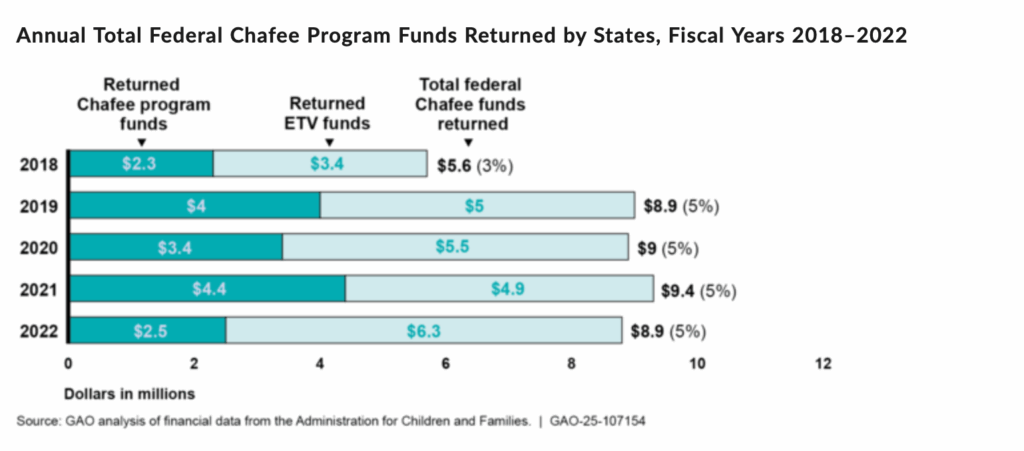
Source: Government Accountability Office
GAO’s review revealed that education, health, and housing were the most common services offered in selected states. However, despite the various needs of foster youth, four of the six states surveyed by GAO reported not spending all available federal funding. GAO recommended HHS create a plan to work closely with state offices to address barriers for spending federal Chafee funds and create guidance on addressing these challenges.
The GAO review aligns with similar findings from the Annie E. Casey Foundation which found that in FY2021, 33 percent of youth ages 14 and older who received at least one Chafee-funded service were not in foster care, while 67 percent of those who received services were in foster care. However, they also found that from 2015 to 2018 youth ages 14 and older became less likely to access transition services through the Chafee program. According to GAO, in FY2021 approximately 440,000 youth were eligible for the Chafee program. However, the Casey Foundation also found that only 23 percent of eligible youth received transitional services that year, and less than half—47 percent—of youth received any services from ages 14-21.
Therefore, there is strong evidence that some states are not maximizing federal Chafee funding, and thus many eligible current and former foster youth who are currently not benefitting from transitional services.
It is reasonable to assume that providing benefits and services to teenagers who are leaving foster care, lack family support networks, and who are at risk of homelessness or suffering other crises could benefit from housing assistance, independent living training, and education. There is some evidence that receiving Chafee benefits such as independent living services or receiving an education and training voucher (ETV) help youth aging out of foster care achieve better life outcomes. For example, an evaluation of several hundred older foster youth in Missouri found that youth who lived in a transitional or independent living setting were more likely to complete high school and enter college. An HHS evaluation of the Chafee program found that “Receiving an ETV is correlated with better educational outcomes for young adults.” These better outcomes benefit those individuals, their communities, and ultimately the nation as a whole.
Housing
“Housing education and home management training” constitutes a category of services under the Chafee program. According to the Casey Foundation study, only 14 percent of youth receiving Chafee-funded services received room and board financial assistance, and only 10 percent received supervised independent living services.
HHS and HUD administer several federal housing support programs for former foster youth, such as the Transitional Living Program, which awards HHS grants to organizations providing residential services for homeless youth; the Marylee Allen Promoting Safe and Stable Families Program, which provides flexible HHS funding to states to prevent family separation and includes housing assistance for youth transition to independence; and the Foster Youth to Independence Initiative and Family Unification Program , which provides HUD public housing choice vouchers for youth who have aged out of foster care.
Despite these programs and funding available for former foster youth, homelessness is still a significant problem for those aging out of the system. The Annie E. Casey Foundation reports that half of the U.S. homeless population has been in foster care, and 25 percent of former foster youth surveyed at age 21 had experienced homelessness at some point in the last two years. These alarming numbers demonstrate that despite millions of government dollars every year poured into improving housing security for foster youth, the status quo is failing to provide adequate support.
Why foster parents need benefits and support
The foster care system should reunite children with their biological parents when safely possible. This is important and laudable. In 2021, about half of all foster children exiting care were returned to their parent or primary caregiver. However, when family reunification is not possible, the next goal is to place the child in a permanent home with relatives, legal guardians, or adoptive parents. Adoption from foster parents is the second-most common way for children to exit foster care, with 25 percent of children being adopted by foster parents in 2021. For many youth in long-term foster care who are unable to be reunited with their family or be adopted, a stable and loving family is not an option. To achieve the goal of placing children in permanent loving homes, it is important to provide foster parents with enough financial support.
The Imprint, a publication that covers the American child welfare and youth justice systems, has calculated the total number of foster children and licensed foster homes in the United States, and the number of children in care exceeded the number of licensed foster homes by 134,358 in 2023.
Because adoption from foster care is the second most common exit for youth from the system, increasing the number of licensed foster homes will create more opportunities for foster youth to achieve permanent, stable homes. According to the National Foster Youth Institute (NFYI), there is a continuing shortage of licensed foster homes. NFYI estimates that the turnover rate of foster parents in states ranges from 30 percent to as high as 50 percent. In addition to low retention rates, states are struggling to recruit foster parents, contributing to many children living in a range of inappropriate settings, including emergency rooms, child welfare offices, and homeless shelters.
A 2019 survey in West Virginia highlighted a variety of contributing factors to the shortage of foster homes, including a lack of awareness of foster care, the long and cumbersome licensing process for prospective homes, and the difficulty of caring for children with complex emotional and behavioral needs. Frustration with the child welfare system and lack of communication from child welfare agencies were the top reasons foster parents reported deciding to no longer be foster parents. While this survey was not nationwide, it highlights specific challenges facing foster families in a state that had a significant increase in foster care placements. While this paper focuses on whether foster youth and foster families access federal benefits, conducting additional surveys and establishing greater transparency about the challenges facing those in the foster care system could inform broader reforms.
Many West Virginia respondents also reported needing more financial resources than were available. This experience comports with one study that found the number of children in foster care increased by 20 percent—relative to other states and settings—after North Carolina increased their payments to foster parents in 2008. Providing financial assistance to foster parents would thus incentivize more people to welcome vulnerable children into their homes and increase the number of foster youth in permanent, loving environments.
Many low-income Americans forgo federal benefits
Many lower-income families miss out on billions of dollars in federal financial assistance simply by not applying for means-tested tax benefits. For example, as of FY2022, the Internal Revenue Service reported that only 81 percent of eligible Americans claimed the federal Earned Income Tax Credit. That many eligible families forgo the EITC causes unnecessary hardship. Researchers have found that the credit improves health outcomes—particularly for single mothers and children—by reducing maternal stress and decreasing instances of low birthweight, while also supporting better home environments, nutrition, education, and economic attainment. The EITC is an important federal assistance program that rewards work and earning, helping to create a glide-path to self-sufficiency.
Broader data on benefit take-up show similar patterns. Aparna Mathur, now a scholar at FREOPP, analyzed Census Bureau survey data from 2019 and found that fewer than one-third of households living at or below 130 percent of the poverty level reported receiving multiple federal benefits, and nearly half reported receiving no federal assistance at all. The complex process to identify, apply for, and receive benefits not only hinders struggling individuals and families, it needlessly adds to government bloat and bureaucracy. Streamlining assistance would make the government more efficient and make foster families better off.
Do foster parents access federal benefits?
In our analysis, we attempted to determine whether foster parents access federal benefits. Given clear data showing that many former foster youth experience negative outcomes in adulthood, and the widespread evidence that many Americans—particularly those from lower-socioeconomic backgrounds—forgo significant federal benefits, it is possible that the failure to access owed federal benefits contributes to the negative cycles affecting foster youth.
We explored the Survey of Income and Program Participation and the Current Population Survey Annual Social and Economic Supplement to understand these problems. Both surveys contain basic demographic information and household characteristics, including income, federal benefits, and tax filing behavior. The purpose of these datasets is to provide official statistics and information on households’ employment, demographics, income, and use of government support systems, rather than focus on foster parents and youth. Upon investigation, the SIPP data from 2023 contained approximately 35,000 households and only 13 households that reported having at least one foster child at any point during the survey year. The 2024 ASEC contained approximately 75,000 households, 96 of which reported having at least one foster child at any point during the survey year. Therefore, the number of foster households surveyed is too limited to conduct a robust statistical analysis that answers the question of whether foster parents access federal benefits.
The lack of national data on foster families is an ongoing problem preventing researchers from understanding the traits of foster parents and their barriers to ensuring the children in their care receive the full support needed to thrive. CHAMPS is a policy campaign with the goal of promoting better life outcomes for foster children. The campaign has highlighted the need for national data collection on foster families in order to better understand foster parents and their needs. No national survey of foster parents has been conducted since 1991. Updated information on foster parents is crucial for researchers and policymakers to develop data-driven policy decisions that uplift foster parents and youth. Additionally, state-level data is necessary for understanding localized needs of foster parents and how they differ across the United States.
The need for new data is especially vital given low foster parent retention rates and a shortage of qualified foster parents. The Imprint reported that the number of licensed foster homes has dropped every year. Developing plans to increase foster parent retention requires data collection to understand and reverse these negative trends.
Child Tax Credit
A Tax Policy Center report estimated that 17 million children in low-income families would miss out on the full CTC in 2025. Furthermore, the current design of the CTC means that many low-income, single-parent families end up receiving a credit that is approximately half the size of high-income, two-parent families with the same number of children, according to the Center on Budget and Policy Priorities.
However, we do not know how many of the 17 million children are foster youth. Foster parents may be able to claim foster children for the CTC if the child meets certain eligibility requirements, including living with the foster parent for more than half of the tax year. This may prevent some foster parents from claiming the CTC, because frequent home transitions and placements can lead to children living in multiple homes throughout the year. While the length of stay requirement may bar some families from eligibility, others who are eligible might not be accessing the CTC. The long list of eligibility criteria may prevent many foster parents from being aware that they are eligible to claim the CTC and accessing extra support that would help them provide quality care to their foster child.
The CTC has the potential to have a large effect on the lives of low-income families. In 2021, under the temporarily expanded CTC, food insecurity declined and poverty rates were cut in half, which has been linked to better health outcomes for children. While the CTC provides a modest benefit that promotes family wellbeing, it is important to ensure that eligible families are taking advantage of the CTC to increase their well-being and health.
The lack of available data on foster parents makes it difficult to understand the full scope of the problem, including how many foster parents access the CTC, how many miss out due to the length-of-stay requirement, and how many eligible families fail to claim the CTC. Better foster parent data is needed to generate policy recommendations on how to strengthen access to tax credits that could benefit foster youth and their caregivers.
Recommendations
- President Trump should issue an executive order directing federal agencies to identify federal benefits that current and former foster youth, and foster parents, are eligible for and evaluate whether these benefits are being accessed consistently. The executive order should direct federal agencies, including HHS, HUD, the Treasury, and other agencies to improve outreach and educational activities to ensure that foster youth and foster parents are aware of these benefits. Moreover, the executive order should direct relevant federal agencies to review the administrative burden associated with accessing federal benefits for current and former foster youth and their caregivers and take steps to reduce the administrative burdens.
- Congress and the administration should prohibit states and child welfare agencies from applying for and using foster children’s owed federal benefits. Moreover, the Trump administration and Congress should review and consider whether alternative funding mechanisms—such as Fostering Independence Accounts— could improve outcomes in adulthood.
- HHS should enact an annual, national-level survey of foster parents to obtain up-to-date data on foster parents, their experiences navigating the system, and the quality of and ease-of- access to state and federal benefits. Additionally, state child welfare agencies should be required to conduct annual foster parent surveys, either through new surveys or existing mechanisms, such as the Adoption and Foster Care Analysis Reporting System , which collects data on all children in the foster care system. Developing data-driven strategies to improve outcomes for foster youth requires reliable data.
- Congress should enact the bipartisan Foster Care Tax Credit Act, introduced in the House of Representatives in March. The bill would establish a $850 annual refundable tax credit for foster parents. The bill would also require federal agencies to evaluate financial burdens on foster families and direct the Treasury to alert foster families about tax benefits that they may be eligible to claim. Foster parents who are ineligible for the child tax credit because they cared for a child for six months or less would be eligible to receive the Foster Care Tax Credit. If passed, this bill would provide crucial financial support to foster parents and potentially incentivize more families to foster children. Creating support and incentives for foster parents is necessary for overcoming the shortage of licensed foster homes and can provide safe homes for more children in need. Establishing this tax credit would involve a reduction in government revenues. Congress could offset this revenue reduction by enacting a cost-saving measure, such as by rescinding $23.6 billion in unexpired, unobligated COVID relief funds that were available as of March 2025.
To be clear, broader societal changes and government reforms are needed to address the current foster care crisis. Ensuring that fewer children enter the child welfare system in the first place should be the primary goal of local, state, and federal policymakers, and they can do so through policies that strengthen families, civil society, and the economy overall. However, policymakers have a responsibility to ensure that current and future children in the nation’s foster care system are not forgotten and receive the necessary support to have an equal opportunity to thrive in adulthood.
Child welfare advocates have been sounding the alarm on a range of issues in the child welfare system. These concerns include the high rates of negative life outcomes among former foster youth, the shortage of licensed foster homes, and the theft of children’s Social Security survivor or disability benefits. Executive action is needed to ensure that current and former foster youth and foster parents are taking full advantage of the support available to them. However, gaps in foster family data prevent policymakers from retaining more qualified caregivers. Surveys will illuminate whether foster parents are struggling to access the CTC, the reasons why so many foster parents are frustrated with the child welfare system, and how agencies can create better communication with foster-involved families. Enacting the Foster Care Tax Credit Act in a revenue-neutral manner can be an important step in the right direction to help foster children and their caregivers. States and the federal government should invest more time and resources ensuring successful transitions to adulthood for the nation’s most vulnerable children and increase support for foster parents. Ensuring that more youth aging out of foster care succeed as they become adults will benefit thousands of individuals, their families, communities, and the nation in the long run.