



Below is written testimony submitted to the US Senate Special Committee on Aging for its hearing “A Bridge, Not a Barrier: Reforming the Safety Net to Reward Work.”
Introduction
Chairman Scott, Ranking Member Gillibrand, Senator Husted, and Members of the Senate Committee on Aging: Thank you for the opportunity to testify today, and for investing your time in making the American Dream a reality for our low-income neighbors by solving benefit cliffs.
My name is Joshua Bandoch. I’m Senior Vice President of Policy Research at the Foundation for Research on Equal Opportunity, a 501(c)(3) think tank dedicated to expanding opportunity for low-income Americans through freedom, innovation, and pluralism. We exist to truly empower everyone to unleash their potential, especially those least empowered to do so.
Why benefit cliffs disincentivize upward mobility
A benefit cliff occurs when an increase in earnings—even as little as $0.48 per hour or $1,000 per year—can trigger an abrupt and disproportionate loss of hundreds or even thousands of dollars in federal benefits. These cliffs can be devastating. For example, in Illinois, a family can lose $25,000 in child care benefits when their household income goes from $54,000 to $55,000 in income.1 Even a $20,000 raise would leave them worse off.
Stated simply: Benefit cliffs make it economically rational and psychologically understandable for poor people to reject opportunity, which harms them and their families. These structural flaws create a snare net, trapping poor people in poverty, when our social welfare system needs to be a launchpad into opportunity and thriving.
The benefit cliffs phenomenon is widespread. Nearly one in four (22%) public assistance recipients reported taking at least one negative action to avoid losing benefits, including rejecting a job offer, declining a raise or promotion, or reducing their number of hours worked, according to research from the Center for Social Development at Washington University in St. Louis.2 Because people often underreport these sorts of things on surveys due to a psychological phenomenon called “social desirability bias,” it’s possible—even likely—the numbers are higher. At 22%, with over 99 million people receiving assistance from at least one means-tested program as of 2019 according to the Department of Health and Human Services, over 20 million of them have decided to avoid a benefit cliff.3
Benefit cliffs are antithetical to the American Dream. If we don’t remove benefit cliffs, that Dream will increasingly turn into a mirage, then cease to exist, particularly for low-income Americans. That’s bad for everyone, and it’s already happening.
Only one third of Americans believe the American Dream still holds true, according to an April 2026 AP-NORC survey.4 A 2025 survey from The Wall Street Journal and NORC had similar findings.5 Low-income Americans are less likely to believe in the American Dream. A 2026 YouGov survey found an enormous gap in belief in this Dream between families with incomes below $50,000 versus those with incomes above $100,000. 72%of the latter believe in it, while only 40% of the former do. This should scare all of us, because this Dream is core to what makes America special.
A Working Group to Identify and Address Benefit Cliffs
For over two years, I’ve participated in a small working group of national experts committed to understanding and proposing solutions to benefit cliffs. We’ve modeled these cliffs, analyzed their impacts, and presented our findings at numerous gatherings of experts and policymakers to solicit feedback. Over this time, remarkable bipartisan, national consensus has emerged on two crucial issues. First, benefit cliffs are real and destructive to upward mobility. Second, clear solutions exist, and states are eager to implement them. The time to act is now.
In December 2025, the working group published the first comprehensive proposal to reform benefit cliffs at the federal level, entitled “Stranded by the Safety Net: How to Fix the Benefit Cliff Problem,” through the American Enterprise Institute.6 Since then, I have investigated how almost one-third of states—sixteen in total, plus the District of Columbia—are attempting or proposing to solve benefit cliffs. In October 2026, I published the first comprehensive analysis of their approaches, entitled “How States Can Solve Benefit Cliffs: A Comprehensive Approach to Supporting Upward Mobility,” and released by my organization, the Foundation for Research of Equal Opportunity.7
Why Congress Must Act
My testimony will cover three main points. First, benefit cliffs are real and economically and psychologically debilitating. Second, red and blue states alike—sixteen states in total, plus DC—are already acting or proposing to act to address benefit cliffs. They have adopted four approaches. However, their approaches can only attack benefit cliffs indirectly, because they do not possess the authority to restructure programs. Third, the only way to comprehensively solve benefit cliffs is through federal reform, which is why I support the Upward Mobility Act. It allows states to solve benefit cliffs and promotes independence and thriving through work.
A comprehensive approach to solving benefit cliffs has three core elements:
- Restructure welfare programs to streamline benefits and eliminate benefit cliffs by adopting consistent tapers across programs.
- Empower individuals through evidence-based workforce development, especially apprenticeships.
- Provide financial literacy training to help individuals acquire the financial knowledge necessary to manage their finances and build wealth.
The Upward Mobility Act is particularly promising because it provides a secure path forward for reform in a few ways. First, it proceeds through pilot programs in up to five states.8 This format allows states to test what does and does not work. Second, states have to voluntarily opt-in to the pilots. They would only undertake this substantial effort if they are committed to solving benefit cliffs. Third, the Upward Mobility Act requires interventions to be evidence-based and subject to third party evaluation and measurement, as well as to proceed through randomized controlled trials or other rigorous methodology.9 This framework ensures efficacy for reforms in the remaining 45 states.
This is not fundamentally a conversation about the size of our social welfare system. Regardless of whether you think it is too big, too small, or just right in size, we can all agree that benefits should taper at a consistent rate within and across programs as income rises, rather than dropping abruptly and sharply.
Benefit cliffs are not a partisan matter, either. Red states like Utah and Tennessee, as well as blue states like Massachusetts and Rhode Island, have demonstrated a willingness to tackle the issue.
I. Benefits Cliffs are Real and Harmful
Marcella Patiño is a single mother of three who was faced with a gut-wrenching choice: should she strive to work hard, earn more, progress in her career, and achieve independence for her family, if doing so would make her family worse off because she’d lose too much assistance from government programs? Her answer: of course not. These flawed social welfare program structures caused her to turn down work opportunities and raises.10
Carlotta Jackson was faced with a similarly unfair choice, and rejected being “foolish” by “shooting” herself “in the foot.” What was the harmful behavior Carlotta was avoiding? Marriage. Why? Carlotta explained: “I believe in the institution of marriage,” Jackson shared. “I have very traditional beliefs and values, and that’s something that’s very important to me … [but] I can’t lose my coverage.” Marrying her long-time partner would have sent her over a benefit cliff.11 So she decided against it.
Powerful as these lived experiences are, one might rightly wonder: Are benefit cliffs widespread? And are they really so bad? The definitive answer to both is: yes, benefit cliffs are pervasive and pernicious. As the research cited above shows, nearly one in four program participants admits to doing things like turning down a job offer or promotion to avoid a benefit cliff.
Recognition of benefit cliffs as real and problematic spans a wide range of organizations, including: the American Enterprise Institute,12 the Urban Institute,13 the Federal Reserve Bank of Atlanta,14 the University of Chicago’s Inclusive Economy Lab,15 the University of Wisconsin-Madison’s Institute for Research on Poverty,16 Georgetown University’s Center on Poverty and Inequality,17 the U.S. Chamber of Commerce Foundation,18 Goodwill Industries of the Southern Piedmont,19 and the National Conference of State Legislatures.20
The economic harms of benefit cliffs are clear: When earning even a little bit more can cause your family to lose hundreds or thousands of dollars, you have a strong incentive to reject opportunity. Low-income individuals are disincentivized from climbing the economic ladder.
Flawed program structures can even cause incomes to plateau. Federal Reserve Bank of Atlanta research found “a hypothetical single adult, one child (aged three) family living in DC would receive no financial gain from a wage increase between $11,000 and $65,000 of earned income” due to benefit program structures.21 A family would be right to wonder: If I don’t come out ahead, why bother? Many don’t.
It’s the psychological harms of benefit cliffs that are in many ways worse than the already severe economic ones. Benefit cliffs punish a virtue—hard work. That can be psychologically debilitating.
II. States Are Already Addressing Benefit Cliffs with Four Approaches
Because they recognize the scope of the problem, states are not waiting for federal action to begin addressing benefit cliffs. In fact, as of October 2026, sixteen states plus the District of Columbia have either taken concrete legislative or executive actions to address benefit cliffs, or proposed legislation to do so. These include Florida, Massachusetts, Ohio, and Maryland. We can expect more to follow.
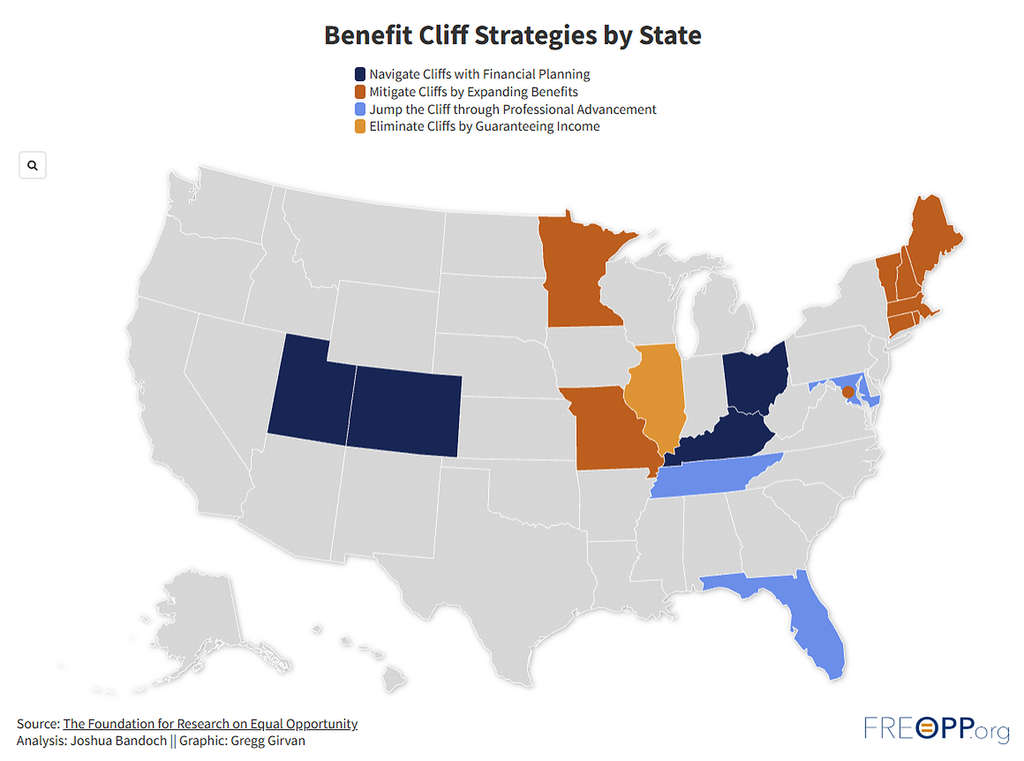
Considering what states are already doing is particularly important for this hearing, because the Upward Mobility Act would permit up to five states to pilot programs that would restructure and rethink their benefit programs comprehensively. This will give us a window into things we could expect to see in their pilots, on top of actually smoothing out the cliffs with a consistent taper of program benefits.
Their approaches generally fall into one of four categories:
- Navigate cliffs with financial planning
- Expand benefits to mitigate cliffs
- Eliminate cliffs by guaranteeing income
- Jump the cliff through professional advancement
We will consider each in turn, summarizing the approaches. I dive into them more deeply in my recent report for FREOPP referenced earlier, should you wish to examine them in greater detail. While the approaches are not mutually exclusive, states generally have placed one of them at the center of their strategy.
It is worth noting, because it is crucial to the context of this hearing on federal reform, that most of these state programs faced important limitations. First, states’ interventions are not based on modeling actual cliffs in their state, likely because they do not have the authority to directly address these structural flaws in federal programs. Second, few of them use randomized controlled trials (RCTs) with robust data collection to assess outcomes, which means it is difficult to truly assess the impact of the interventions. Third, most of the pilots are small in size, ranging from 100-500 people. Such small populations make it more difficult to draw broad conclusions from any results. These are problems the Upward Mobility Act would overcome. Finally, few of the program’s states have implemented require evidence-based methods that evaluate and adjust based on results.
1. Navigating Cliffs Through Financial Planning
The first approach is to “navigate cliffs through financial planning.” The idea is simple: If social welfare program participants receive financial literacy training that helps them understand how earning more impacts their benefits, and can plan for it, they will be able to navigate benefit cliffs more successfully. They can develop a plan, execute it, and continue to climb the economic ladder. Financial literacy is undoubtedly crucial to achieving upward mobility and financial independence. Even if someone’s income rises, bad financial decisions, like not having an emergency savings fund or accumulating high-interest debt, can trap someone in poverty. That’s why a study of 113 countries showed financial literacy reduces the chances someone falls into poverty.22
Utah, Ohio, Kentucky, and Colorado have adopted this approach. Goodwill Industries of the Southern Piedmont, Goodwill of North Georgia, and Atrium Health have tested it through a pilot program for their employees.23 The Federal Reserve Bank of Atlanta has also developed a tool to help people navigate benefit cliffs called the CLIFF (Career Ladder Identifier and Financial Forecaster).
2. Expand Benefits to Mitigate Cliffs
The second approach is to “expand benefits to mitigate cliffs.” The idea is that program participants need additional financial support as they climb the economic ladder. Connecticut, the District of Columbia, Maine, Missouri, New Hampshire, Rhode Island, and Vermont have all adopted or proposed variations of the “expand benefits” approach.
This approach operates on a sort of sliding scale, which can be summarized as follows:
– Increasing asset limit: Families are allowed to accumulate a larger amount of assets before it is counted against program eligibility.
– Income disregards: Some portion of additional earned income is not counted against eligibility for welfare programs.
– Smooth the cliff by extending benefits: States eliminate or reduce the severity of a benefit cliff by extending benefits beyond the current point where they decline sharply.
– Benefit replacement: States provide financial supplements to replace benefits as they taper off.
– Stable benefits: The state extends benefits to ensure they remain stable as income increases.
– Cash payouts: Participants receive a cash payment (usually one-time) upon completion of a program. These have generally been added on to one of the above approaches.
These approaches are not mutually exclusive.
The “expand benefits” approaches vary widely as you move up the scale of expansiveness. The approach at the beginning of that scale—expanding asset limits and income disregards—are more modest and worth piloting. The more expansive approaches, particularly the stable benefits and cash handout approaches, are expensive and raise concerns about scalability. What’s more, many of these programs do not require work as a condition to receive expanded benefits. Without work, participants will not climb the economic ladder and experience upward mobility.
3. Eliminating Benefit Cliffs by Guaranteeing Income
The third approach to eliminating benefit cliffs is to guarantee income. While guaranteed income programs are not directly aimed at solving these cliffs, they would address them because participants receive monthly cash payments on top of their earnings and social welfare program benefits. Some of the “expand benefit” approaches, particularly stable benefits, point in this direction.
From 2017 to 2025, 33 states and DC piloted at least 122 guaranteed income programs, according to a report from the American Enterprise Institute.24
Guaranteed income programs have proven harmful to recipients. The most rigorous pilot, conducted by OpenResearch in Illinois and Texas, found that participants reduced their workforce participation by 4.2 percentage points, their earned income fell by $1,900, and participants and their partners worked fewer hours.25 The American Enterprise Institute report found negative employment effects for the most rigorous pilots with treatment groups of at least 500 participants, with workforce participation declining by an average of 3.2 percentage points.26
These programs are also extremely expensive. If they were made universal, it would cost over $2 trillion per year to give all 342 million people living in the United States a relatively modest $500 per month.
4. Jumping the Cliff
The fourth approach states have taken is what I call “jump the cliff”: By growing professionally and earning substantially more, social welfare recipients can overcome the loss of benefits mostly, or even entirely, and replace the lost financial resources. Through effective career training and workforce development that allows someone to enter a new profession or climb the ladder in their current one, they can secure a substantial raise. Tennessee has placed this approach at the center of its efforts to address benefit cliffs, as has a Florida program for youth aging out of foster care. Maryland has proposed legislation along these lines.
One might quickly wonder: can people really secure such substantial raises?
Happily, the answer is yes. Consider apprenticeships. Someone who completes an apprenticeship program has an average starting salary of $86,000.27 It is not only traditional blue-collar trades that are apprenticeable. White-collar jobs in finance, technology, health care, and other fields are apprenticeable,28 with the number of fields continuing to grow. As long as we build a nimble system, it will also help workers adapt as AI and the future of work evolve the workforce.
Tennessee’s approach, established in the 2021 Tennessee Opportunity Act, is notable and appealing. The Act created three-year pilot programs that will use “evidence-based and evidence-informed programs and services” to demonstrate “the efficacy of well-implemented two-generation approaches to improving education, health, and economic outcomes for children and the adults in their lives.”29 The pilots offer support across a range of items, including workforce training and apprenticeships, economic advancement supports (e.g. transportation and housing), child care, wrap-around services, after school and summer learning programs, home visiting services, high-quality data systems, and other evidence-based solutions.30 The act also requires research on and evaluation of these pilot programs through a partner or partners.31
Since states are already doing so much to address benefit cliffs, this begs the question: why should the federal government act?
III. Federal Action Is the Only Way to Comprehensively Eliminate Benefit Cliffs
One commonality across these four approaches is that they do not directly solve or even truly mitigate benefit cliffs themselves. Rather, they find ways to help individuals work around these cliffs, such as by navigating or jumping over them, or expanding benefits in an effort to help them push through them. The reason for that is simple: States do not possess the authority to systematically address benefit cliffs, which are structural flaws in federal social welfare programs.
That’s why federal action is necessary: it’s the only way to actually eliminate benefit cliffs. A comprehensive approach to solving benefit cliffs has three core elements:
- Restructure welfare programs to streamline benefits and eliminate benefit cliffs by adopting consistent tapers across programs.
- Empower individuals through evidence-based workforce development, especially apprenticeships.
- Provide financial literacy training to help individuals acquire the financial knowledge necessary to manage their finances and build wealth.
Let us consider why these three components are crucial to ensuring upward mobility and opportunity for those who need it most.
First, restructuring social welfare programs to actually eliminate benefit cliffs is foundational to any reform. The Upward Mobility Act would achieve this by permitting states to consolidate funding and benefits across ten core social welfare programs: SNAP, TANF, Section 521 Rural Rental Assistance Payments, Section 8 Tenant-Based Rental Assistance, Public Housing Capital and Operating Funds, Child Care and Development Funding, LIHEAP, Community Development Block Grant, and WIOA Dislocated Workers Funding.
The inclusion of so many programs is crucial because of an issue called “stacking.” Program benefits “stack” on top of each other, because most people receive benefits from more than one program. As such, they face multiple benefit cliffs on their journey up the economic ladder, resulting in their family potentially being hurt multiple times by benefit cliffs. The more benefit cliffs they face, the harder it can be to overcome all of them.
Currently, there are also different taper rates across programs, meaning the rate at which benefits are reduced as income rises. Benefits decline at different rates based on the program. This makes financial planning unnecessarily difficult.
While there is no consensus about what the “ideal” taper is, it is likely in the range of 30-50%; definitely not above that rate, and quite possibly near the lower end. Otherwise, individuals have insufficient incentive to continue to climb the economic ladder, because they do not reap enough of the rewards of their hard work. Pilots allow states to test different taper rates for their effects, with up to five different taper rates (one for each state) in the pilots.
Solely eliminating benefit cliffs only removes an enormous barrier to opportunity. It does not ensure the people most in need of opportunity experience it, because it does not provide them the skills and experiences necessary to grow. Being what I have called “anti-anti-opportunity” is insufficient.32
That’s why the second element of comprehensive benefits cliffs reform should be to empower people through work. The inclusion of “promoting upward mobility through improved employment outcomes…including increased employment and earnings” as a goal in the Upward Mobility Act is a crucial step toward achieving this.33
Work is the only proven pathway out of poverty and into independence and dignity. It’s the only way for individuals to climb the economic ladder and provide for themselves and their families. No other pathway exists.
Workforce development programming and career training need to be driven by outcomes rather than activities. We need to measure results, not money spent or trainings administered. The outcomes that matter most are whether participants get a job, whether they hold it and for how long, whether it’s full- or part-time, how much they earn, and whether they are moving out of poverty and into independence. While most everyone agrees that these are the right goals, in far too few cases are these outcomes actually measured. They need to be. That’s why the provisions in the Upward Mobility Act that require such measurements are crucial to empowering people.
Without these metrics, workforce training can actually be harmful in at least three ways. First, and most importantly, a participant can complete months of training and then find themselves unable to secure a job. That’s devastating. Second, money spent on programs that do not work is money not spent on programs that do. Third, the money from these programs ultimately comes from taxpayers. We always owe it to them to be good stewards of their resources.
Third, states should require proven financial literacy training as a condition for receiving support from social welfare programs. The goal is to ensure everyone has the tools necessary to thrive. Financial literacy is one such tool. Without it, many people do not take the steps necessary to create a personal financial safety net and instead forgo savings and make other financial decisions like taking on high-interest debt that create barriers to independence for years to come, and can even drag them back into poverty or deny them opportunity.
There are other policies discussed above that states might consider testing in their pilots. The first is to increase asset limits when they are too low, to a minimum of $6,000, and likely higher. The second is to test income disregards. Since states will receive the same amount of money for their social welfare programs, they would have to fund income disregards from existing funds, not with additional federal funds.
Conclusion
Since nearly one-third of states are acting or have proposed acting to address benefit cliffs, we know there is enormous appetite among red and blue states to address this problem. States are eager to empower people to grow, achieve independence, and climb the economic ladder. And they could do a far better job of that if they were given the authority to restructure their benefit programs, which is exactly what the Upward Mobility Act would do. This Act takes a big step toward making the American Dream a reality for more low-income Americans and empowering them to live their version of it.
Endnotes
- Janelle Blackwood, Elias Ilin, and Misuzu Schexnider, Exploring Benefits Cliffs in Illinois: CCAP as a Case Study (Federal Reserve Bank of Atlanta and University of Chicago Inclusive Economy Lab, 2021), 5, https://urbanlabs.uchicago.edu/attachments/14265904df0a33358c29a1c99642f480015e8548/store/6dbbcf726529cc71b3e8ff72cb9c75a30cd0913444f0f9635f9894fa8c13/IEL_AFRB_Cliffs%2BReport%2B_vFinal_wAuthors.pdf.
- Stephen Roll et al., “The Impact of Benefits Cliffs and Asset Limits on Low-Wage Workers: New Evidence from a Nationally Representative Survey,” Center for Social Development, George Warren Brown School of Social Work, Washington University in St. Louis, May 22, 2025, https://openscholarship.wustl.edu/cgi/viewcontent.cgi?article=1962&context=csd_research.
- Suzanne Macartney and Robin Ghertner, How Many People Participate in the Social Safety Net?, U.S. Department of Health and Human Services, Office of the Assistant Secretary for Planning and Evaluation, Office of Human Services Policy, January 20, 2023, https://aspe.hhs.gov/sites/default/files/documents/18eff5e45b2be85fb4c350176bca5c28/how-many-people-social-safety-net.pdf. These figures count the EITC but not the CTC.
- AP-NORC Center for Public Affairs Research, “AP-NORC America 250 Poll,” June 2026, https://apnorc.org/projects/ap-norc-america-250-poll/.
- NORC at the University of Chicago, WSJ/NORC Poll July 2025 (Chicago: NORC at the University of Chicago, July 2025), https://prod-i.a.dj.com/public/resources/documents/WSJNORCJuly2025.pdf.
- Joshua Bandoch, Nic Dunn, Leslie Ford, Angela Rachidi, Erik Randolph, and Mat Weidinger, Stranded by the Safety Net: How to Fix the Benefit Cliff Problem (American Enterprise Institute, 2025), https://cosm.aei.org/wp-content/uploads/2025/12/Stranded-by-the-Safety-Net-1.pdf.
- Joshua Bandoch, How States Can Solve Benefit Cliffs: A Comprehensive Approach to Supporting Upward Mobility (Foundation for Research on Equal Opportunity, October 19, 2026),
- U.S. Congress, Senate, Upward Mobility Act of 2026, S. 3583, 119th Cong., 2nd sess., introduced January 6, 2026, 8, https://www.congress.gov/119/bills/s3583/BILLS-119s3583is.pdf.
- U.S. Congress, Upward Mobility Act of 2026, 22, 28.
- Nic Dunn et al., Defending Ideas, podcast, “What It’s Like to Face Safety-Net ‘Benefits Cliffs’ That Can Discourage Work and Opportunity,” Sutherland Institute, July 30, 2024, https://sutherlandinstitute.org/what-its-like-to-face-safety-net-benefits-cliffs-that-can-discourage-work-and-opportunity/.
- Nic Dunn, Strengthening the American Dream: Addressing Benefits Cliffs to Empower Safety Net Participants to Pursue Work and Opportunity (Salt Lake City: Sutherland Institute, November 2024), 16, https://sutherlandinstitute.org/wp-content/uploads/2024/11/Strengthening_the_American_Dream.pdf.
- Bandoch et al, “Stranded by the Safety Net.”
- Theresa Anderson, Amelia Coffey, Hannah Sumiko Daly, Heather Hahn, Elaine Maag, and Kevin Werner, Balancing at the Edge of the Cliff: Experiences and Calculations of Benefit Cliffs, Plateaus, and Trade-Offs (Washington, DC: Urban Institute, January 11, 2022), https://www.urban.org/research/publication/balancing-edge-cliff.
- Federal Reserve Bank of Atlanta, “What Are Benefits Cliffs?,” Advancing Careers for Low-Income Families, accessed November 14, 2026, https://www.atlantafed.org/what-we-study/workforce-development/advancing-careers-for-low-income-families/what-are-benefits-cliffs
- Blackwood et al, University of Chicago Inclusive Economy Lab, Benefits Cliffs in Illinois.
- Institute for Research on Poverty, University of Wisconsin–Madison, “Understanding Benefit Cliffs and Marginal Tax Rates,” Fast Focus, no. 43-2019 (September 2019), https://www.irp.wisc.edu/wp/wp-content/uploads/2019/12/FF43-2019.pdf; Matthew Unrath, Mathieu Despard, and Taryn Morrissey, “Understanding Benefit Cliffs, Worker Realities, and Policy Solutions,” webinar, Institute for Research on Poverty, University of Wisconsin–Madison, October 28, 2026, https://www.irp.wisc.edu/resource/understanding-benefit-cliffs-worker-realities-and-policy-solutions/
- Stephanie Scott, Making Work Pay: Ending Benefits Cliffs for Families (Washington, DC: Georgetown University Center on Poverty and Inequality, March 29, 2026), https://www.georgetownpoverty.org/wp-content/uploads/2026/03/GCPI-Benefits-Cliffs-Brief-20260327-1.pdf.
- Mathieu Despard, Benefits Cliffs: Effects on Workers and the Role of Employers (Washington, DC: U.S. Chamber of Commerce Foundation, October 12, 2023), https://www.uschamberfoundation.org/workforce/benefits-cliffs-effects-on-workers-and-the-role-of-employers.
- Goodwill Industries of the Southern Piedmont, “Benefits Cliff Employer Pilot Program Evaluation,” February 20, 2025, https://goodwillsp.org/news/benefits-cliff-white-paper/
- National Conference of State Legislatures, “Addressing Benefits Cliffs,” August 20, 2019, https://www.ncsl.org/human-services/addressing-benefits-cliffs.
- Elias Ilin and Alvaro Sanchez, “Mitigating Benefits Cliffs for Low-Income Families: District of Columbia Career Mobility Action Plan as a Case Study,” Community and Economic Development Discussion Paper no. 23-1 (Federal Reserve Bank of Atlanta, September 2023), 1, https://www.atlantafed.org/-/media/documents/community-development/publications/discussion-papers/2023/01-a-case-study-mitigatingbenefits-cliffs-in-the-district-of-columbia.pdf.
- N. D. Lang, H. M. Tran, G. T. Nguyen, et al., “An Untapped Instrument in the Fight Against Poverty: The Impacts of Financial Literacy on Poverty Worldwide,” Social Indicators Research 174 (2024): 657–95, https://doi.org/10.1007/s11205-024-03404-w.
- Mecca Howe, Benefits Cliff Employer Pilot Program Evaluation: Overview and Strategies for Employers (Charlotte: UNC Charlotte Urban Institute, October 2024), commissioned by Goodwill Industries of the Southern Piedmont, https://benefitscliffcommunitylab.org/wp-content/uploads/2025/03/Benefits-Cliff-Employer-Pilot-Program-Evaluation-Feb-2025.pdf.
- Kevin Corinth and Hannah Mayhew, “What Can We Learn from Guaranteed Basic Income Pilots in the United States? Evidence on Employment Effects,” AEI Center on Opportunity and Social Mobility Working Paper (Washington, DC: American Enterprise Institute, February 2026), https://www.aei.org/research-products/working-paper/what-can-we-learn-from-guaranteed-basic-income-pilots-in-the-united-states-evidence-on-employment-effects/.
- Eva Vivalt, Elizabeth Rhodes, Alexander W. Bartik, David E. Broockman, Patrick Krause, and Sarah Miller, “The Employment Effects of a Guaranteed Income: Experimental Evidence from Two U.S. States,” National Bureau of Economic Research, August 2026, https://www.nber.org/system/files/working_papers/w32719/w32719.pdf.
- Corinth and Mayhew, “What Can We Learn from Guaranteed Basic Income Pilots,” 1.
- U.S. Department of Labor, “Apprenticeship,” accessed November 12, 2026, https://www.apprenticeship.gov/.
- Joshua Bandoch and Lauren Zuar, Beyond Degrees: Empowering Illinoisans through Career-first Education, Illinois Policy Institute, Spring 2025, 15, https://www.illinoispolicy.org/reports/beyond-degrees-empowering-illinoisans-through-career-first-education/
- Tennessee General Assembly, Senate Bill 144, 112th Gen. Assemb., 2021–22, 4, https://www.capitol.tn.gov/Bills/112/Bill/SB0144.pdf.
- Tennessee General Assembly, Senate Bill 144, 5.
- Tennessee General Assembly, Senate Bill 144, 6.
- Joshua Bandoch, “Anti-Anti-Opportunity Isn’t Pro-Opportunity,” Foundation for Research on Equal Opportunity (FREOPP), November 2, 2026, https://freopp.org/oppblog/anti-anti-opportunity-isnt-pro-opportunity/.
- U.S. Congress, Upward Mobility Act of 2026, 7.