


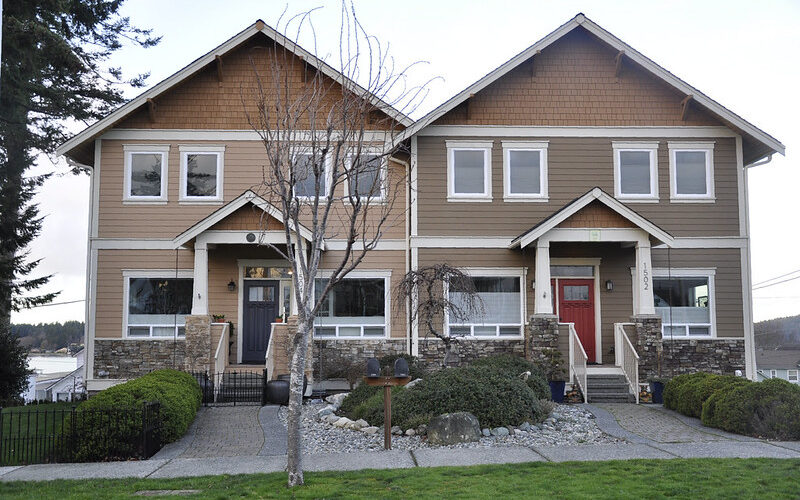
Since the COVID-19 pandemic exacerbated the housing shortage and spiked home prices, public interest has grown in “missing middle” housing, a broad category between detached single-family homes and large apartment buildings. More Americans correctly recognize that such housing is a more affordable way to live in safe, largely single-family residential neighborhoods near desirable public schools and jobs. Such small multifamily housing also has unique potential to create millions of new homes in the United States.
In a 2010 book, architect and urban designer Daniel Parolek popularized the term “missing middle housing”. Housing policy experts most closely associate missing middle with structures of two to ten units, which this analysis focuses on and will refer to as “small multifamily” housing.
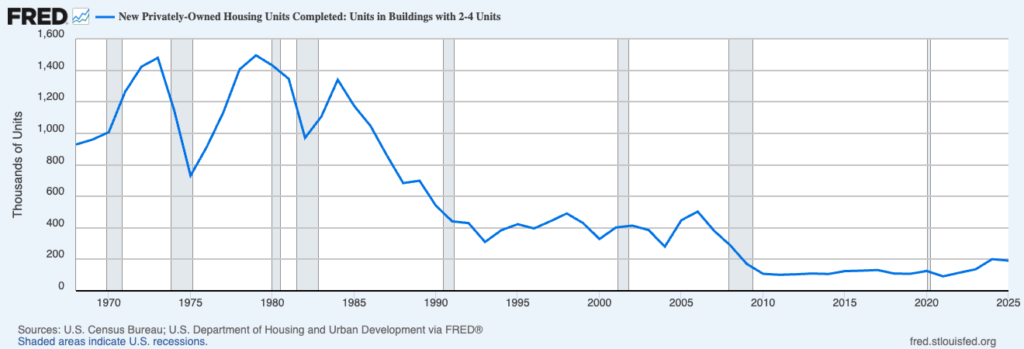
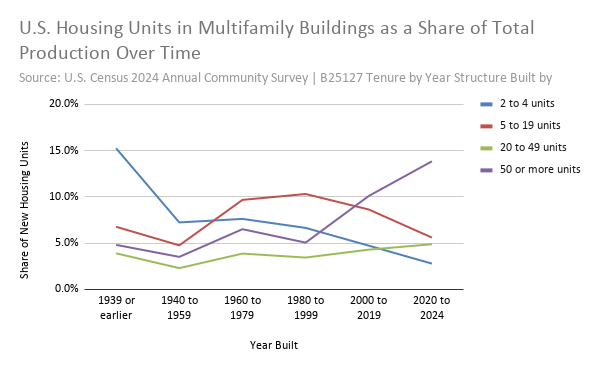
Some missing middle definitions go up to 20 units, but that overlaps with low- and mid-rise apartment buildings, which still constitute a sizable share of U.S. housing production. As the two charts below illustrate, residential structures of two to four units have most dramatically declined since 1939. Yet small multifamily housing is inherently scalable because it fits on millions of small lots in American cities and towns, making it a powerful solution to the housing shortage.
The biggest barriers to small multifamily housing are onerous regulations, which a broad and growing supply-side housing reform movement is working to roll back. Though that effort will take time, California’s boom of accessory dwelling units (ADUs) and the ecosystem of small entrepreneurs powering it illustrate a concrete path to abundant small multifamily housing.
A broad definition of missing middle housing includes ADUs. They may be an addition to an existing home or a backyard cottage, such as a tiny home built offsite. Californians are now developing all of these ADU types at scale, less than a decade after fully legalizing ADUs.
California’s experience is instructive and encouraging because ADUs overcame the same basic obstacles that prevent development of small multifamily buildings: hostile zoning, building code ambiguity, and a dearth of conventional financing.
Why people like living in and around small multifamily housing
Small multifamily housing’s primary value is making homes more affordable by increasing their overall supply and dividing high land costs among multiple households.
Consider a sixplex built in Arlington, Virginia, after a missing middle zoning reform. A three-bedroom unit in the sixplex currently costs roughly $500,000 less than comparable single-family homes, a difference large enough to buy a house in many parts of the country. Moreover, most new detached houses in Arlington are much larger and worth at least $1 million more per unit. New small multifamily units create an alternative to single-family homes that only the wealthiest buyers could consider.
As for increasing supply, small multifamily housing could be developed at enormous scale. Strong Towns chairman and co-founder Andrew Burleson explains that a typical metropolitan area has thousands of lots suitable for denser development—via ADUs or small multifamily structures—while few sites could fit a large multifamily building. Burleson calls this “abundant incrementalism.”
But small multifamily housing’s benefits go beyond compromise between detached single-family homes and large multifamily buildings. Perhaps its greatest strength is physically bringing neighbors together and cultivating strong social and community ties while still providing residents privacy.
Small multifamily housing contributes to welcoming, quiet, calm neighborhoods dense enough for foot traffic to support local businesses. Residents can walk and bike, and children play along peaceful streets. Many such U.S. neighborhoods are turn-of-the-century streetcar suburbs, developed alongside private commuter lines, featuring small lots and diverse housing types, both of which are banned by typical zoning.
A notable type of small multifamily housing is garden apartments, generally two- or three-story residential buildings that feature green space and landscaping. Garden apartments are attractive because they allow for relatively affordable housing that is pleasant and peaceful.
Happily, more Americans will have the opportunity to live in affordable homes as the regulations that limit small multifamily housing fall.
Overcoming regulatory barriers to small multifamily housing
Unlocking small multifamily housing necessarily starts with loosening zoning regulations. As I wrote in FREOPP’s housing primer, a 2019 New York Times analysis found that many American cities restricted most of their land, often 70 percent or 80 percent, to single-family detached homes.
In 2018, Minneapolis drew national attention as the first U.S. city to relax single-family zoning when its city council voted to legalize multiplexes. Many other localities followed suit, allowing multiple homes per lot in single-family zones. However, Minneapolis and these other jurisdictions found that few multiplex projects were proposed, squeezed by remaining zoning rules tied to parameters such as building height and size. But these aspects of zoning are changeable too. State legislatures’ interest in zoning can accelerate those reforms.
Building codes also must be adjusted to accommodate small multifamily housing. The United States follows the International Building Code (IBC) and International Residential Code (IRC), which, respectively, govern commercial and small-scale residential construction. Single-family homes and duplexes fall under the fairly inexpensive IRC, while everything from a small three-unit building to a steel residential skyscraper is subject to the highly complex IBC. This especially burdens small multifamily structures, whose low unit counts limit economies of scale.
Many townhouses are built under a modified IRC, suggesting it could safely apply to buildings of six, eight, or ten units. The Center for Building in North America is leading the charge to study these issues, build public awareness, and secure such building code changes.
Architect Sam Naylor’s report, “Unlocking Small Multifamily Housing through Building Code Reform,” produced in collaboration with the Harvard Joint Center for Housing Studies, provides a wealth of thoughtful recommendations. Naylor concludes that fire protection requirements—such as the design, engineering, construction, and maintenance of commercial-grade sprinkler systems—are often the single largest cost driver for small multifamily projects.
The challenge of financing small multifamily housing
Financing difficulties also impede small multifamily housing development, though they are not nearly as serious as regulatory bans and burdens. Developers often struggle to secure construction loans for small multifamily projects. Local community banks—the traditional source of capital for smaller developments—have been in long-term decline. Additionally, institutional investors like private equity and pension funds typically do not finance projects worth less than about $10 million dollars. Yet the business case for developing small multifamily housing is still strong, attracting new types of investors such as “retail capital,” using online communication campaigns to reach affluent individual investors.
Ultimately, small multifamily housing is more economically efficient and thus profitable than alternatives like large single-family homes because multiple households split the cost of a lot. A sound small multifamily project offers competitive risk-adjusted returns for the equity investors needed to secure loans. The United States still produces around 100,000 to 200,000 duplex, threeplex, and fourplex units annually. The fundamental problem is not that developing small multifamily housing is impossible. Rather, building small multifamily housing has become much more difficult, due mostly to regulation. A developer may have an established relationship with a loan officer or local investor group who trusts them to execute and is comfortable with small multifamily projects, but finding such friendly capital is not a scalable policy option. I previously explained the “missing middle financing gap” in greater detail, explaining why institutional investors finance townhouses and describing the existing sources of capital for small multifamily housing projects.
Underwriting these projects can be complicated by a paucity of comparable properties, but this is a solvable issue in a world of old multiplexes commanding high rents. Demonstrating that this type of lending could be more commoditized, the Federal Housing Administration and other federal lenders offer a standard mortgage to the owner of a building with up to four units if they live in one, a practice called house hacking.
Those who want to revive small multifamily housing will also have to overcome a natural feedback loop of decline: few developers, architects, and builders are familiar with such housing, so less of it is built, perpetuating the status quo. Fortunately, California’s ADU revival shows that cycle can be broken and financing becomes simpler when regulatory reform unlocks a different type of housing.
California’s ADU boom and opportunity abundance
California housing advocates had to pass multiple rounds of state legislation over five years, to go from theoretically permitting ADUs to stamping out various obfuscations by local governments. The results were undeniable: Californians built 101,458 ADUs from 2018 to 2025, with 171,354 ADUs permitted, according to state housing agency data, illustrated below. ADUs constitute a large chunk of housing completed (13.5 percent) and permitted (17.3 percent) statewide in that period.
The sizable gap between ADUs completed and permitted reflects the difficulties many property owners face as novice developers. Even in a tolerant regulatory environment, obtaining upfront financing, sheer cost, and navigating the complexity of the process complicate these one-off projects. These issues would be less applicable or daunting to professional developers of small multifamily housing, were it fully legalized.
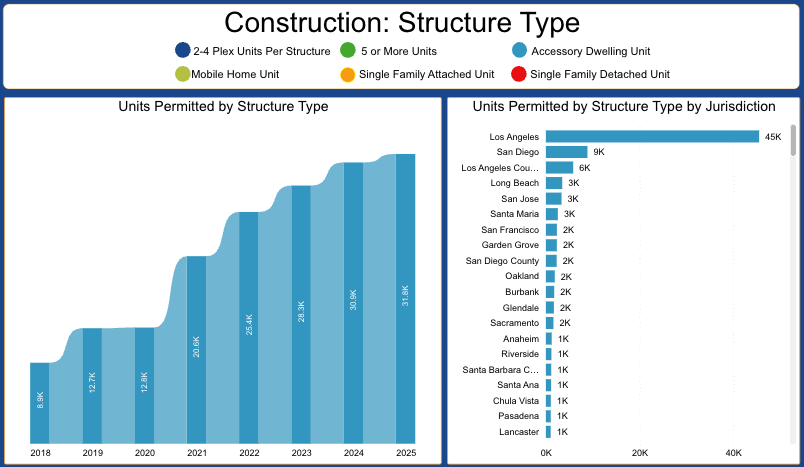
The most intriguing aspect of California’s ADU rush is not the wave of housing itself but rather the emerging ecosystem of developers, builders, and financiers racing to meet pent-up demand. Enterprise real estate data intelligence platform Shovels reported that ADU activity’s 8.6 percent jump in 2025 from the prior year defied a broader housing production plateau in California.
ADUs’ small size, simplicity, and robust market make them a training ground for neighborhood developers and mom-and-pop entrepreneurs—as well as contractors, tradespeople, and other construction labor—to gain experience and build professional networks that will eventually let them level up to larger, more profitable projects. Luxurious single-family homes are an obvious target because they are straightforward to build and priced at a premium, but as regulatory barriers fall, small multifamily housing will be a lucrative opportunity for small developers. These smaller projects will ideally help make real estate development more of a blue-collar profession and source of socioeconomic mobility, as it was a century ago. This path to scaling up small multifamily housing underlines its full potential: Offering an abundance of opportunity not only for the people living in it but also for the people involved in creating it.