


Introduction
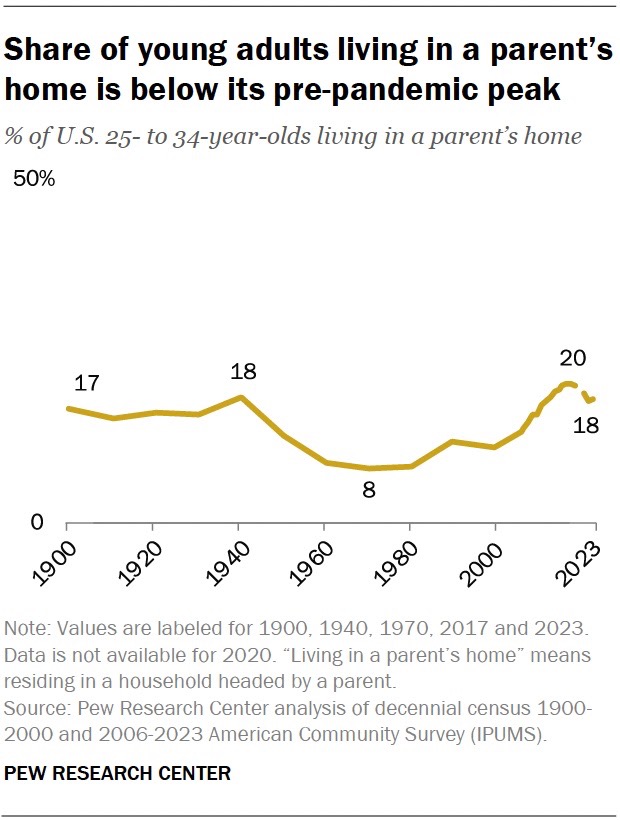
Roughly 18 percent of Americans aged 25 to 34 lived with a parent in 2023, based on Pew Research Center data. A similar share of young adults lived with a parent across the 20th century’s first four decades, when the country was much less prosperous. By midcentury, the proportion fell to a mere eight percent. But in 1980, it began to rise. Maybe coincidentally, a space-age term emerged: “failure to launch.” A growing share of young adults were not striking out on their own. The trend took off around 2000, as did the phrase “stuck at home.”
In the late 1970s and early 1980s, a new housing problem appeared: mass, urban, outdoor homelessness. People sleeping rough may seem to confirm that the poor will always be with us, to paraphrase Jesus’s invocation of Deuteronomy. But this kind of homelessness in America simply did not exist before. There is nothing normal about it. A federal report found that a major contributing cause was “an inadequate supply of affordable housing.”
A household that spends more than 30 percent of its income on housing is formally defined as “cost-burdened,” and as “severely burdened” if it spends more than 50 percent. In 2023, half of renters were cost-burdened, while a grim 27 percent were severely burdened, according to the Harvard Joint Center for Housing Studies’ 2025 State of the Nation’s Housing. “Fully 83 percent of renters earning under $30,000 were cost burdened in the most recent data, including an astounding 67 percent with severe burdens,” the report adds.
Enormous suffering fuels the question: Why is housing so expensive?
This primer examines the nation’s housing shortage and the regulations that created it, after briefly delving into the unforgiving enterprise of real estate development.
Land is an extraordinarily precious resource, yet zoning insists upon inefficient land use. Building codes are tainted by safetyism—extreme demands for safety that may provide little value or even backfire—and special interest capture. Permitting is too often a bureaucratic morass with extractive negotiations layered on top.
The housing shortage is a case study of unfortunate regulatory success, not failure: a ruthlessly effective system doing what it was designed to do.
The housing shortage and unaffordability
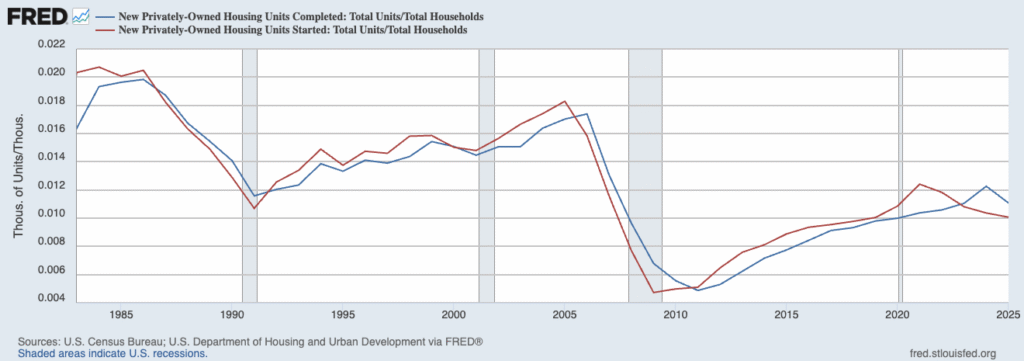
Federal Reserve Economic Data (FRED) clearly show a long-term decline in the number of housing units started and completed in the United States as a proportion of the total number of U.S. households, which is the proper unit of analysis because one home is occupied by one household. From 1980 to 2025, the U.S. population grew by more than 50 percent, yet FRED data also show that far fewer new homes were completed over time.
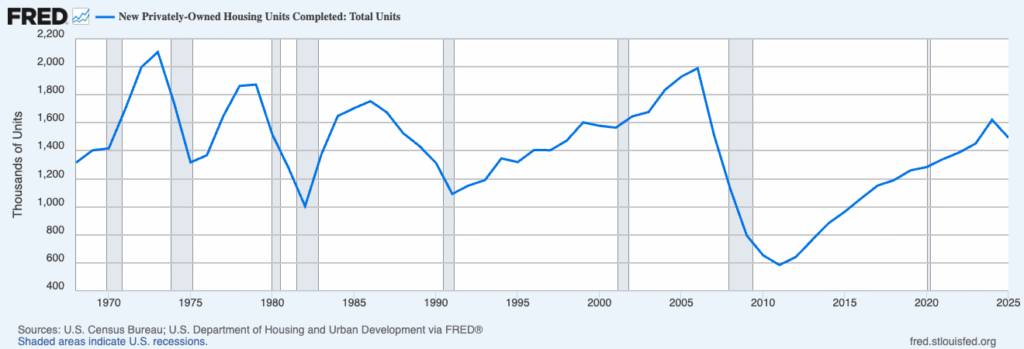
Summarizing annual totals into decades shows fewer homes completed in the 1980s, 1990s, and 2010s than in each prior decade. The 2000s defied that trend, but the 2010s fell off sharply. The 2020s might end up producing more new homes than the 2010s or 1990s, but probably still fewer than the 1970s. These numbers simply do not match U.S. population growth.
Some skeptics assert that Americans’ high incomes are more than a match for housing costs, citing the relatively weak purchasing power of homebuyers in many other countries. That is technically correct, but U.S. housing prices have grown much faster than incomes in recent decades. Visualizing this growth reveals how our all too real housing affordability crisis unfolded.
Harvard’s Joint Center for Housing Studies (JCHS) has a fascinating map showing that median housing prices soared relative to median incomes. A price-to-income ratio of three to five is generally considered reasonable. In 1980, only coastal California metro areas exceeded the 5x benchmark: the San Francisco Bay Area, Los Angeles, and San Diego. Retirees skewed the ratios in Naples, Florida, and Santa Fe, New Mexico.
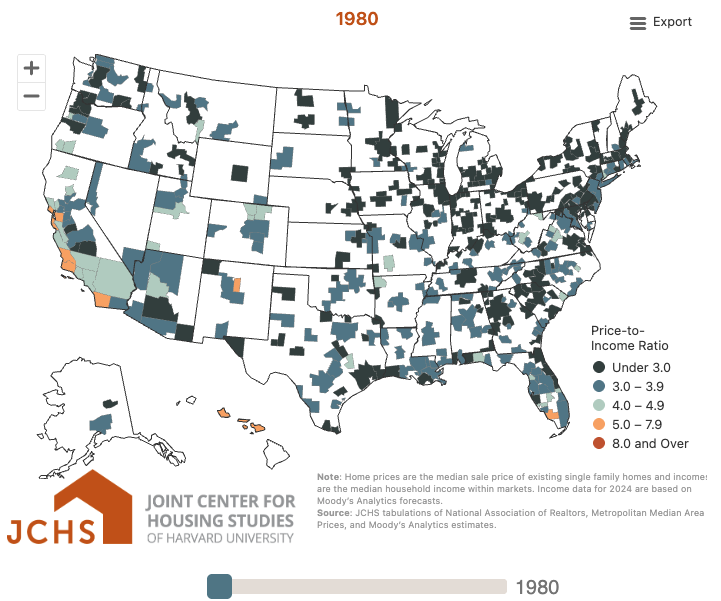
In the 21st century, the affordability crisis spread throughout the West and emerged on the East Coast.
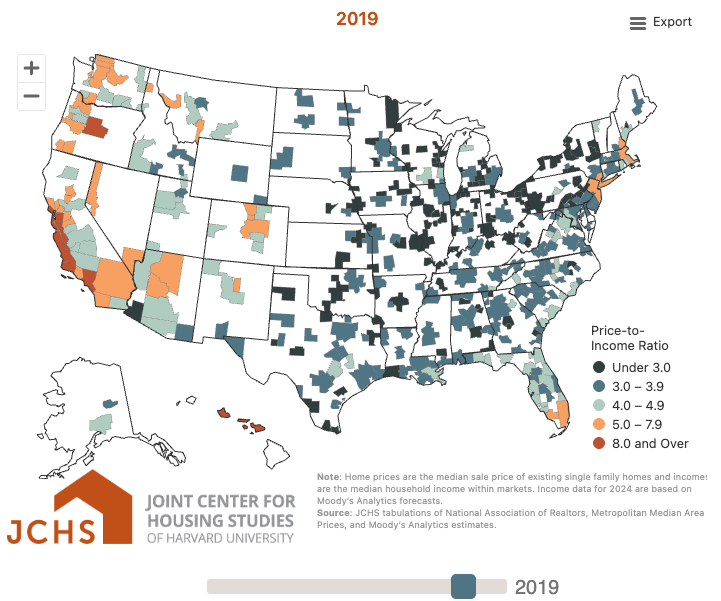
The pandemic pushed virtually all meaningfully populated areas to a ratio of four or more.
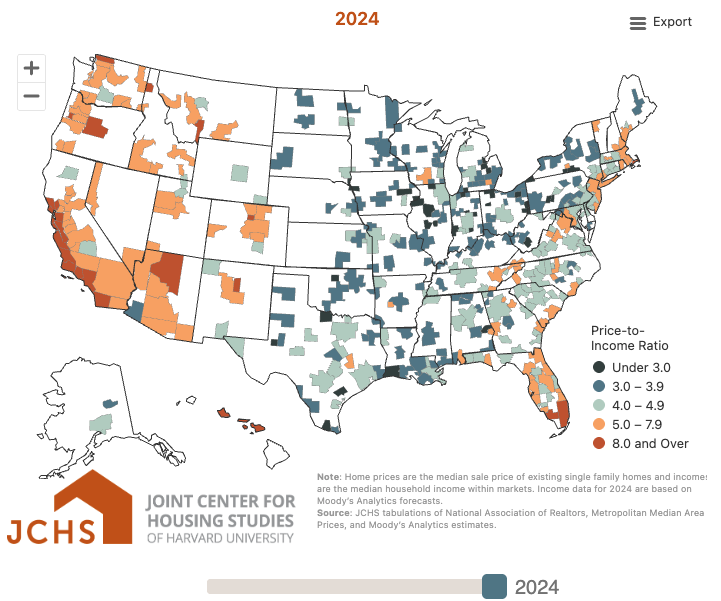
Mercatus Center senior research fellow and Urbanity Project director Salim Furth observes that the pandemic triggered a demand shock as residents of large cities moved to cheaper or larger housing, often in different metro areas. Despite dense urban centers’ post-pandemic recovery, the end result has been a significant redistribution of population away from places like California and New York City to even minimally appealing parts of the country, from isolated Mountain West amenity towns to second and third-tier cities.
The pandemic shock also left far fewer parts of the country with home price-to-income ratios of less than three (dark blue on the JCHS map), devastating low-income Americans’ budgets.
Although not entirely immune to the effects of COVID-19, Texas’s housing market is a success story worth highlighting. Houston and metropolitan Dallas are rapidly populating economic powerhouses that have dampened housing costs by adding many new homes.
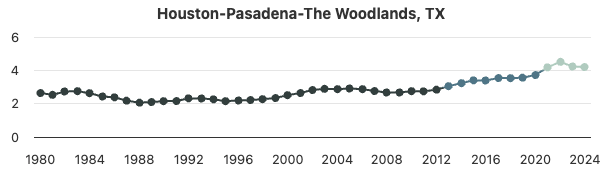
Both areas, but especially Houston, built more housing after the financial crisis than other large Sunbelt metros, including Atlanta and Phoenix. This is evident below in the comparison of new single-family detached homes and semidetached townhouses permitted per capita in each metropolitan statistical area.
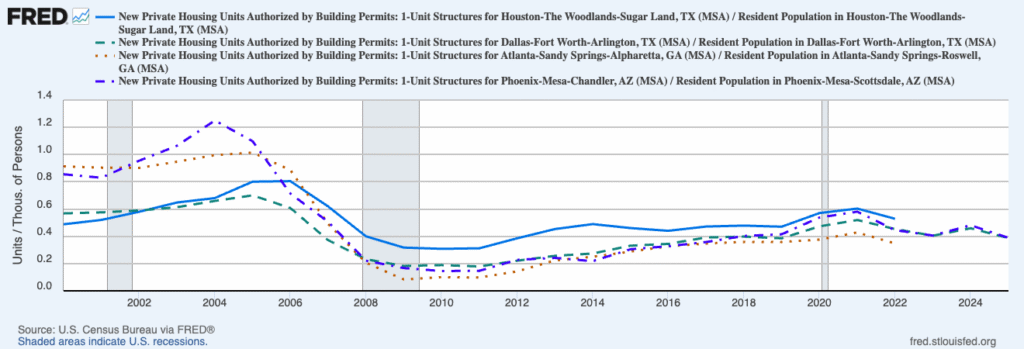
The difference was policy. Houston’s 1998 reform to allow houses on much smaller lots fueled a wave of new construction, leading the city to expand the regulatory change to a wider area in 2013. Meanwhile, ambitious cities like Plano and Frisco in the Dallas suburbs embraced population growth as an economic engine, as Freakonomics Radio explained in a colorful two–part episode.
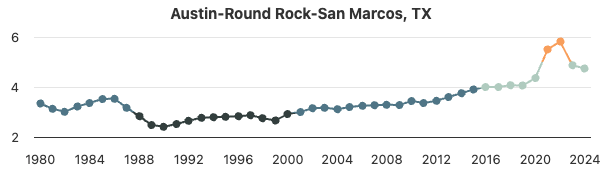
Austin was becoming a cautionary tale in the 2010s, as its population exploded and housing prices spiked. But a recent home construction boom pushed prices down. Similar to Dallas, Austin’s suburbs had fewer roadblocks to home construction and have enjoyed the bulk of that region’s population growth, according to local journalist and housing advocate Ryan Puzycki.
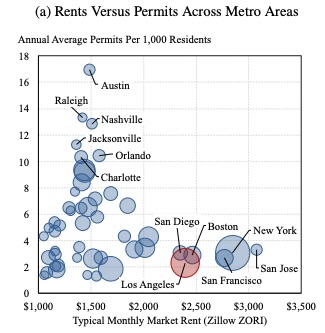
Real-world evidence demonstrates that building more housing reduces prices in a local market. How many building permits a city issues is clearly correlated with the typical monthly market rent in the scatterplot below from the February 2026 paper, “How Costly Is Permitting in Housing Development?” by economists Evan Soltas and Jonathan Gruber.
Development is hard and making it harder hurts consumers
Housing regulations’ negative effects are more tangible if we consider the inherent challenges of real estate development. These challenges are little-known to people outside of the industry, including a surprising number of city planners and elected officials who closely interact with developers, as well as housing activists and advocates. The extra costs that developers incur flow to renters and homebuyers, directly as higher prices or lower quality, or indirectly as fewer housing units, worsening the shortage.
Development is expensive. A project’s pro forma—or financial model—has a profit margin that is often thin and always delicate. Regulatory costs, both routine and unforeseen, translate into more expensive, less plentiful housing. A competent developer does copious legwork and due diligence, ensures their assumptions are conservative, and budgets for contingencies. But development is inherently risky, and projects go sideways for any number of unpredictable reasons. A failed project can wipe out a developer, especially a small operator making a personal guarantee to investors.
Timing the market is critical. Partially because development has long lead times, regional and local real estate markets go through boom and bust cycles. The housing production charts above also show national booms and busts. Many developers and builders left the industry in the aftermath of the 2008 financial crisis.
Zoning requires large, expensive lots and directly drives the housing shortage
Zoning—the all-encompassing term for various land use regulations—is surprisingly interesting and less complicated than is generally assumed. The genesis of the zoning system clarifies its internal logic and how it operates today.
In his 2025 book Stuck, journalist and historian Yoni Appelbaum traces zoning’s origins to late 19th-century California, where cities wished to isolate Chinese laundromats and immigrants. The book deftly chronicles the rise and fall of Americans’ spatial and socioeconomic mobility.
Zoning’s big break came in 1910s New York City. A commercial real estate bust allowed garment makers to set up shop along Fifth Avenue. Jewish and Italian garment workers became fixtures on the posh promenade’s sidewalks. Distressed that their well-to-do clients were being exposed to what they viewed as undesirables, particularly Eastern European Jews, predominantly WASP business leaders in 1916 adopted zoning to keep workers’ factories and apartment buildings out of respectable commercial and residential areas.
The architects of this stratagem knew it was vulnerable to constitutional challenges, Appelbaum documents, so they pushed federal authorities to embrace zoning and entrench it nationwide. In the 1920s, the consummate Progressive Era administrator and U.S. Commerce Secretary Herbert Hoover convinced more than a dozen states to adopt a Standard State Zoning Enabling Act, paving the way for ubiquitous local zoning regimes.
According to the American Planning Association, zoning is “a set of rules that defines what each land parcel could or should be used for (such as housing, manufacturing, or open space).” Zoning can be understood in terms of the policy problem at issue: how people can afford housing in cities and towns where they want to live with ready access to good jobs and other opportunities. The American constitutional system grants the states police powers, including the power to regulate land use, which states have broadly delegated to local government. This regulation takes the form of zoning, which creates districts where land is restricted to a single use. The uses relevant here are residential, commercial (office and retail), and industrial (with health and safety risks).
Zoning is often justified as separating noxious industrial land uses from residential areas, but there are other legal frameworks to achieve this common-sense outcome. Zoning’s real innovation was to separate and homogenize the places where people live and work. The commute across town from home to office and back is largely a result of single-use zoning. So too is barring a family from opening a business on the first floor of their home, which discourages the kind of working-class striving that rankles well-bred, upstanding citizens. Segregating residents by class, ethnicity, and race was zoning’s overt purpose from inception to nationwide adoption.
Residential districts comprise a litany of rules and regulations that give zoning awesome power over daily life. They also exclude people from opportunity. Below is a fairly comprehensive list of zoning regs, which we will analyze in terms of their effect on land use:
- Number of residential units permitted on a single lot
- Minimum lot sizes
- Front and side setbacks (how close a structure may be to each property boundary)
- Lot coverage (proportion of lot that can be covered by impervious surface)
- Floor-to-area ratios (FAR; a structure’s floor space versus the area of the lot it sits on)
- Height limits
- Massing (general shape and size of a structure)
- Minimum parking requirements
An influential 2019 New York Times analysis found that many American cities restricted most of their land, often 70 percent or 80 percent, to single-family detached homes. This is the most expensive type of housing, a feature not a bug in a system designed to reserve most urban land for affluent and middle-class residents. Low-income city residents are excluded entirely or pushed to limited districts of multifamily housing in undesirable locations, often near noxious land uses.
Zoning’s defining feature is restricting multifamily housing. There is a strong case for allowing much more of it, including rowhouses (also called townhouses). But for simplicity, we will focus on how zoning bans small, detached single-family houses: the classic American starter home.
Many small homes in the United States were built decades ago and “grandfathered in” to local regulations. San Francisco is among the densest U.S. cities, yet 54 percent of San Francisco’s housing units—including rowhouses and individual apartments—are in structures that would be illegal to build under current zoning. Zoning is not designed to meet demand. And, as a result, San Francisco is horrifically expensive, a housing bust amid an economic supernova.
Many U.S. cities have old neighborhoods with modest dwellings that were, at historical valuations, starter homes. They sit on lots smaller than what current zoning allows. Such undersized or irregularly shaped lots are termed nonconforming or “defective.” Mercatus housing scholar Charles Gardner found that about 20 percent of U.S. municipalities had adopted minimum lot sizes by 1940. An additional 59 percent did so by 1970, for three broad reasons.
First, as babies boomed, cities sought to restrict starter homes that would attract families with children who would consume local public school budgets. Second, localities believed that large lots would accommodate septic tanks, letting them avoid the cost of providing new sewage connections, which is no longer a concern.
As for the third factor, Gardner writes: “The timing of the adoption of lot size minimums in non-southern American cities and their suburbs is correlated with the arrival of black Americans into those cities during the so-called Second Great Migration and with school desegregation.”
Skeptical readers might object that these historical examinations—and the solidifying consensus that zoning is a destructive policy—seek out and selectively emphasize racial or class prejudice. But the Supreme Court opinion that ensconced local zoning power dripped with contempt for working people and their children. In the 1926 Euclid v. Ambler Realty decision, the Court affirmed:
[V]ery often the apartment house is a mere parasite, constructed in order to take advantage of the open spaces and attractive surroundings created by the residential character of the district. Moreover, the coming of one apartment house is followed by others, interfering by their height and bulk with the free circulation of air and monopolizing the rays of the sun which otherwise would fall upon the smaller homes, and bringing, as their necessary accompaniments, the disturbing noises incident to increased traffic and business, and the occupation, by means of moving and parked automobiles, of larger portions of the streets, thus detracting from their safety and depriving children of the privilege of quiet and open spaces for play, enjoyed by those in more favored localities-until, finally, the residential character of the neighborhood and its desirability as a place of detached residences are utterly destroyed.
Since this case, single-use zoning has been called Euclidean zoning. As overtly racial land use regulations, such as Baltimore’s explicitly anti-black zoning, were ruled unconstitutional in the early 20th century, private actors adopted deed restrictions containing racial covenants that typically barred the sale of a property to black buyers and “any person not of the caucasian race.” Covenants also often targeted Jews and persons of Asian descent, among others. Only in 1948 did the Supreme Court rule racial covenants unenforceable. Deed restrictions often forbade working-class vulgarities such as placing more than one residential unit on a lot or the operation of a home business, though servants were allowed.
Zoning limits what can be built on the large lots it requires. Front setbacks prevent homes from being close to the street, lest persons inside and outside run the risk of comfortably interacting with each other. Side setbacks are also enforced in the name of privacy, with the side effect of limiting how many homes can be in a neighborhood. Requiring large lots pushes developers to build larger homes, but lot coverage maximums, FAR, height limits, and massing rules restrict homes’ maximum size, further distorting the market and artificially spreading out development.
This tour of zoning ends with minimum parking requirements, a half-baked central planning scheme. Essentially, local government parking mandates add enormous cost to all kinds of housing, translating into fewer homes built and higher rents and home prices. Dozens of municipalities, states, and entire countries have given private actors the flexibility to determine how much parking they need and realized huge benefits, from new housing construction to more efficient land use. The solution to scarce public pricing is a simple pricing or permitting regime, not forcing renters and homebuyers to pay for unused off-street parking.
The building code is warped by safetyism
Much as zoning regulates land use, the building code regulates how structures are designed and built. The big takeaway from the 2025 YIMBYtown national housing advocacy conference was that the building code is the next frontier for reform. Housing scholars, including at FREOPP, are only beginning to delve into the issue but learning quickly.
While most of the world follows other standards, the United States obeys the confusingly named International Code Council (ICC), a private nonprofit. The ICC oversees the International Building Code (IBC) and International Residential Code (IRC) which, respectively, govern commercial and small-scale residential construction. Lacking scrutiny from an oblivious public, the ICC code development process is prone to influence by insiders and industry groups. Many ICC standards are grounded in empirical evidence and engineering. But many others are not, as outlined below. ICC codes contain unnecessary requirements that add up to make housing much more difficult to build. That means fewer, more expensive homes for renters and homebuyers.
Single-family homes and duplexes fall under the fairly inexpensive IRC, while everything from a small three-unit building to a steel residential skyscraper is subject to the highly complex IBC, which adds cost with features such as mandatory commercial-grade sprinklers. Yet townhouses, which share side walls, essentially fall under the IRC. Local governments also vary in how they apply building codes, for example, to townhouses. The building code’s arbitrary distinctions and inconsistent local administration prevent developers from finding economies of scale and cutting costs; the same is true of permitting.
A 2025 paper by Memphis Chief of Development and Infrastructure John Zeanah examines how IBC requirements, relative to the IRC, burden small-scale multifamily. Excessive requirements he identified include architectural drawing complexity, fire safety, stormwater regulations, and utility connections, plus accessibility rules that kick in for buildings with only four units. In a presentation of his research, he estimated that requiring small multifamily buildings to follow the IBC instead of the IRC adds about 30 percent of additional cost per unit.
How many units per building should be allowed under the residential code is not obvious, but the answer is probably more than two, given that many townhouses are built under the IRC. In the presentation, Zeanah said he found ample ambiguity in the regulatory distinctions between a cluster of four townhouses subject to the IRC and a four-unit multiplex subject to the IBC.
Fire safety and elevators starkly illuminate U.S. building codes’ systemic flaws
Firefighters advocate for the ICC to increase safety standards. This crusade is deeply personal for men and women who risk their lives and have witnessed life lost to fire. However well-intentioned, their demands do not always hold up to cost-benefit analysis. A difficult dynamic in the building code is that ostensibly benign fire safety or energy efficiency standards, to the extent they make development more difficult and contribute to the housing shortage, leave many low-income Americans living in outdated structures that are much more dangerous and less efficient than reasonably up-to-date buildings. Lead paint was only banned in 1978.
The good news is that multifamily housing built in the previous quarter-century is incredibly well-protected from fire. A landmark report by the Pew Charitable Trusts found that fire deaths are significantly rarer in multifamily housing constructed since 2000 than in single-family and older multifamily housing. “Additional safety measures, such as self-closing doors, fire-safe materials, and sprinklers have been adopted widely,” Pew explains. In 2023, modern multifamily had a fire death rate of only 1.2 per one million residents, compared with 7.7 in pre-2000 multifamily and 7.6 in single-family homes. Although modern multifamily is more than six times safer, only about 6 percent of Americans live in it, while 15 percent live in older multifamily. Meanwhile, 80 percent of Americans live in single-family homes. This ratio fits what we have seen about local zoning, and indicates that few Americans merely have the option to live in the safest type of housing. Large multifamily buildings are built to a high standard that also protects their occupants from natural disasters. A great benefit of building much more housing would be letting millions of Americans leave subpar living conditions. Idealized safety standards have become counterproductive.
Housing professionals are uniquely excited by the potential of single-staircase apartment buildings. Most U.S. states limit residential buildings with one point of egress to three stories. Increasing that limit to six stories, in tandem with common-sense fire safety requirements, would open a sea of small or irregularly shaped lots to the development of many new homes. Single-staircase buildings can have creative layouts and features. Every apartment or condo in a single-stair building can be a corner unit, for example, unlike buildings with two elevator shafts connected by a long hallway. However, single-stair reform would largely fall flat if policymakers do not fix standards that make U.S. elevators outrageously, unnecessarily expensive.
Stephen Smith leads the Center for Building in North America, which published Zeanah’s paper and is spearheading building code reform. Speaking at YIMBYtown 2025, Smith explained that elevators are at least three times more expensive in the U.S. than in Western Europe, including advanced economies like Switzerland, for three reasons:
- U.S. accessibility requirements mandate that elevators are large enough to fit a full-sized ambulance stretcher or to allow a person in a wheelchair to enter and turn around, rather than just rolling in and out. Meanwhile, socially progressive Europeans use small elevators.
- U.S. labor union rules mandate assembly on-site, rather than in a factory, which would be much more efficient. Manufacturers sometimes put pilot holes in certain components, but a union member in the field must drill the final hole, adding cost and reducing quality control.
- The U.S. has unique technical standards for elevator parts that yield a smaller supply chain for elevator parts separate from the rest of the world, making them more expensive.
Increasing transparency does not always produce serious policymaking or good outcomes for the general public. But when the starting point is near zero, as in the case of the building code and the special interests around it, sunlight hopefully will do more good than harm.
Permitting is “in the gray”
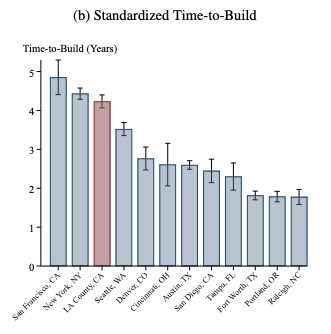
Permitting is the administrative process that developers must complete to gain permission to break ground and construct a building. Soltas and Gruber, the economists who developed the scatterplot above, calculated that developers are willing to pay an eye-popping 50 percent more for pre-approved land in Los Angeles, which has a notoriously slow and dysfunctional permitting regime. As the next chart from Soltas and Gruber’s paper illustrates, cities vary widely in how quickly they allow housing to be built. Executing a project in two years versus four or five dramatically alters a project’s budget and risk profile, even though developers’ and financiers’ expectations and planning account for the local regulatory environment.
Permitting’s maladies are difficult to concisely describe. As a rule, local governments’ staff resources are constrained, creating waiting periods and backlogs. City planners must balance day-to-day administration with long-term studies and requests from elected officials. With that understood, permitting is also an example of extreme bureaucratic indifference and malice. It is highly discretionary and subjective, adding costs that ultimately fall on renters and homebuyers.
Buy a developer a beer, and the most colorful troubles they share will probably be about permitting and Kafkaesque planning office behavior. The developer quotes below about project design review, from the Mercatus scholar Salim Furth’s recent report on permitting in Arizona, summarize the problems with permitting exceptionally well.
- “I’ve seen [local planning office] staff hold developers up on architectural and design questions that aren’t requirements, just their personal preferences. The planning commission is better because they follow regulations and do a technical review.”
- “All of it’s in the gray. There’s almost nothing written down.”
- “I have a famous example that I always use: Builder submits their roof tile schedule. Planner says, ‘No, I don’t like that.’ They submit another one. They submit a third. They submit a fourth. Finally, the builder gets frustrated and resends the original one that got denied. Planner says, ‘That’s it. I love it. Let’s do that one.’”
Note that Arizona builds housing in some meaningful quantity. If permitting there is a labyrinth, permitting in progressive coastal states is a dungeon that projects must break out of.
A developer may need to coordinate with inspectors from multiple local departments, often only one at a time. Cities regularly leave developers twisting in the wind for days, weeks, or months. Delays are costly in an industry where time is risk.
Impact fees are vulnerable to abuse
In theory, local government levies impact fees to cover the marginal fiscal costs associated with new development, such as infrastructure improvements. In such cases, fees are eminently reasonable and may even prevent a situation where development creates financial strain that animates political resistance to population growth and new housing. However, impact fees are too often a venue for extractive, zero-sum negotiations that add unnecessary cost to housing.
Impact fees commonly include payment into a local affordable housing trust fund. This application implies that new development makes housing more expensive. But the opposite is true due to a phenomenon called vacancy chains: expensive (i.e., most) new housing attracts residents who vacate less expensive housing, reducing upward pressure on its price. Conversely, it is easy to imagine how demolishing expensive housing would leave its wealthy former residents to bid up housing prices overall. Affluent people move into undesirable, unsafe neighborhoods for the same basic reason that poor people cannot move out: a lack of alternatives.
Fees on new development might fund a new park or new infrastructure beyond the project’s scope, not for a sound policy reason, but rather because the local planning office has leverage, not unlike a racket. A developer can turn down a request but risks retaliation, such as foot-dragging or denial of some niche application. The big losers are consumers, who must pay to cover extraneous fees or are simply deprived of housing because projects are scaled back.
Life, liberty, and the pursuit of happiness
The broad consensus among housing reform advocates is that after a century of overt exclusion and mounting scarcity, local control over housing policy should end. Housing and job markets are regional. State governments should reclaim their constitutionally vested land use power.
State elected officials should dramatically loosen or eventually eliminate zoning. Building codes should be simplified and consistently grounded in empirical evidence. And permitting should be rule-based rather than discretionary and subjective.
Local control has yielded spiritually corrosive parochialism. Housing regulations seem to presume that neighbors, children, and human existence itself are not affirmative goods.
At FREOPP, we believe in the Americans who keep our country going and make daily life possible. We know that they recognize life’s inherent goodness, in a way people unaccustomed to struggle may not. Clearing the barriers to abundant housing will give Americans the freedom to move to places of opportunity, across town or across the country. In turn, new neighbors will naturally reach out to each other and build tight communities.
Though treacherous and contested, the tangible prospect of abundant housing renews our hope as American patriots for a bright future of broadly shared prosperity and mutual embrace.
Acknowledgements: The author is grateful to Mercatus Center senior research fellow and Urbanity Project director Emily Hamilton for her technical corrections and thoughtful feedback.