



This article is an excerpt from FREOPP’s policy handbook, “Affording the American Dream.”
Policymakers should:
- Repeal trade laws that empower the executive branch to restrict trade without congressional approval.
- Reduce or eliminate tariffs on all imported products except where national security is directly implicated.
Bringing down the cost of living will be a complex process that will not be accomplished overnight. But one thing that policymakers can do that will have a swift impact would be to stop making the problem worse. Policies that make goods and services more expensive should be subject to intense scrutiny and tariffs should be at the top of the list.
Start with the basics: A tariff is a tax. Worse, it is a highly regressive tax that falls hardest on those who can least afford it: low-income Americans.
Economists debate precisely how much of this tax falls on consumers versus domestic importers and foreign exporters. Legally, any American tariff is paid by U.S. importers. However, the bulk of those costs are passed down the supply chain until they reach consumers at the retail level.
Even worse, price increases aren’t confined to the tariffed products. Domestic producers, protected from competition by lower-cost foreign competitors, have more leeway to increase their prices. For example, during President Trump’s first term, when the United States slapped 20-50 percent tariffs on imported washing machines like LG and Samsung, American producer Whirlpool hiked its washer prices by 12 percent.
And, as price hikes work their way through the supply chain, even products produced downstream from the original tax payment have their costs and thus prices rise as well.
The true costs of this administration’s tariffs to any particular American family are difficult to calculate because the tariffs keep changing. Some have been struck down by courts but then were replaced by new tariffs with different rationales that trigger a new round of legal challenges. Others are imposed and dropped, raised or lowered at the president’s whim, despite the Congressional authority to impose taxes and tariffs.
Since it can take as long as seven months for the increased costs of tariffs to affect retail prices, the tariff may have been raised, lowered, or eliminated before consumers feel the full impact. Roughly $100 billion in illegally imposed tariffs was refunded to importers following the Supreme Court’s decision in Learning Resources Inc. v. Trump, but very little of that sum has been used for consumer relief.
The Tax Foundation estimates that in 2025, the Trump tariffs amounted to an average tax increase of $1,000 per U.S. household. Other studies have put the per-family cost in 2025 even higher, perhaps as much as $1,700 per household. And, even with the Supreme Court striking down most “Liberation Day” tariffs, the average U.S. household will pay another $900 in 2026.
Tariff-induced increases in the cost of living likely harmed low-income and working-class Americans the most. Because tariffs are effectively a tax on consumption, and lower-income families devote a greater share of their income to consumption, the tax costs them the most in relative terms. In addition, tariffs are more likely to be imposed on lower-end goods and necessities—and at higher rates—than they are on luxury goods. For example, basic canvas sneakers or low-cost synthetic shoes face tariffs as high as 67 percent, while high-end, all-leather luxury shoes often are tariffed at 8.5 percent or less.
Even modest price increases caused by tariffs can add up quickly over time for low-income workers, significantly eroding purchasing power compared to those who have more of a financial cushion. And, with limited savings or other resources to fall back on, low-income workers must often resort to credit to cover increasing prices, where they face high interest rates and other costs.
Looking at how the tariffs affected specific sectors provides additional evidence of how much tariffs raise the cost of living.
Groceries: The U.S. imports roughly $220 billion in food products each year. After various exemptions and exclusions, roughly half of these imports remain subject to tariffs. The Yale Budget Lab estimated that tariffs have driven up overall grocery costs by 1.6 to 2.8 percent. Seafood, beef, fruit, coffee, wine, nuts, rice, cheese, and chocolate likely saw even bigger price rises. Nor is it easy for consumers to avoid tariff-induced price rises by switching to domestically produced equivalents. Many agricultural staples—pineapples or bananas, for instance—simply cannot be widely grown in the United States. Tariffs on foodstuffs hit low-income Americans particularly hard, as they already spend one-third of their pre-tax income on food.
Housing: Although most of the blame for high housing costs comes from zoning regulations, tariffs play a role as well. Softwood lumber, used for framing, and imported mostly from Canada, have been subject to some of the Trump administration’s highest tariffs. Indeed, lumber prices have hit a four-year high. Copper and steel—necessary for plumbing and wiring, among other things—are heavily tariffed as well. Even gypsum, a component of drywall, is included in Trump’s tariff regime. All together, the National Association of Home Builders estimates that tariffs add $10,000–$17,500 to the cost of a new home.
Durable goods: Home appliances, consumer electronics, and furniture by the Trump administration’s tariffs. Estimates of how much tariffs raised prices vary significantly from product to product but have generally been put between 4 and 15 percent. Policymakers should understand that, when Vice President J.D. Vance contemptuously says, “a million cheap, knockoff toasters aren’t worth the price of a single American manufacturing job,” he ignores that many Americans cannot afford more expensive toasters.
Automobiles: Tariffs add roughly $1,600 to $2,000 to the cost of a U.S. assembled vehicle, and as much as $6,000 to 9,000 to an import. Many automakers have discontinued smaller, less expensive models altogether because of tariffs. Replacement parts are likewise subject to the tariffs, raising the cost of auto repairs thus increasing auto insurance premiums. Americans are therefore left with fewer less-expensive vehicle options, meaning they either have to pay more or forgo buying a car.
Pharmaceuticals: According to a study by the Federal Reserve Bank of St. Louis, non-generic prescription drugs were subject to more than a four percent price increase, one of the highest tariff-induced price increases. Tariffs put health-improving and other necessary medications further out of reach for more Americans. That needless suffering likely to get worse since the Trump administration has announced that it will impose 100 percent tariffs on generic drugs starting in 2028. Analysts warn that this could cost an average family around $600 per year in additional costs. The tariffs could result in shortages of some critical drugs.
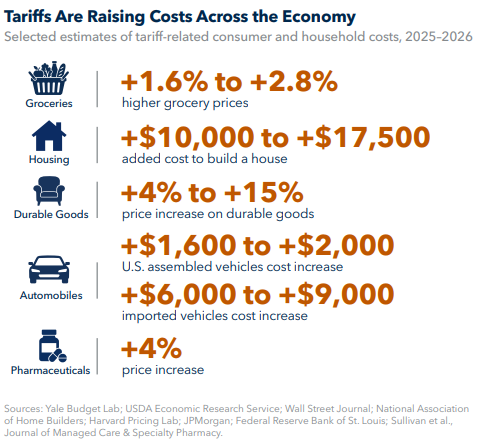
All told, tariffs are having particularly damaging effects on the cost of living for those whose family budgets have little or no wiggle room.
If tariff costs were offset by increased employment and higher wages, perhaps they would make more economic sense, but they simply do not. In the months following the announcement of Trump’s “Liberation Day” tariffs, which were meant to support American factories, the U.S. lost 90,000 manufacturing jobs. Nominal wage growth for private sector workers generally—and manufacturing workers specifically—declined in the aftermath of tariff announcements. Overall, analysts believe that the Trump tariffs have reduced U.S. GDP by 0.4 percent or nearly $130 billion.
Nor have tariffs raised anywhere near the amount of revenue expected or claimed by President Trump. The president has promised that tariff revenue would fund everything from payments to farmers to consumer rebates to the elimination of the federal income tax. The tariffs brought in just $264 billion in revenue in 2025. Much of that is now being refunded to importers in the wake of the Supreme Court’s decision.
There are many reasons why tariffs and other trade restrictions are generally a bad idea: they can reduce economic growth, disrupt relations with American allies, and make domestic producers less innovative, less efficient, and less competitive. But tariffs are particularly painful for lower-income Americans who are struggling with the already high cost of living.
Of course, policymakers should keep in mind that the benefits of freer trade are not equally distributed, with some workers and industries inevitably paying a price for goods bought elsewhere. Policymakers should help affected workers when necessary, with workforce development programs and other support to get them back on their feet. Even so, policymakers concerned with the cost of living should take immediate steps to reduce or eliminate most tariffs in order to reduce prices, expand jobs, and increase economic growth.
Endnotes
- Ann Swanson and Brad Plumer, “Trump Slaps Steep Tariffs on Washing Machines and Solar Products,” New York Times, Jan 22, 2018, https://www.nytimes.com/2018/01/22/business/trump-tariffs-washing-machines-solar-panels.html.
- Kelsey Dallas, “Tariff Refund Reaches $100 Billion Mark,” SCOTUSblog, August 6, 2026, https://www.scotusblog.com/2026/08/tariff-refunds-reach-100-billion-mark/.
- Joint Economic Committee Minority, “American Families Have Paid More Than $1,700 Each in Tariff Costs Since Trump Entered Office,” February 2026, https://www.jec.senate.gov/public/_cache/files/7cc03e65-d40a-465f-9e88-09dd53d3502f/jec-fact-sheet-on-cost-of-tariffs-for-families-update.pdf.
- Miguel Acosta and Lydia Cox, “The Regressive Nature of the U.S. Tariff Code: Origins and Implications,” Cato Institute, September 8, 2022, https://www.cato.org/research-briefs-economic-policy/regressive-nature-us-tariff-code.
- Yale University Budget Lab, “Where We Stand: The Fiscal, Economic, and Distributive Effects of All U.S. Tariffs Enacted in 2025 Through April 2.” April 2, 2025, https://budgetlab.yale.edu/research/where-we-stand-fiscal-economic-and-distributional-effects-all-us-tariffs-enacted-2025-through-april.
- U.S. Department of Agriculture, Economic Research Service, “Food Prices and Spending.” Updated June 1, 2026, https://www.ers.usda.gov/data-products/ag-and-food-statistics-charting-the-essentials/food-prices-and-spending
- Ryan Dezember, “Home Building is Sputtering, but Lumber Prices Haven’t Been So High in Years,” Wall Street Journal, August 5, 2026, https://www.wsj.com/finance/commodities-futures/home-building-is-sputtering-but-lumber-prices-havent-been-so-high-in-years-a2ef1cf2?mod.
- “How Tariffs Impact the Home Building Industry,” National Association of Home Builders, 2026, https://www.nahb.org/advocacy/top-priorities/building-materials-trade-policy/how-tariffs-impact-home-building.
- Alberto Cavallo, et al. “Tracking the Short-Run Impact of U.S. Tariffs.” Harvard Business School Pricing Lab, January 30, 2026, https://www.pricinglab.org/files/TrackingTariffs_Cavallo_Llamas_Vazquez.pdf.
- Jose Asumendi, “Who Will Pay the Price for U.S. Auto Tariffs?” JPMorgan, September 25, 2025. JPMorgan article https://www.jpmorgan.com/insights/global-research/autos/auto-tariffs.
- Maximiliano Dvorkin et al., “How Tariffs are Affecting Prices in 2025,” Federal Reserve Bank of St. Louis, On the Economy Blog, October 16, 2025. https://www.stlouisfed.org/on-the-economy/2025/oct/how-tariffs-are-affecting-prices-2025.
- Sean Sullivan et al., “The Consequences of Pharmaceutical Tariffs in the United States,” Journal of Managed Care & Specialty Pharmacy, Vol.31, No.6 https://doi.org/10.18553/jmcp.2025.25090.
- Ryan Mulholland and Kennedy Andara, “One Year After Liberation Day, American Workers are Feeling the Negative Effects of the Trump Administration’s Tariffs,” Center for American Progress, March 17, 2026, https://www.americanprogress.org/article/one-year-after-liberation-day-american-workers-are-feeling-the-negative-effects-of-the-trump-administrations-tariffs/.
- Ibid.
- Erica York and Alex Durante, “Tracking the Impact of the Trump Tariffs.” Tax Foundation, September 2, 2026, https://taxfoundation.org/research/federal-tax/trump-tariffs-trade-war/.
- Rachel Snyderman and Andrew Lautz, Caleb Quakenbush, Aaron Till, and Upamanyu Lahiri, “How Much Are U.S. Tariffs Raising in Revenue?” Bipartisan Policy Center, May 2026. https://bipartisanpolicy.org/explainer/tariff-tracker/.