



This article is an excerpt from FREOPP’s policy handbook, “Affording the American Dream.”
Policymakers should:
- Offer Americans access to universal—and universally affordable—coverage for today while remaining fiscally sustainable for future generations.
- Give Americans the freedom to choose health coverage that is tailored to their needs.
- Ensure that subsidies to help pay for coverage are reserved for those who truly need it.
- Lower costs by advancing policies that promote competition and curtail the power of health care monopolies.
The escalating cost of health care in the United States presents a critical challenge to millions of Americans. Recent studies indicate that more than 110 million Americans have medical debt, with 65 million having bills that are past due or they are unable to pay.1 In fact, the cost of hospital care as a share of median household income in the United States now exceeds the median household’s federal tax liabilities.2
The cost of prescription drugs continues to rise rapidly and increasingly burdens Americans, even when they are not currently taking medication. While prescription drugs account for about 10.6 percent of personal health care spending,3 they account for 24.2 cents of every insurance premium dollar.4 The rising cost of physician services and long-term care further compound the cost crisis in American health care.
This crisis has two major consequences. First, 30 million Americans lack access to affordable health insurance 5 while many others with coverage struggle to maintain that coverage due to high premiums and cost-sharing requirements. Second, runaway government spending on health care programs such as Medicare, Medicaid, the Affordable Care Act, and military and veterans care continues to fuel America’s mounting debt and deficits, contributing to inflation in health care as well as the rest of the economy.
Since 2000, overall health care prices have risen more than 121 percent,6 faster than hourly wages (104 percent).7 Moreover, hospital care costs rose faster than all other major categories of spending in the U.S. economy at over 230 percent.8 As these costs rise, they pose a threat both to the well-being and longevity of Americans.
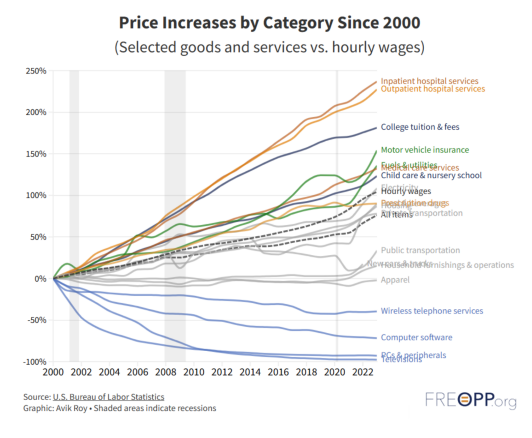
Americans deserve better. They deserve a health care system with affordable coverage options for everyone while remaining fiscally sustainable for generations to come.
Fortunately, through a host of federal executive actions and legislative proposals, as well as state-driven reforms, the United States can achieve this vision by advancing a handful of key principles, including:
- Offering Americans access to universal—and universally affordable—coverage for today while remaining fiscally sustainable for future generations.
- Giving Americans the freedom to choose health coverage that is tailored to their needs.
- Ensuring that subsidies to help pay for coverage are reserved for those who truly need it.
- Lowering costs by advancing policies that promote competition and curtail the power of health care monopolies.
Federal policies to improve health care affordability
Legislation: The Fair Care Act
Legislation provides the best path for permanent improvements in the cost and availability of health care. Drawing upon several bipartisan reform proposals, The Fair Care Act (FCA), introduced by Rep. Bruce Westerman (R., Ark.), provides a blueprint for comprehensive health care reform.9
First, the FCA achieves universal coverage by encouraging uninsured residents to directly purchase insurance. It accomplishes this by reducing the underlying cost of care through market-based reforms and reforming the design flaws in the ACA. It also permanently expands eligibility for premium tax credits, from a current range of 100-400 percent FPL to everyone at 600 percent FPL or below.
Second, the FCA expands coverage options so Americans can purchase a health plan that fits their needs. It would fully legalize short-term limited-duration insurance plans first recognized in Trump-era regulation, integrate the Federal Employees Health Benefits Program (FEHBP) into the FCA’s insurance marketplaces to create economies of scale, and consolidate tax advantaged savings accounts such as Health Savings Accounts and Flexible Spending Accounts into single funds called Medisave Accounts (MDAs).
Third, the FCA promotes fairness to taxpayers by funding the premium tax credit expansion to the working poor and middle class while eliminating federal health care subsidies for the wealthy, closing the Medicaid provider tax loophole in all states,10 and eliminating the ability of hospitals to charge higher prices at physicians offices they own.
Finally, the FCA promotes innovation and competition to lower the cost of health care for patients in a number of ways. It does so by empowering the Federal Trade Commission to investigate hospital mergers and other anticompetitive behavior, incentivizing regional hospital monopolies to divest subsidiaries to increase competition, and allowing insurance carriers to jointly negotiate reimbursement rates for providers and prescription drugs. The FCA also codifies and improves the Trump administration’s executive actions on price transparency and increases uptake of more affordable generic and biosimilar drugs.
Executive Actions
While permanent health care reform requires Congressional action, achieving bipartisan consensus on major legislation is difficult and takes time. In the near-term, the president has options to extend reform absent comprehensive legislation.
- Private insurance reform. In 2021, the Biden administration revoked a Trump-era executive order promoting association health plans, short-term limited-duration plans, and health reimbursement arrangements (HRAs). The administration should refocus attention on these beneficial arrangements by reducing regulatory barriers for small employers and expanding their use in the gig economy. These forms of coverage give patients affordable and flexible options and provide vital financial protection from catastrophic illness. HRAs are also an important vehicle for employers to provide health coverage without the burden of administering health plans for employees. Additionally, the administration should build on prior efforts to expand access to health savings accounts and to explore reference pricing to help drive down costs.
- Antitrust enforcement. Consolidation in hospital and provider markets represent one of the biggest drivers of higher health care prices in the United States. Though the Federal Trade Commission has a responsibility to challenge anticompetitive mergers and other business practices throughout the economy, the agency has taken little action to address consolidation in the health care industry. To the extent possible under existing budgets and authority, the president should shift focus away from antitrust action where no clear consumer harm has been demonstrated and instead focus on addressing the health care market where evidence clearly shows higher consumer prices11 without better outcomes.12 Additionally, the administration should oppose practices such as certificate of need laws and all-or-nothing contract terms between providers and insurers13 to help states curb anticompetitive practices that prevent the development of new hospitals and competition between existing providers.
- Price transparency. Building on Trump-era regulations that require hospitals to publish prices and insurance-negotiated rates on an array of services, the president can strengthen such measures, including increasing penalties for noncompliance. Additionally, the president can allocate funds to other transparency initiatives, such as developing all-payer claims databases so researchers can report on trends in health care prices across the industry.
State policies to improve health care affordability
State lawmakers play important roles and possess several policy levers to improve health care affordability for their residents.
- Reducing state barriers to insurance options. Though most employer-based plans are regulated under federal laws, states have influence over the strength of their own individual markets and can encourage participation in affordable, flexible insurance arrangements. A promising model of insurance choice is the individual coverage health reimbursement arrangement (ICHRA). The model functions similar to a defined contribution retirement plan, in that an employer contributes a certain amount of money to an employee to use to purchase his or her own insurance, in contrast to a defined benefit arrangement where the employer selects the plan offerings for the employee. 14 While the parameters of ICHRAs are regulated under federal law, states can encourage greater participation in ICHRAs in a number of ways.15 States such as Indiana and Mississippi passed laws to offer small employers a tax credit for each covered employee.16 Texas is considering exempting participating small businesses from a state’s sales tax.17 Florida has explored the option of creating an ICHRA marketplace,18 a dedicated online portal that makes shopping for coverage easier for employees and overcomes a common objection with ICHRA adoption: that employees will be easily overwhelmed when choosing a health plan for themselves.
- Containing health care costs for state employees. States have significant control over state employee health benefits, including how plans are operated and financed, as well as what plans are offered. States should explore alternative payment strategies within state employee benefits to lower costs for both employees and taxpayers. One strategy that has accelerated in recent years involves benchmarking prices for certain health care services and procedures to payment rates in public health programs like Medicare, a process known as reference pricing. Diverse states such as Arkansas, California, Montana, Oklahoma, Oregon, South Carolina, and Washington employ different reference price designs to control costs,19 with some allowing payments to hospitals as low as 200 percent of Medicare rates. Because state employee plans are among the largest purchasers of coverage in their respective states, such plans leverage their market power through reference prices to not only bring prices down, but also maintain broad provider participation; a dual benefit that is more difficult for individual coverage insurers to attain.
- Curbing the monopolistic behavior of providers, especially hospitals. States have broad authority over how, when, and where providers can practice, influencing the competitive balance of local health care markets. In ways similar to enhanced FTC enforcement, state attorneys general should more aggressively challenge health system mergers that reduce competition and lead to higher prices for patients. States can fight against monopolistic providers in other ways as well. As is the case with states implementing reference prices for state employee health plans, states can condition hospitals’ tax-exempt status on reducing prices to a benchmark. Indiana is the first state to implement such a policy,20 targeting especially high-priced non-profit hospitals by stripping them of their tax exempt status unless they reduce prices to the nationwide average. States can also follow Indiana’s lead by requiring hospitals to offer such prices directly to employers, bypassing traditional insurance company negotiation.
- Reforming provider licensing requirements and scope of practice rules. Rather than protecting patients by ensuring high quality providers, state licensing requirements often do little more than protect providers’ economic interests by setting artificial barriers to provider competition. Since all states have robust licensing requirements, states should recognize licensing of providers from other states to encourage providers to move across state borders. In addition, states should expand scope of practice laws to allow lower-cost professionals to practice at the highest level of care they can safely provide to patients. Finally, states should liberalize residency requirements that allow qualified international providers to practice in their states rather than repeat residency training they have completed outside the United States.
The Road Ahead
The high cost of health care threatens America’s promise of prosperity. A health care system that continually demands more while delivering less acts as a tax on work, entrepreneurship, and economic opportunity. Yet with every problem of this magnitude, there is also enormous opportunity for change. The federal and state governments can achieve a more affordable and sustainable system if they commit to reforms that give patients more choice, reserve assistance for those who truly need it, and reduce costs through competition.
Endnotes
- “Health Care Debt In The U.S.: The Broad Consequences Of Medical And Dental Bills,” Kaiser Family Foundation, last modified August 9, 2025, https://www.kff.org/health-costs/kff-health-care-debt-survey/#c7f7c77b-dec4-4baf-bed1-78e3522b4f46
- “Affordable Hospital Care Through Competition and Price Transparency,” Foundation for Research on Equal Opportunity, last modified September 8, 2025, https://freopp.org/whitepapers/affordable-hospital-care-through-competition-and-price-transparency/
- “National Health Expenditure Data,” Centers for Medicare and Medicaid Services, last modified September 22, 2025, https://www.cms.gov/data-research/statistics-trends-and-reports/national-health-expenditure-data
- “Where Does Your Healthcare Dollar Go?,” America’s Health Insurance Plans, published October 24, 2024, https://www.ahip.org/resources/where-does-your-health-care-dollar-go
- “Federal Subsidies for Health Insurance, 2026 to 2036,” Congressional Budget Office, published July 23, 2026, https://www.cbo.gov/publication/62539
- “Healthcare price & use indices,” Peterson-KFF Health System Tracker, last modified February 19, 2026, https://www.healthsystemtracker.org/indicator/spending/price-index/
- “Overview of BLS Wage Data by Area and Occupation,” Bureau of Labor Statistics, last modified September 24, 2024, https://www.bls.gov/bls/blswage.htm
- “Health Care Services in the Producer Price Index,” Bureau of Labor Statistics, last modified September 16, 2025, https://www.bls.gov/ppi/factsheets/producer-price-index-healthcare-factsheet.htm
- “H.R.8840 – Fair Care Act of 2026,” Congress.gov, accessed September 4, 2026, https://www.congress.gov/bill/119th-congress/house-bill/8840
- Medicaid provider taxes are fees states levy on hospitals to pay for the Medicaid program. States collect the tax, and then return the tax to providers as inflated Medicaid payments for medical services to extract more federal matching dollars.
- James C. Robinson, “Hospital Market Concentration, Pricing, and Profitability in
- Nancy D. Beaulieu, Ph.D., et al., “Changes in Quality of Care after Hospital Mergers and Acquisitions,” New England Journal of Medicine 382, no. 1 (2020): 51-59, https://www.nejm.org/doi/full/10.1056/NEJMsa1901383
- Certificate of Need laws require providers to get permission from the government before building new facilities or expanding services. Hospitals include All-or-Nothing contract terms with insurers, which stipulate insurers must include all of a health system’s hospitals and physicians or none of them.
- “What is a defined-benefit plan?,” healthinsurance.org, last modified March 30, 2026, https://www.healthinsurance.org/glossary/defined-benefit-plan/
- Brynn Stadtmueller, “States that have health benefit tax credits for small businesses,” Stretch Dollar, April 17, 2026, https://www.stretchdollar.com/posts/states-that-have-health-benefit-tax-credits-for-small-businesses
- Stadtmuller, “States that have health benefit tax credits.”
- “Text for 89(R) SB 1949,” Texas Legislature Online, accessed September 4, 2026, https://capitol.texas.gov/BillLookup/Text.aspx?LegSess=89R&Bill=SB1949
- “SB 440: Florida Employee Health Choices Program,” The Florida Senate, accessed September 4, 2026, http://flsenate.gov/Session/Bill/2026/440
- “State Spotlight: The Use Of Provider-Based Reference Pricing In Oklahoma And South Carolina,” Health Affairs Forefront, January 28, 2025, https://www.healthaffairs.org/content/forefront/state-spotlight-use-provider-based-reference-pricing-oklahoma-and-south-carolina
- “IN HB1004 Health care matters,” Bill Track 50, accessed September 4, 2026, https://www.billtrack50.com/billdetail/1780795