



This article is an excerpt from FREOPP’s policy handbook, “Affording the American Dream.”
Policymakers should:
- Lower the cost of child care and make it more available to working families by amending regulations that unnecessarily raise prices and ensure reimbursement rates reflect actual costs.
- Give parents greater choice and protect taxpayer funds by making child care assistance neutral among centers, home-based providers, and other lawful care arrangements, while strengthening eligibility, work verification, and payment integrity.
- Eliminate benefit cliffs by replacing abrupt subsidy cutoffs with phasedowns that allow parents to earn more and advance economically without suddenly losing the child care assistance that makes employment possible.
Introduction
Child care prices are one of the greatest impediments to flourishing for young families. Since 1990, the cost of child care has nearly quadrupled, far surpassing increases in wages or household necessities like food, health care, and housing. Over three quarters of American families spend 10 percent or more of their household income on care. But low-income families feel the pricing pressure even more. In 31 states, the child care price-to-income ratio for low-income working parents exceeds 30 percent of their income. Compounding this, assistance for these families is limited and high costs have created long wait lists.
The all-too-common government response to high child care prices is more spending. This spending most often doesn’t address the core issue of why prices continue to rise far too fast. Instead, higher government subsidies inflate the cost of care for all families. Better policies can address the core problems low-income families face.
Regulation is a top driver of child care costs. Policymakers at every level can reform avoidable regulatory costs without compromising genuine safety standards to make child care more affordable. States can also lower child care prices with oversight that makes sure assistance finds its intended purpose.
Child care assistance has some of the most severe state-set “benefit cliffs.” Benefit cliffs occur when a modest increase in household earnings causes a family to lose subsidies, sometimes worth thousands of dollars, leaving families financially worse off for working more or accepting a raise.
On top of rising costs and benefit cliffs, low-income working families don’t have access to the child care that fits their needs. Despite half of parents saying they prefer informal child care arrangements to formal care, even if the latter is free and conveniently located, states prioritize subsidized center-based care. Reform should prioritize flexibility and self-direction for all families.
Smarter decisions can make a difference. Policymakers can lower child care prices, extend current assistance to more working families, address benefit cliffs, and open the flexibility families need all in a fiscally responsible manner. Federal and state regulators alike have both the authority and the obligation to act so working parents can find safe, reliable, and affordable care.
Federal Child Care Assistance Programs
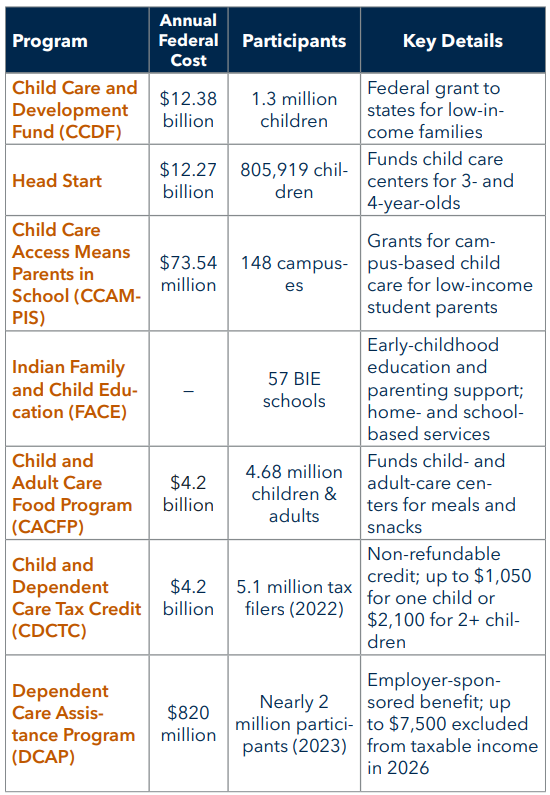
Before diving into reform, it’s important to assess the number and size of federal child care programs. The largest assistance program is the Child Care and Development Fund (CCDF). This sends federal dollars to states to create child care subsidies for low-income families. Head Start is the second largest federal program. Head Start bypasses states and directly funds pre-K centers for 3- to 4-year-old children from families below 130 percent Federal Poverty Level (FPL). There are also several smaller, targeted child care programs and nonrefundable tax credits to offset middle-income child care expenses.
Solutions
Policymakers at every level can lower the cost of child care for working, low-income families while expanding its availability to other families by reforming regulations, providing effective oversight, increasing parental choice, and addressing benefit cliffs.
Lower Regulatory-Based Cost Increases
States can amend their regulations to lower the cost of child care for families. Regulatory choices often drive cost increases, particularly low staff-to-child ratios, unnecessary credentialing requirements, and overly strict group-size caps. Also, many states also use market rate surveys that inflate reimbursement rates rather than measuring actual child care costs.
- States should carefully reevaluate their regulatory standards, particularly staff credentialling and group ratio requirements. The Administration for Children and Families (ACF) can assist state decision-making by publishing a framework and rewarding states that ease onerous rules in quality-grant competitions.
- States should stop using market-rate surveys, which ask what child care providers charge unsubsidized families and use that inform subsidy reimbursement rates. States should instead use a cost-rate survey that would measure the costs of staffing, wages and benefits, facilities, supplies, enrollment levels, child age, geography, and quality requirements.
- ACF should finalize the Notices of Proposed Rulemaking: “Restoring Flexibility to Support Head Start Program Access” and “Reducing Federal Burden for Head Start Programs” These proposed rules would reduce Head Start costs and extend the assistance to more low-income, working families. States would gain real authority over ratios, group size, background checks, and transportation for Head Start providers in-state for the first time.
Ensure Program Integrity
Child care assistance face integrity concerns. While CCDF’s FY2025 official improper payment rate is 4.93 percent—over $900 million—state investigations have revealed even higher rates. For instance, a 2025 Minnesota HHS-OIG audit found a 19 percent error rate in 200 sampled child care payments and that 11 percent of overall payments had at least one error. In addition, many states don’t track whether parents who receive child care assistance are working.
States can ensure program integrity with these reforms:
- States should monitor and report monthly CCDF data. This should include the number of children receiving CCDF assistance, gender, race, age, and hourly attendance. ACF should create parallel automatic, monthly audits of the same data.
- States can institute new fraud prevention procedures, including routine and risk-triggered attendance audits, independent attendance documentation, automated comparisons of enrollment and payment data, unannounced provider inspections, prompt recovery of overpayments, and referral of suspected intentional fraud for investigation.
- States can track work or education hours to ensure that families are using assistance to seek independence.
- States should publish their child care provider rates, setting, and category online to allow families to see their options and what taxpayers subsidize, which is often hidden from them. ACF can also require care providers who utilize taxpayer funds to be fully transparent. This should include requiring a monthly electronic report from each provider on the number of children receiving CCDF assistance, including attendance hours. It should also assess the provider payments issued, by child, and total per provider.
- ACF should create an automatic state match for improper payments. This would mean that states with a high rate of inaccurate, erroneous, and fraudulent payments would have to pay a financial penalty. The penalty would be a percentage of the child care benefit, like is done in SNAP and Medicaid.
Increase Parental Choice
Parents deserve the freedom to choose the type of child care that best meets their needs. Despite this, most state child care programs prioritize child care centers, the most expensive form of child care. Of the 1.3 million CCDF children served in federal FY2022, 77 percent received care in child care centers. For young children, center-based care is 37 percent more expensive than home-based infant care.
The most recent authorization of the Child Care and Development Block Grant Act clearly intended to prioritize parental choice by individually funding parents. Despite this authority, only one percent of CCDF parents receives their assistance through a mechanism like direct deposits which would allow them to choose the type of care that fits their needs best. Only three states and one territory prioritize parental choice. State-wide flexibility is possible: Hawaii distributes 100 percent of their grant to parents, permitting these parents to choose home-based care which costs far less: $11,632 as compared to the annual $24,115 price tag of center-based care.
- States can create and apply Education Savings Accounts (ESA) for child care funds. States can ensure safety, quality, and access from ESAs by modeling the technology available for FSA and HSA accounts. This would allow parents to graduate from CCDF subsidies to tax credit-based assistance that refund some of the cost of child care. ACF can also make changes to the disclosure requirements in regulation to make sure that ESAs are available to low-income families.
- As part of a new transparency effort, both the state and ACF can publish key data to help low-income working families find the child care options that fit their needs best. This include assessing the type of child care (family care, in-home, center-based) and function (certificate, ESA, voucher) used to pay for the care in every county.
Address Benefit Cliffs
Child care is one of the most extreme state-set benefit cliffs. The Poverty Solution’s CLIFF Index, which measures the severity of U.S. benefit cliffs, found that “CCDF is the dominant cliff in 73 percent of counties.” Earning just $1,000 more can lead to cliffs as dramatic as $25,000. Because states set their CCDF subsidies, they can directly address cutoffs with gradual phasedowns so families can increase earnings without suddenly losing the child care support that makes work possible.
- States should audit the extent of any benefit cliffs embedded into their CCDF subsidies. They should move from annual income checks to continuously assessing income and reducing assistance with real-time increases in earnings. Federal assistance regulations should require states and child care centers to report on beneficiaries’ income and the benefit design of relevant state programs.
- When households depend on multiple programs, benefit cliffs are more prominent and destabilizing. States and ACF should assess the total receipt of safety net benefits by any person in the household and the number of months of receipt.
- Marital status can result in a “marriage penalty” benefit cliff. Two unmarried partners are treated as different households despite sharing the same residence, but married partners are treated as a single household, meaning the unmarried partners could earn the same as the married spouses and still qualify for child care assistance, but the married spouses would not. Policymakers should expand the definition of the household to count the income of all live-in partners regardless of the relationship to children in the home, thus removing the marriage penalty. Likewise, all child care regulations can require eligibility assessments to include the income of all members living in the household, including biological, adoptive, foster, and presumed parents, regardless of marital status, and live-in partners of those parents.
- States should make extensive use of public-private partnerships (PPPs) with employers and nonprofit organizations to leverage private funds and resources. The federal Child Care and Development Block Grant Act specifically mandates that states demonstrate how to take advantage of PPPs to leverage funds and increase the supply of child care services.
Conclusion
The stakes in child care are not abstract. Child care is the often the most significant expense low-income families face. When families cannot afford child care, they risk slipping off the economic ladder into dependency. The good news is that there are ready-to-roll solutions to help them. Federal and state policymakers have the authority, the evidence, and the tools sitting in front of them to reform regulations, increase oversight, give parents the options they need, and eliminate benefit cliffs. Low-income families deserve child care options that meet their efforts to work, earn, and provide.