



This article is an excerpt from FREOPP’s policy handbook, “Affording the American Dream.”
Policymakers should:
- Hold the rate of increase in federal spending to less than the rate of increase in economic growth.
- Reform Social Security and Medicare to preserve their solvency, while reducing future unfunded liabilities.
- Address affordability by reducing the regulatory burdens that artificially limit supply of necessary goods and services, rather than through increasing subsidies.
The United States is racing down a road to fiscal disaster. Low-income Americans will be hurt most by this irresponsibility as things become increasingly unaffordable.
The U.S. national debt currently stands at more than $40 trillion, slightly more than 100 percent of GDP, or greater than the value of all goods and services produced in the country this year. That’s as if someone’s credit card bills were bigger than their entire salary.
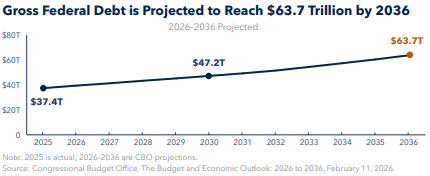
On the current trajectory, the story only gets worse. The Congressional Budget Office (CBO) warns that the debt will top $63.7 trillion (135 percent of GDP) within the next decade. That is likely an underestimate, since it assumes that several popular tax cuts are allowed to expire as scheduled.
As the numbers get ever larger and congressional inaction is taken for granted, the public largely tunes out. In ways both large and small, this tide of red ink is driving up the cost of living and making a wide range of goods and services unaffordable, especially for low- and middle-income earners.
How does the debt raise the cost of living for Americans? Here are a few of the ways:
Higher interest rates: Government debt drives up interest rates across the broader economy. As a rule of thumb, the CBO estimates that every one percent increase in the debt to GDP ratio results in a two basis point (0.02 percentage points) hike in interest rates. This, in turn, makes everyday consumer borrowing—such as auto loans, credit cards, and mortgages—more expensive. Kent Smetter, faculty director of the Penn Wharton Budget Model, estimates that roughly 60 percent of the recent rise in U.S. Treasury yields—the return or interest rate that the government pays on its bonds—is due to expectations that the United States will continue to run massive deficits. Higher treasury yields translate into higher interest rates for consumers. The Yale Budget Lab suggests the increased cost of borrowing adds roughly $2,500 per year to the cost of a typical 30-year mortgage, and $120 to the annual cost of an auto loan. That puts home- and car-ownership out of reach for many low-income Americans.
Inflation: While the effect of the debt on inflation is not always as obvious or direct as it is for interest rates, it is significant nonetheless. To the degree that deficit spending, financed by borrowing, puts money in the hands of consumers faster than the supply of goods increases, prices inevitably rise. At the same time, the Federal Reserve, in an attempt to keep interest rates from spiking, is buying government bonds paid for by creating new bank reserves. This effectively increases the money supply, leading to a situation where too much money is chasing too few goods. The net result is that every dollar can purchase fewer goods and services, while sending prices up. According to the Yale Budget Lab, five years after the national debt increases by an amount equal to one percent of GDP, the average American family could lose up to $1,250 in purchasing power.
Worse, as prices rise and economic growth and wages are unable to keep pace, consumers increasingly turn to credit cards and other forms of high-interest borrowing in order to make ends meet. With the national debt driving up interest rates, families get trapped in a debt/inflation feedback loop.
While inflation is problematic across the economy, it falls hardest on low-income Americans. That is because they typically already have smaller, less-flexible budgets and lower savings, so any increase in prices hurts them more acutely. Moreover, poorer Americans typically devote a larger share of their budget to essentials like food, housing, and transportation, which are disproportionately affected by rising prices. Goods like these tend to exhibit inelastic demand, meaning that even slight price increases can significantly erode purchasing power.
Slower economic growth: Even as the debt drives up the cost of living, it also slows the economic growth that would enable families to earn more and offset rising costs. High levels of public debt can crowd out private investment, resulting in lower productivity and ultimately lower wages. According to the CBO, income per person in 2050 will be as much as $6,300 lower than it would have if policymakers were able to reduce the debt level to 79 percent of GDP, still high by historical standards. Another study, from the Peter G. Peterson Foundation, warns that if the debt remains on its current trajectory, the economy will produce 1.2 million fewer jobs by 2035 and wages will be lower than they would without the debt burden.
A review of 80 empirical studies from 2010–2025 estimates that every one percent in the debt-to-GDP ratio above 100 percent results in a 0.033 percent decrease in economic growth. Given the current level of debt and its expected increase, that would lower this year’s GDP growth roughly 0.8 percent points lower than it would be otherwise. This might not seem like a big deal, but compounded over time, it means far fewer jobs and lower wages in the future. These pressures apply while prices increase, causing low-income families to feel the pinch from every angle.
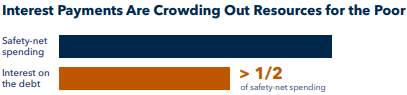
Crowding-out needed assistance: This year, interest payments on the national debt will amount to more than $1 trillion, roughly 14 percent of all federal government spending and more than half of the estimated $1.6 trillion the government spends on safety net programs. That is $1 trillion that cannot be spent on other programs or tax cuts targeted at helping those most in need. Indeed, since the middle-class entitlements Medicare and Social Security are off-limits—the traditional third rail of American politics—and the Trump administration wants to dramatically increase defense spending, any spending cuts are likely to fall most heavily on programs for the poor.
There are few clean hands when it comes to blame for the debt, nor is there much difference between Democrats and Republicans. George W. Bush added $6.1 trillion to the debt over eight years. Barack Obama topped that, increasing the debt by another $9.3 trillion. President Trump’s first term was actually a mild improvement, running up just $7.8 trillion in additional debt. President Biden looks almost fiscally responsible, generating just $4.7 trillion during his single term, though he benefited from post-COVID economic growth. But bipartisan profligacy has regained momentum in President Trump’s second term. In just a year and a half, he has already added another $2.25 trillion to the debt.
Worse, as the affordability crisis grows, many of the proposals for dealing with it—particularly from the populist left and right—are likely to make the problem worse. For example, many politicians want to subsidize essential goods and services from housing to child care. But to the degree those subsidies are financed by borrowing, they risk simply increasing the debt. At the same time, financing them through higher taxes carries the risk of slowing economic growth, thereby reducing job growth and lowering wages. Moreover, subsidies increase demand without increasing supply, thus increasing inflationary pressures and likely raising prices for those goods. Pumping subsidies into rental housing in, say, San Francisco, without addressing the severe supply constraints will only increase rents, requiring ever-more inflationary subsidies in a never-ending cycle that ignores the underlying problems.
At the same time, attempts to cajole the Fed into lowering interest rates prematurely are likely to be self-defeating, marking a return to the loose money policies of the COVID-era that generated record levels of inflation. Or, if one thinks that COVID was a special case, consider the 1970s when low-interest rates and an expanding monetary supply led to extremely high inflation. The Federal Reserve ultimately had to raise interest rates to as much as 20 percent to break the inflationary cycle.
Ultimately, there are only two ways to reduce the debt without doing more harm than good. First, policymakers must address the regulatory burdens that artificially limit supply. Cities need to build more housing, make child care more widely available, and so on. The goal should be to lower prices by expanding the availability of those goods, not simply shift costs from individuals to taxpayers.
Second, Congress must both reduce spending and increase growth. If the rate of economic growth exceeds the rate of government spending, the burden of debt to GDP will naturally shrink over time. However, both growth and spending restraint are necessary to achieve this. Projections that economic growth can be high enough that spending restraint is unnecessary are based on wildly unrealistic scenarios.
Debt reduction is seldom discussed in relation to affordability. But until both parties begin to take it seriously, there will be little chance of bringing down the cost of living over the long term.
Endnotes
- “What is the Federal Debt?” United States Department of the Treasury, https://fiscaldata.treasury.gov/americas-finance-guide. Accessed September 4, 2026.
- “The Budget and Economic Outlook: 2026 to 2036,” Congressional Budget Office, February 11, 2026, https://www.cbo.gov/publication/61882.
- Andre Neveau and Jeffrey Schafer, “Revisiting the Relationship Between Debt and Long-Term Interest Rates: Working Paper 2024–25,” Congressional Budget Office, December 20, 2024, https://www.cbo.gov/publication/60314.
- Abhi Gupta, “The Impact of Deficits on Costs for Households,” The Budget Lab at Yale, March 9, 2026, https://budgetlab.yale.edu/research/impact-deficits-costs-households.
- Julian di Giovanni, et al., “Quantifying the Inflationary Impact of Fiscal Stimulus under Supply Constraint,” Federal Reserve Bank of New York Staff Reports, no. 1050 (2023), https://www.newyorkfed.org/research/staff_reports/sr1050.
- Gupta.
- Jackson Mejia and John Hartley, “Inflations Compounding Impact on the Poor,” Foundation for Research on Equal Opportunity. https://freopp.org/whitepapers/inflations-compounding-impact-on-the-poor/.
- “The 2020 Long-Term Budget Outlook” Congressional Budget Office, September 2020, https://www.cbo.gov/publication/56516.
- “The Rising National Debt Will Cause Significant Economic Damage.” Peter G. Peterson Foundation, May 2025, https://www.pgpf.org/wp-content/uploads/2025/05/EY-Rising-National-Debt-Will-Cause-Significant-Economic-Damage.pdf.
- Jack Salmon, “The Impact of Public Debt on Economic Growth: What the Empirical Literature Tells Us,” Mercatus Center, January 7, 2026, https://www.mercatus.org/research/policy-briefs/impact-public-debt-economic-growth-what-empirical-literature-tells-us.
- “Interest Costs on the National Debt,” Peter G. Peterson Foundation, 2026, https://www.pgpf.org/programs-and-projects/fiscal-policy/monthly-interest-tracker-national-debt/.