



Introduction
Too often, the debate over government efficiency begins and ends with how much Washington spends, skipping the harder questions. Does the money reach the people it was meant for? Does it accomplish what it was supposed to do? Are we measuring results honestly? Failing to address these questions erodes public trust in the integrity of government programs and our institutions more broadly.
This system is screaming for reform.
The federal safety net now spans more than 90 means-tested programs and well over a trillion dollars per year, administered by more than a dozen agencies, each with its own rules, data, and systems that rarely communicate. The result is a government that too often pays first and asks questions later. The Government Accountability Office calls this “pay-and-chase,” a model it describes as costly and ineffective.
The consequences are substantial. Medicaid reported $37 billion in improper payments in fiscal year 2025 alone. GAO estimates that pandemic-era unemployment insurance fraud totaled between $100 billion and $135 billion. In Massachusetts, a small convenience store redeemed nearly $7 million in SNAP benefits, six times what a nearby full-service supermarket received, without detection until long after the money was gone.
These failures transcend political parties. Republican and Democratic administrations alike have expanded government programs without consistently prioritizing accountability, effectiveness, or measurable outcomes. Too often, success is defined by dollars spent and people served rather than whether programs achieve their intended purpose.
In some cases, the tools for greater accountability already exist. Since 1983, federal law has directed HHS to withhold Medicaid funds from states with error rates above three percent. Yet that authority has routinely been waived and never enforced.
Waste and inefficiency are a bipartisan inheritance. Addressing them should be a bipartisan undertaking. Every dollar lost to improper payments is a dollar unavailable to advance other priorities, serve eligible families, or reduce the burden on taxpayers.
At FREOPP, we believe meaningful reform requires more than identifying what is broken. It requires bringing forward practical solutions, examining competing approaches, and creating space for serious policy debate. Our role is not simply to identify problems, but to connect ideas, expertise, and opportunities for action.
That is the purpose of this handbook.
We invited researchers and policy experts to identify opportunities to improve the efficiency, integrity, and accountability of federal programs through existing executive and administrative authorities. Rather than waiting for Congress to act, we asked contributors to examine what could be accomplished under current law, identify the responsible decision makers, and outline concrete steps for implementation.
The resulting collection offers a range of proposals for policymakers to consider. Each brief reflects the analysis and recommendations of its author, rather than necessarily representing an institutional position of FREOPP. Our goal is to put actionable ideas into the hands of decision makers, encourage rigorous examination of their merits, and advance a more informed conversation about government reform.
The briefs fall into three groups.
Pay the right people, at the right time. Five briefs examine opportunities to prevent improper payments before they occur. Proposals include expanding the use of Treasury’s Do Not Pay system as a verification gateway, replacing after-the-fact audits with continuous data-driven screening, enforcing existing Medicaid improper-payment penalties, withholding federal Medicaid and CHIP matching funds for enrollees whose eligibility renewals are significantly overdue, and strengthening unemployment insurance through federal-state performance agreements. Together, these proposals explore how better information, stronger oversight, and existing administrative tools could improve program integrity.
Strengthen accountability. Two briefs examine how existing authorities could keep programs aligned with their intended design. One considers whether a 2023 rule lowering the Community Eligibility Provision threshold has extended free school meals beyond the high-poverty schools the provision was meant to serve, and whether it has shifted costs from states to federal taxpayers. The other examines federal TANF reporting requirements and opportunities for HHS to improve data collection concerning households in which an adult is ineligible for assistance because of immigration status. Both consider how administrative action could improve transparency and align programs with their statutory purpose.
Measure honestly, and examine federal classification requirements. Two briefs challenge foundational elements of federal data collection. One examines whether official poverty and inequality statistics adequately account for government transfer payments and their effects. The other questions federal racial and ethnic classification requirements on constitutional and principled grounds. Both invite policymakers to reconsider how government collects, interprets, and uses information to shape public policy.
These proposals differ in their approaches and implications, but they share an important premise: Government should be accountable for how it spends public resources, whether programs accomplish their intended purposes, and whether the people they are designed to serve are actually benefiting.
Good stewardship is not hostile to the safety net. It is essential to maintaining an effective safety net worthy of public trust.
We hope the recommendations that follow offer policymakers a starting point that sparks thoughtful debate, further examination, and ultimately, better government.
In freedom,
Akash Chougule
President, FREOPP
Federal Enforcement of Medicaid/CHIP Redetermination Standards
by Erik Randolph and Ray Packeri, Georgia Center for Opportunity
Recommendation
Starting in January 2027, the Centers for Medicare and Medicaid Services (CMS) should implement a policy that federal matching dollars for Medicaid and the related Children’s Health Insurance Program (CHIP) are dispensed only for enrollees who are either current in their renewal status or no more than 30 days overdue in their renewals or redeterminations. All federal match payments for those more than 30 days overdue will be withheld until such time that state administering agencies can properly verify enrollment status consistent with federal standards. This recommendation is not about cutting eligible people off medical assistance. It is about reinforcing the duty of states to adhere to federal regulations meant to limit fraud, waste, and abuse. The estimated savings to the federal government will be conservatively between $151 million and $377 million, and states could collectively and conservatively save between $61 million and $148 million.
The Problem
In general, agencies administering programs dispersing funds must adopt operational standards and attitudes necessary for program integrity controls to be successful. Foremost among them is a culture of program integrity that permeates all aspects of operations and extends across all programs whether administered by the federal government, state government, local government or other contracted entities. Success hinges not only on cooperation but also on collaboration with data exchanges and investigative actions, including sharing unique identifiers for each recipient across programs and jurisdictions to avoid duplicate payments for the same eligibility period. The principle of continuous improvement comprises an important component of the culture whereby failures and weak links are routinely identified and repaired.
A key area where the federal government can enforce this culture is with timely Medicaid redeterminations done according to high standards, which is currently required by statute. Medicaid is by far the largest safety net program in terms of funding and enrollment. The Congressional Budget Office estimates that the FFY 2027 federal share of Medicaid and the Children’s Health Insurance Program (CHIP) will be between $640 billion and $670 billion. States will be spending another $300 billion to $330 billion, making the total spending approximately $1 trillion. In contrast, the second largest safety-net program is the Supplemental Nutrition Assistance Program (SNAP) with estimated funding between $100 billion and $115 billion,1 which is just over one tenth of the magnitude of Medicaid and CHIP.
While not as extreme in magnitude but still double in size, Medicaid and CHIP also dwarf other safety-net programs in participation. According to the same Congressional Budget Office baseline projections, the average monthly enrollment for Medicaid and CHIP in fiscal year 2027 is estimated to be between 71 million and 73 million participants. In contrast, the second largest safety-net program is SNAP, which averages an estimated 36 million to 40 million participants monthly.
Medicaid/CHIP participation is estimated to comprise 21 percent to 22 percent of the U.S. population versus 11 percent to 12 percent for SNAP.2
State agencies have mixed records when it comes to preventing fraud, waste, and abuse. Recent failures have received high visibility, such as Minnesota’s funding of billed autism services that were never rendered,3 Mississippi’s misspent TANF funds scandal,4 and California’s hospice scheme, funded through Medi-Cal, its Medicaid program,5 to name a few. Beyond those high-profile cases, actions or the lack of actions by the states, including dubious schemes to maximize the flow of federal funds and lax enforcement, cost the federal government and taxpayers significant money. Examples include hospital tax schemes to extract more federal share Medicaid funds6 or extending unemployment zones to avoid enforcing work requirements for Able-Bodied Adults Without Dependents (ABAWDs).7
Currently, states must redetermine Medicaid eligibility to renew enrollment once every 12 months, and no more often, for the expansion population as well as for children, parents, and pregnant women. Medicaid enrollees who are aged, blind, or have disabilities are renewed at least every 12 months. However, states have been chronically out of compliance with the timely processing of these renewals.8 On average among the states from March 2025 through February 2026, 10.5 percent of all redeterminations were more than 30 days overdue, and 4.1 percent were more than 90 days overdue.9
Carrying ineligible people on Medicaid and CHIP rolls comes with a cost in either capitation payments to managed care organizations or fee-for-service payments. Because the federal government has been providing matching funds to the states for all persons enrolled in Medicaid and CHIP, it is also paying costs for states that carry ineligible people on their Medicaid and CHIP rolls. States, too, incur costs for carrying ineligible people.
During the COVID-19 pandemic, Congress indirectly halted eligibility terminations at Medicaid renewals by raising the federal matching rate by 6.2 percentage points for states that kept enrollees continuously enrolled, an amount that states could hardly refuse during the intense revenue uncertainty of the pandemic.10 All states unsurprisingly adopted the change,11 and the continuous enrollment condition ended by statute on March 31, 2023.12
In addition to requiring states to restart redeterminations, CMS worked with the states and the District of Columbia to prepare them for the termination of continuous enrollment. During this process, CMS identified 34 states and the district that were out of compliance with federal redetermination standards. CMS required them to adopt up to 10 defined mitigation strategies to address the noncompliance. Those states and D.C. had to adopt on average 4.6 mitigation strategies with three states (Missouri, Oregon, and Utah) having to adopt only 1 strategy and 1 state (Minnesota) having to adopt nine strategies.13
Under its general authority and starting on February 1, 2023, CMS gave state agencies up to 12 months to initiate the “unwinding” of continuous enrollment and 14 months to complete redeterminations for all enrollees in Medicaid and CHIP by May 1, 2024. CMS further stipulated that “redeterminations must be conducted in accordance with all applicable federal requirements.”14
On September 20, 2024, CMS issued a bulletin requiring states to come into full Medicaid renewal compliance by December 31, 2026.15 This coincides with a new deadline imposed by the One Big Beautiful Bill Act (OBBBA), enacted July 4, 2025, requiring states to renew eligibility every six months for the Affordable Care Act adult expansion group (adults with incomes up to 138 percent of the federal poverty level), beginning with renewals scheduled on or after January 1, 2027.16
The Solution
Requiring states to timely process Medicaid/CHIP renewals according to program integrity standards will reduce fraud, waste, and abuse, saving both federal and state governments money. Therefore, CMS must hold state agencies accountable for timely redetermination of renewals according to high program integrity standards. Having given state agencies nearly four years to come into full redetermination compliance, CMS should take a hard line that the federal government will not pay for renewals more than 30 days overdue. The state would then bear the full cost of those overdue renewals that always include some percentage of ineligible individuals. Once compliance is reached, then CMS will provide matching funds only for those found to be eligible and not those who are ineligible. During this process, CMS will continue to respect the ninety-day redetermination period per federal regulations17 by providing matching funds for those individuals who became eligible during the look-back period but not until the redetermination process is completed according to standards.
This federal action is not about cutting off eligible people from Medicaid. It is about the enforcement of states to come into compliance with their duty to process renewals in a timely manner according to federal standards. In this way, the federal government can help reinforce a program integrity culture.
Moreover, CMS should continuously assist states in implementing program integrity controls and continuous improvement.18
CMS has the authority to withhold federal payments to a state, in whole or in part, when the state fails to comply with federal standards in practice. In this case, the withholding of funds is for those individuals who have not been shown to be eligible to receive those payments.19 Once states catch up with their redeterminations, then they will receive the matching funds for those who are eligible.
Expected Benefits
The importance of being timely with redeterminations cannot be overstated. The greater benefit will be reinforcing a program integrity culture with continuous improvement.
There will also be cost savings associated with the solution, and the authors used the following methodology to make a conservative estimate. Federal data sources and statistical formulae provide the data and calculations with assistance from Claude AI, under the supervision of the authors. The general formula used is the number of renewal processes overdue multiplied by per-member costs multiplied by the overall ineligibility rate of those processed for renewal. An upper-end calculation and a low-end calculation were performed using 30 days overdue and 90 days overdue, respectively. The analysis focused at the state level, calculating costs for each state and the District of Columbia over the months of March 2025 through February 2026, which were chosen for being the most recent data spanning12 months. The trendlines for overdue renewals have been increasing, but only this twelve-month period was used.
Using a federal dataset,20 the number of monthly renewals, those processed and determined to be ineligible, those overdue more than 30 days, and those overdue more than 90 days were determined for each state and Washington, DC. Using monthly averages, 5.7 million renewals were due, 601,132 were more than 30 days overdue, and 235,584 were more than 90 days overdue. Of those overdue monthly averages, 80,897 and 32,365 were found to be both ineligible and overdue, respectively, which was calculated by multiplying the ineligibility rate for each state derived from those ineligibles of all renewals processed within each respective state.
MACStats, the data book published by the Medicaid and CHIP Payment and Access Commission (MACPAC),21 is the most authoritative source on enrollment, spending, and benefits in Medicaid and CHIP. MACStats showed per member per month (PMPM) Medicaid/CHIP costs averaged $482 in FY 2023, with a high of $827 (Washington) and a low of $259 (Florida). Five forecasting models were performed to provide a PMPM estimate for FFY 2027 for each state, consisting of three ARIMA
models differing only in the number of years used, health care inflation, and log-linear trend. The median model was chosen, which was the log-linear trend of annual increases of 3.67 percent, giving an average PMPM cost of $546.
The final annual savings estimate ranges from $212 million to $526 million. Applying blended Federal Medical Assistance Percentages22 for each of the states yields estimated federal savings between $151 million and $377 million and total states savings between $61 million and $148 million. These numbers are conservative, meaning actual savings will likely be more, because data was unavailable for the following states: Alabama, Minnesota, South Dakota, Utah, and Wisconsin.
Endnotes
- i Erik Randolph is Director of Research for the Georgia Center for Opportunity, and Ray Packer is a Senior Research Fellow with the Center. All calculations were performed by the authors with the assistance of Claude AI.
- Congressional Budget Office (CBO), The Budget and Economic Outlook: 2026 to 2036 (Washington, D.C.: CBO, 2026), https://www.cbo.gov/taxonomy/term/46/latest; National Association of State Budget Officers (NASBO), Spring 2026 Fiscal Survey of States and State Expenditure Report Historical Dataset (Washington, D.C.: NASBO, 2026), https://community.nasbo.org/home.
- The Budget and Economic Outlook: 2026 to 2036 and Congressional Budget Office (CBO), SNAP Baseline Projections (Washington, D.C.: CBO, 2026), https://www.cbo.gov/system/files/2026-01/51312-2026-02- snap.pdf.
- U.S. Attorney’s Office, District of Minnesota, “Six Additional Defendants Charged, One Defendant Pleads Guilty in Ongoing Fraud Schemes,” press release, December 18, 2025, https://www.justice.gov/usao- mn/pr/six-additional-defendants-charged-one-defendant-pleads-guilty-ongoing-fraud-schemes.
- Mississippi Office of the State Auditor, “Auditor Demands Repayment of Misspent Welfare Money,” press release, October 12, 2021, https://www.osa.ms.gov/news/auditor-demands-repayment-misspent-welfare-money.
- California Department of Justice, Office of the Attorney General, “Attorney General Bonta Dismantles Los Angeles Hospice Fraud Ring Responsible for $267 Million in Fraud, 21 Charged,” press release, April 9, 2026, https://oag.ca.gov/news/press-releases/attorney-general-bonta-dismantles-los-angeles-hospice-fraud-ring- responsible-267.
- Brian Blase and Niklas Kleinworth, “Addressing Medicaid Money Laundering: The Lack of Integrity with Medicaid Financing and the Need for Reform,” Paragon Health Institute, March 26, 2025, https://paragoninstitute.org/medicaid/addressing-medicaid-money-laundering-the-lack-of-integrity-with- medicaid-financing-and-the-need-for-reform/; U.S. Government Accountability Office, Medicaid Financing: States’ Increased Reliance on Funds from Health Care Providers and Local Governments Warrants Improved CMS Data Collection, GAO-14-627 (Washington, DC, July 2014), https://www.gao.gov/assets/gao-14-627.pdf.; U.S. Government Accountability Office, Medicaid: CMS Needs More Information on States’ Financing and Payment Arrangements to Improve Oversight, GAO-21-98 (Washington, DC, December 7, 2020), https://www.gao.gov/products/gao-21-98.
- Jamie Bryan Hall, “Geographic-Area Waivers Undermine Food Stamp Work Requirements,” Backgrounder no. 3332 (Washington, DC: Heritage Foundation, July 19, 2018), https://www.heritage.org/sites/default/files/2018-07/BG3332.pdf; Richard Burkhauser, Kevin Corinth, Thomas O’Rourke, and Angela Rachidi, “President Trump’s USDA Should Fix Food Stamp Work Requirement Waivers,” AEI Center on Opportunity and Social Mobility, January 21, 2025, https://cosm.aei.org/?p=2517.
- 42 C.F.R. §§ 435.912(c), 435.916(a)(1), (b); id. § 457.343 (CHIP); see also 42 U.S.C. § 1396a(a)(8) (medical assistance must be furnished with reasonable promptness). On state noncompliance, see CMS, CMCS Informational Bulletin, State Compliance with Medicaid and CHIP Renewal Requirements by December 31, 2026 (Sept. 20, 2024), https://www.medicaid.gov/federal-policy-guidance/downloads/cib09202024.pdf (CMS “identified areas of non-compliance with renewal requirements in nearly every state during unwinding”).
- Authors calculations per data extract from CMS, State Medicaid and CHIP Eligibility Processing Data, data.medicaid.gov, Sept. 2026 release: https://catalog.data.gov/dataset/state-medicaid-and-chip-eligibility- processing-data and using Claude as an analytical tool.
- Families First Coronavirus Response Act, Pub. L. No. 116-127, § 6008, 134 Stat. 178 (2020), https://www.congress.gov/bill/116th-congress/house-bill/6201.
- Office of the Assistant Secretary for Planning and Evaluation, Unwinding the Medicaid Continuous Enrollment Provision: Projected Enrollment Effects and Policy Approaches, Issue Brief HP-2022-20 (Washington, DC: U.S. Department of Health and Human Services, August 19, 2022), 2, https://www.aspe.hhs.gov/sites/default/files/documents/a892859839a80f8c3b9a1df1fcb79844/aspe-end- mcaid-continuous-coverage.pdf.
- Consolidated Appropriations Act, 2023, Pub. L. No. 117-328, div. FF, § 5131, 136 Stat. 4459 (2022) (ending the continuous enrollment condition on March 31, 2023;.
- The states in compliance were California, Colorado, Florida, Illinois, Indiana, Kansas, Kentucky, Louisiana, Maryland, Massachusetts, Montana, New Hampshire, New Mexico, North Dakota, Rhode Island, Tennessee. Centers for Medicare & Medicaid Services, Summary of State Mitigation Strategies for Complying with Medicaid Renewal Requirements Described in the Consolidated Appropriations Act, 2023 (Baltimore, MD: Centers for Medicare & Medicaid Services, n.d.), 4–10, https://www.medicaid.gov/resources-for- states/downloads/sum-st-mit-strat-comply-medi-renew-req.pdf.
- Centers for Medicare & Medicaid Services, Center for Medicaid and CHIP Services, “Key Dates Related to the Medicaid Continuous Enrollment Condition Provisions in the Consolidated Appropriations Act, 2023,” CMCS Informational Bulletin, January 5, 2023, https://www.hhs.gov/guidance/sites/default/files/hhs- guidance-documents/AID/cib010523_1.pdf; CIB (Sept. 20, 2024), supra note 2 (“in March 2023, CMS required that 36 states implement mitigation strategies to avoid further agency action”); see also CMS, Summary of State Mitigation Strategies for Complying with Medicaid Renewal Requirements Described in the Consolidated Appropriations Act, 2023, https://www.medicaid.gov/resources-for-states/downloads/sum-st- mit-strat-comply-medi-renew-req.pdf
- Centers for Medicare & Medicaid Services, Center for Medicaid and CHIP Services, “State Compliance with Medicaid and CHIP Renewal Requirements by December 31, 2026,” CMCS Informational Bulletin, September 20, 2024, https://www.medicaid.gov/federal-policy-guidance/downloads/cib09202024.pdf.
- An Act to Provide for Reconciliation Pursuant to Title II of H. Con. Res. 14 (One Big Beautiful Bill Act), Pub. L. No. 119-21, § 71107, 139 Stat. 72 (2025) (adding Social Security Act § 1902(e)(14)(L), 42 U.S.C. § 1396a(e)(14)(L), effective for renewals scheduled on or after the first day of the first quarter beginning after December 31, 2026); see also CMS, SMD Letter No. 26-001, Implementation of “Eligibility Redeterminations,” Section 71107 of the “Working Families Tax Cut” Legislation (Public Law 119-21) (Mar. 6, 2026), https://www.medicaid.gov/federal-policy-guidance/downloads/smd26001.pdf. The adult expansion group is defined at 42 U.S.C. § 1396a(a)(10)(A)(i)(VIII) (133% of the federal poverty level, effectively 138% with the 5% income disregard under 42 U.S.C. § 1396a(e)(14)(I)).
- 42 CFR § 435.916(a)(3)(iii)
- States verify eligibility at renewal through electronic data matching, including the Federal Data Services Hub and state wage, income, and resource data, under 42 C.F.R. §§ 435.940–435.965 (see especially §§ 435.948, 435.949, 435.952). The accuracy of state eligibility determinations is measured through Medicaid Eligibility Quality Control (MEQC) reviews and the Payment Error Rate Measurement (PERM) program. See 42 C.F.R. pt. 431, subpts. P–Q; 42 U.S.C. § 1396b(u).
- Social Security Act § 1904, 42 U.S.C. § 1396c; 42 C.F.R. § 430.35 (payments may be withheld in whole or in part after reasonable notice and opportunity for a hearing; under § 430.35(d)(2), payments may be limited to parts of the program not affected by the noncompliance); id. §§ 430.60–430.104 (hearing procedures); 42 U.S.C. § 1316(a) (reconsideration and judicial review in the U.S. court of appeals).
- CMS, State Medicaid and CHIP Eligibility Processing Data, data.medicaid.gov, Sept. 2026 release: https://catalog.data.gov/dataset/state-medicaid-and-chip-eligibility-processing-data
- MACPAC, MACStats: Medicaid and CHIP Data Book, Exhibits 10, 15, 16, 22: https://www.macpac.gov/macstats/
- Blended Federal Medical Assistance Percentages (FMAP)s combine each state’s regular FY2027 FMAP with the 90 percent federal match for the ACA new adult group (Social Security Act §1905(y), 42 U.S.C. §1396d(y)). The two rates are weighted by each group’s share of the state’s FY2023 MAGI benefit spending. For states without a new adult group in FY2023, we used the regular FMAP. Source: U.S. Department of Health and Human Services, “Federal Financial Participation in State Assistance Expenditures; Federal Matching Shares for Medicaid, the Children’s Health Insurance Program, and Aid to Needy Aged, Blind, or Disabled Persons for October 1, 2026, Through September 30, 2027,” Federal Register 90, no. 227 (November 28, 2025): 54696–99, https://www.govinfo.gov/content/pkg/FR-2025-11-28/html/2025-21332.htm.
Enhancing Medicaid Program Integrity
by Chris Jacobs, Juniper Research Group
Recommendation:
High rates of improper payments in the federal-state Medicaid program reflect a failure by Republican and Democratic Administrations to use existing federal law to hold states accountable for poor program integrity. While Congress strengthened accountability provisions in 2025’s budget reconciliation bill, those provisions do not take effect until October 2029, and could be repealed by a future Congress and President. The Trump Administration should use existing authority to begin implementing this important program integrity measure sooner.
Problem:
Large levels of Medicaid improper payments
In Fiscal Year 2025, Medicaid made $37 billion in improper payments, according to a report by the Government Accountability Office.1 At 6.1 percent, the improper payment level is large in both absolute and relative terms. Improper payments, which include payments made in the incorrect amount or without proper documentation, do not necessarily represent fraud, but they indicate an inattention to detail that could make fraud more likely.
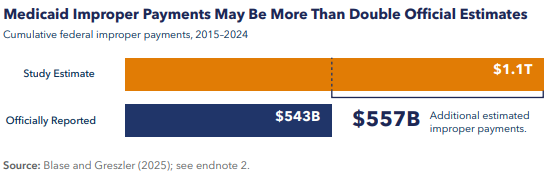
However, that official improper payment rate will likely rise in future years. COVID-era prohibitions on removing beneficiaries from the Medicaid rolls temporarily eliminated one of the largest sources of improper payments—eligibility verification errors; as eligibility verification returns, audits will likely show higher rates of improper payments. One study in 2025 concluded that from 2015 through 2024 Medicaid’s true improper payments totaled nearly $1.1 trillion, or more than twice the official estimate of $543 billion, when considering eligibility errors throughout that time span.2
Solution:
Require states with high improper payment rates to reimburse the federal government for these expenses
Section 1903 of the Social Security Act provides that, “for any full fiscal year” after Fiscal Year 1983, if any state has an erroneous excess payment rate of greater than three percent, “then the Secretary [of Health and Human Services] shall make no payment for such period or fiscal year with respect to so much of such erroneous excess payments as exceeds such allowable error rate of” three percent.3 However, this measure, while existing in law, has been waived as a matter of course, with HHS never withholding funds under this statutory provision.4
The 2025 budget reconciliation measure included several provisions intended to enhance program integrity by holding states accountable for program error rates. For instance, Section 10105 required states with high payment error rates for the SNAP program to pay a portion of their state’s benefit costs, beginning in Fiscal Year 2028.
Section 71106 of the reconciliation measure amended Section 1903, limiting the Secretary’s ability to waive repayments by states when their improper Medicaid payments exceed three percent. The Congressional Budget Office in its analysis of the law as enacted estimated that this provision would reduce federal Medicaid spending by $7.5 billion over the coming decade.5
But Section 71106’s amendments to the Social Security Act will not take effect until Fiscal Year 2030, which begins on October 1, 2029. For this reason, the Trump Administration should use its existing authority under Section 1903 of the Social Security Act to begin implementation sooner, end the perpetual waivers, and enforce penalties on states with high rates of improper payments.
Expected Benefits:
The existing federal Medicaid match rate structure dissuades states from closely scrutinizing improper payments and fraud. The Affordable Care Act’s expansion of Medicaid to able-bodied adults provides states with a 90% federal match; in some cases, budget gimmicks used by states to exploit federal matching dollars mean that Washington is effectively paying the full share of expansion costs.6
Enforcing program integrity provisions that Congress first enacted more than four decades ago would give state Medicaid programs a stronger incentive to serve as wise stewards of taxpayer dollars. In addition, using existing authority to begin implementation now via regulations would prevent the next Administration and Congress from nullifying its effects by repealing Section 71106 of the 2025 reconciliation measure before it takes effect in October 2029.
Endnotes
- Government Accountability Office. 2026. “Payment Integrity: Agencies’ Estimated Improper Payments Increased to $186 Billion in Fiscal Year 2025.” Report GAO-26-108694. https://www.gao.gov/assets/gao-26-108694.pdf.
- Brian Blase and Rachel Greszler. 2025. “Medicaid’s True Improper Payments Double Those Reported by CMS.” EPIC-Paragon Health Institute Policy Brief. https://paragoninstitute.org/wp-content/uploads/2025/03/Medicaids_True_Improper_Payments_FOR-RELEASE_V4.pdf.
- Section 1903(u)(1)(A) of the Social Security Act, 42 U.S.C. 1396b(u)(1)(A).
- Blase and Greszler.
- Congressional Budget Office. 2025. “Estimated Budgetary Effects of Public Law 119-21, to Provide for Reconciliation Pursuant to Title II of H. Con. Res. 14, Relative to CBO’s January 2025 Baseline.” https://www.cbo.gov/publication/61570.
- Families USA. 2019. “Options to Generate the State Share of Medicaid Expansion Costs.” Fact sheet. Families USA. https://familiesusa.org/wp-content/uploads/2019/09/MCD_States-Share-10-Percent_Fact-Sheet.pdf.
Executive Actions to Strengthen Unemployment Insurance Before the Next Downturn
by Thomas Savidge, American Institute for Economic Research
Recommendation:
The President should direct the Department of Labor (DOL), working with Treasury and the Office of Management and Budget (OMB), to establish federal-state UI performance agreements that strengthen front-end verification, publish comparable solvency and performance measures, require administrative corrective action plans, and test an emergency operating playbook. Each agreement would identify federal and state responsibilities, performance targets, and deadlines. The initiative would operate under existing executive and administrative authority and within available appropriations. The agreements would aim to prevent improper payments before disbursement while reducing unnecessary delays for eligible workers.
Implementation Timetable
- 90 days: Publish the legal-and-data inventory, common metrics, and draft agreement.
- 180 days: Launch the scorecard, issue SQSP and grant guidance, and invite all 53 UI jurisdictions to participate.
- One year: Complete the first national readiness exercise and publish state results, remediation milestones, and federal bottlenecks.
The Problem:
The Pandemic Exposed a Fragile UI system
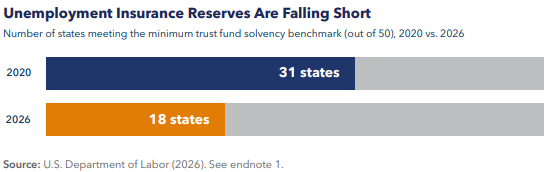
Unemployment insurance depends on adequate reserves and accurate, timely claims administration. The pandemic exposed weaknesses in both, as states entered the crisis with different reserves and administrative capabilities while also being asked to implement newly created federal programs. The DOL reported that only 18 states met its minimum trust-fund solvency benchmark entering 2026, compared with 31 states immediately before the pandemic. 1 State-level analysis finds that stronger pre-2020 reserves were the most consistent predictor of later solvency; borrowing exposure was associated with weaker outcomes, while administrative-integrity measures were relevant but less stable.2 These are descriptive associations, not proof that any single policy caused recovery.
Program integrity became a fiscal and service-delivery crisis. GAO estimated pandemic UI fraud at $100 billion to $135 billion from April 2020 through May 2023. 3 An NBER study estimates that $214 billion in 2020–21 payments (24 percent of benefits) appeared anomalous or likely ineligible.4 The estimated share was about 45 percent in Pandemic Unemployment Assistance (PUA) and 15 percent in regular UI; roughly half of anomalous payments could have been flagged before disbursement through better data use.5 The $214 billion figure is broader than proven fraud.
Administrative funding is also reactive: federal support rises with claims and emergency programs, then falls when states should maintain systems and prepare. AEI scholar Matt Weidinger cautions that more money through the existing allocation machinery would not necessarily improve performance, while transferring federal unemployment tax revenue to states would require Congressional approval. 6
Recent research illustrates the tradeoffs involved in financing and benefit design. A California simulation finds that expanding the taxable wage base can improve financing and experience rating—the link between an employer’s layoffs and its UI taxes—but can also impose larger percentage tax increases on employers with few layoffs unless tax rates are adjusted.7 Canadian evidence finds that the budget effect of behavioral responses is larger for a uniform extension of benefit duration than for one targeted at claimants with short work histories.8 Neither study establishes a universal prescription for U.S. states. Comparable measures would help assess these choices.
The Solution:
Federal-State UI Performance Agreements
The President should direct DOL to launch a UI Performance Agreement Initiative within 180 days. Each agreement would pair state commitments on verification, service, remediation, and emergency testing with federal commitments to provide lawful data access, usable tools, and technical assistance, specifying responsible officials and deadlines for both sides. These compacts would be administrative performance agreements, not interstate compacts. DOL would enforce baseline federal requirements through existing conformity and substantial-compliance procedures, while obtaining additional commitments through voluntary administrative agreements, technical assistance, and lawful conditions on discretionary grants.
Existing law supplies the foundation. Section 302 of the Social Security Act authorizes state administrative payments within appropriations. 9 Section 303 requires methods reasonably calculated to ensure full payment when due, permits federal reporting and verification requirements, and provides a process for substantial noncompliance. 10 Regulations already set payment and appeals-promptness standards. 11 DOL’s State Quality Service Plan (SQSP) process already requires corrective-action plans for specified performance deficiencies.12
Establish risk-based front-end controls
The DOL and Treasury should make participation in the UI Integrity Data Hub and available Do Not Pay services a core agreement term.13 States should submit claims at least daily, use all legally available identity and eligibility matches, and document how flags are resolved before payment. Federal agencies should publish data uptime and response times. The DOL should distinguish hard identity failures from indicators requiring review: A missing wage record or out-of-state connection should not automatically deny a claim. For certain Treasury income and asset information, Section 1137(c) requires independent verification before adverse benefit action, notification of verified findings, and an opportunity to contest them.14
Publish a single state performance and solvency scorecard
The DOL should publish a quarterly state dashboard covering payment accuracy and timeliness, appeals, identity-theft complaints, improper-payment causes, claimant service, data-hub use, reserve measures, Title XII debt, taxable wage bases, and employer contribution rates. Emergency programs should be reported separately from regular UI. Subject to OMB approval when required, DOL should add uniform recession stress tests and measures of employers persistently at minimum or maximum tax rates. The dashboard would expose financing risks without prescribing state tax or benefit policy.
Tie remediation resources to measurable milestones
The DOL should build the agreements around its existing SQSP process and model National UI Standards.15 States with specified performance deficiencies would submit time-bound corrective-action plans identifying responsible officials and milestones. Public reporting should cover aggregate results and non-sensitive progress summaries, while SQSPs and Integrity Action Plans remain nonpublic under current DOL guidance.16 The DOL should target technical assistance and legally available discretionary grants toward verified remediation. Low-solvency states should publish nonbinding responses to the common stress test. The DOL should also disclose administrative funding by state and by the outcomes purchased. Because federal law sets no mandatory reserve level, DOL could not treat failure to reach a particular Average High Cost Multiple as statutory noncompliance or withhold formula funding on that basis.
Test an emergency operating framework
The DOL should conduct annual state load tests and a national tabletop exercise covering claims surges, cross-state fraud, vendor failure, appeals backlogs, and implementation of benefits authorized by existing law. A common playbook should supply pre-cleared data formats, model agreements, procurement templates, surge staffing, and rules against self-certification when authoritative data are legally available. Separate controls for emergency programs would keep states from inventing procedures after a crisis begins.
Expected Benefits
Performance agreements could make UI more dependable for eligible workers while reducing avoidable losses. Better identity and eligibility checks would help prevent improper payments before disbursement. Timely review and accessible appeals would help eligible claimants correct errors and avoid unnecessary payment delays.
Public scorecards would help states identify reserve and debt pressures before a downturn. Emergency exercises could reveal processing and data-sharing weaknesses while agencies still have time to correct them. The DOL should evaluate progress against pre-implementation baselines of payment accuracy, timeliness, and claimant service. The DOL should also publish estimated reductions in overpayments alongside implementation and ongoing operating costs, distinguishing savings to state trust funds from federal budget savings. States would retain authority over their taxes and benefit policies.
Conclusion:
Expected Benefits and Federalism
The Administration should direct DOL, Treasury, and OMB to establish these agreements through existing oversight, reporting, and technical-assistance authorities, within available appropriations. Implementation should comply with Internal Revenue Code Section 6103 and other privacy restrictions while respecting state authority over tax and benefit laws.17 Establishing clear responsibilities and testing emergency procedures now would give agencies a practical framework for managing the next downturn.
Endnotes
- U.S. Department of Labor, Office of Unemployment Insurance, State Unemployment Insurance Trust Fund Solvency Report 2026 (February 2026), “2026 Highlights,” https://oui.doleta.gov/unemploy/docs/trustFundSolvReport2026.pdf.
- Thomas Savidge, A Safety Net Full of Holes: Unemployment Insurance in the Wake of 2020 and the Path to Reform, AIER Papers no. 22 (American Institute for Economic Research, July 2026), 11–12, https://aier.org/article/a-safety-net-full-of-holes/.
- U.S. Government Accountability Office, Unemployment Insurance: Estimated Amount of Fraud During Pandemic Likely Between $100 Billion and $135 Billion, GAO-23-106696, September 12, 2023, https://www.gao.gov/products/gao-23-106696.
- Adam Isen, Elira Kuka, and Bryan A. Stuart, “Social Insurance with Imperfect Eligibility Screening: Theory and Evidence from Pandemic UI,” NBER Working Paper no. 35465 (July 2026), 15, https://www.nber.org/papers/w35465.
- Isen, Kuka, and Stuart, “Social Insurance with Imperfect Eligibility Screening,” 3.
- Matt Weidinger, Funding the Administration of Unemployment Benefits: Overview and Reforms to Improve Efficiency and Program Integrity (American Enterprise Institute, January 21, 2026), https://www.aei.org/research-products/report/funding-the-administration-of-unemployment-benefits-overview-and-reforms-to-improve-efficiency-and-program-integrity/.
- Mark Duggan, Jonathan Gruber, and Audrey Guo, “The Revenue and Distributional Impacts of Unemployment Insurance Reform: Evidence from California,” NBER Working Paper no. 33995 (July 2025), abstract, https://www.nber.org/papers/w33995.
- Leonard Goff and Simon Quach, “The Welfare Effects of Conditioning the Potential Duration of UI Benefits on Prior Work History,” NBER Working Paper no. 35524 (July 2026), abstract, https://www.nber.org/papers/w35524.
- Social Security Act § 302(a), 42 U.S.C. § 502(a), https://www.ssa.gov/OP_Home/ssact/title03/0302.htm.
- Social Security Act § 303(a)(1), (a)(6), and (b), 42 U.S.C. § 503, https://www.ssa.gov/OP_Home/ssact/title03/0303.htm.
- 20 C.F.R. pts. 640 and 650, https://www.ecfr.gov/current/title-20/chapter-V/part-640 and https://www.ecfr.gov/current/title-20/chapter-V/part-650.
- U.S. Department of Labor, Employment and Training Administration, “Additional Planning Guidance for the Fiscal Year 2027 Unemployment Insurance State Quality Service Plan,” Unemployment Insurance Program Letter no. 14-26, September 8, 2026, sec. 4.c, https://www.dol.gov/sites/dolgov/files/ETA/advisories/UIPL/2026/UIPL%2014-26%20%28Complete%20document1%29.pdf.
- U.S. Department of Labor, Employment and Training Administration, Training and Employment Notice no. 28-23, May 2, 2024, DOL notice.
- Social Security Act § 1137(c), 42 U.S.C. § 1320b-7(c), https://www.ssa.gov/OP_Home/ssact/title11/1137.htm.
- U.S. Department of Labor, “Additional Planning Guidance,” sec. 4.a and attachment I.
- U.S. Department of Labor, “Additional Planning Guidance for the Fiscal Year 2027,” sec. 3.b.
- Internal Revenue Code § 6103, 26 U.S.C. § 6103; Internal Revenue Service, “Disclosure Laws,” accessed October 8, 2026, https://www.irs.gov/government-entities/federal-state-local-governments/disclosure-laws.
Implement Artificial Intelligence in Safety Net Verification to Increase Efficiency
By David B. McGarry and Vladlena Klymova, Taxpayers Protection Alliance
Recommendation:
As fraudsters increasingly exploit advanced technology to defraud federal benefits programs, administrators should adapt fraud-detection capabilities to include data analytics and other sophisticated tools that will improve detection and prevention of waste, fraud and abuse. Administrators should expand the use of advanced analytics, machine learning, and automated prepayment screening across the federal safety net, thus moving away from the ineffective, costly practices of detecting improper payments only after funds have reached bad actors. Building on existing federal tools and approaches demonstrated by the Centers for Medicare & Medicaid Services (CMS), agencies should analyze eligibility and payment data continuously to identify suspicious patterns and act swiftly to prevent fraud schemes from siphoning public money or scaling. These reforms could significantly reduce losses to fraud and improve administrative efficiency, as well as help curb identity-related abuse.
The Problem:
Outdated verification systems, reliance on self-reported information, and underused fraud-prevention tools are among the systemic weaknesses of welfare programs1 that contribute to multibillion-dollar losses to fraud alone, and tens of billions of dollars in improper payments more broadly, each year across the federal safety net.2
Moreover, fraudsters continuously adopt new technology; their tactics are ever-evolving. Therefore, the use of technology-enabled fraud detection to counter them is becoming ever more urgent. The Government Accountability Office (GAO) reports that stolen and synthetic identities and widely available advanced tools have left officials “one step” behind organized fraud groups, which can use bots and artificial intelligence (AI) to file large numbers of applications within minutes and reuse the same information across programs and states.3
Moreover, fraudulent schemes, even unassisted by sophisticated technology, can look remarkably conspicuous when uncovered later, yet often go undetected by the conventional checks and audits already in place. In Massachusetts, for example, a small convenience store fraudulently redeemed nearly $7 million in the Supplemental Nutrition Assistance Program’s (SNAP) benefits, at times processing $500,000 in a single month—more than six times the monthly redemptions of a nearby full-service supermarket. More than 70 percent of its transactions exceeded $95, despite the store’s limited food inventory.4 Such discrepancies illustrate the kind of suspicious activity to which advanced automated fraud-detection systems can alert administrators before substantial public funds are lost.
Advanced analytics and machine learning are indispensable as agencies work to catch up with entrepreneurial bad actors. The administration should therefore expand the use of advanced analytics and artificial intelligence (AI)–powered fraud detection across numerous federal benefit programs, tapping into these technologies’ extraordinary capacity to process large volumes of data and recognize patterns that escape human oversight.
The Solution:
Using Shared Data for Continuous Prepayment Fraud Detection
Historically, program administrators have relied too heavily on what GAO calls a “pay-and-chase”5 model to uphold program integrity. In this model, the attempt is made to recover money after it has already been paid, which is inherently “costly and ineffective.”6 For example, in Medicaid, suspicious provider payments often escape weak state controls and reach CMS at a later date, when states submit paid-claims data.7 Subsequent high-profile fraud allegations require lengthy investigations and prosecutions. Likewise, SNAP’s principal measurement of payment accuracy remains retrospective.8 SSA upholds the program integrity of Supplemental Security Income (SSI) with striking inefficiency: SSA’s inspector general found that the agency “has limited access to automated real-time information” needed to determine eligibility and payment amounts, which often reaches the agency only “after the fact,” leaving administrators to pursue billions of dollars in overpayments.9
Prioritizing the most cost-effective preventive controls whenever possible is crucial to effectively police fraud and improper payments. The administration should require benefit programs, where their governing statutes permit, to conduct a prepayment screen of transactions and continuous automated analysis of existing and newly added eligibility and payment data to detect suspicious and possibly fraudulent patterns promptly. That can be best implemented by taking greater advantage of existing federal prepayment-verification resources and harnessing the prodigious and rapidly evolving capabilities of AI.
Program administrators should first conduct routine checks in the status quo—through the Treasury’s Do Not Pay system and other authoritative sources—to confirm whether a beneficiary is alive and otherwise eligible, whether a provider is barred from the program, whether verified wage information conflicts with reported income, and whether a bank account belongs to the stated payee.
In addition, agencies should, where legally permissible, deploy existing—and invest in new—statistical and machine-learning models to find patterns that simple matches, even automated ones, cannot catch. Modern technologies would allow administrators to compare millions of claims, benefit records, retailers, providers, and past cases at once and spot combinations of facts that no caseworker could readily see. Their use, however, is not at present very common across programs.
CMS is perhaps a leader integrating such tools. Its Medicare Fraud Prevention System10 applies advanced analytics and machine learning to Medicare fee-for-service claims on a streaming basis and can flag suspicious claims before CMS pays providers. CMS is taking the same approach with respect to Medicaid. During its first 88 days, for example, the Medicaid Fraud War Room11 used advanced analytics to identify 50 high-risk providers associated with more than $203 million in Medicaid payments subject to federal or state action.
OpenMedicaid12 is, in some respects, an even more illustrative model for agencies to emulate, showing how modern data analysis can greatly expand their capacity to identify potential waste, fraud, and abuse. Using the publicly available Medicaid Provider Spending dataset, released earlier this year, OpenMedicaid’s analysis applies a series of statistical tests across 227 million aggregated Medicaid billing records and supplements them with a machine-learning model trained on the billing patterns of 514 providers appearing on the federal health-program exclusion list. The tests ask whether a provider departs sharply from relevant peers—for example, through extreme prices for the same billing code, sudden spending growth, unusually high claim volume, or several such signals at once.
Some of the anomalies are telling. Mains’l Florida, Inc. received $996.8 million in Medicaid payments from 2018 through 2024, with all of its billing concentrated in just two codes and virtually all spending through one that averaged $3,271 per claim—more than four times the national median of $798.13 Rem Missouri LLC saw annual Medicaid payments jump 804 percent, from $5.3 million to $48.3 million in a single year, while one transportation service was paid at 8.6 times the national median rate.14
These patterns alone do not meet the burden of proof for fraud, but they illustrate how conspicuous some patterns strongly suggestive of program abuse can be even after the underlying payments have been made—and how useful prospective screening could be. Each OpenMedicaid flag explains why a provider was identified and provides the risk levels. If adopted by administrative agencies, a similar approach could help reviewers prioritize the cases warranting the closest scrutiny. Federal and state benefit administering agencies should build or procure the same kind of tool around the fraud and abuse patterns found in their own programs.
The United States Department of Agriculture (USDA) has also begun exploring the potential of tools such as advanced analytics and machine learning, particularly to help combat identity-related fraud. In 2025, USDA awarded grants to Arkansas and New Jersey to develop machine-learning systems capable of detecting unusual SNAP transactions based on location and usage patterns and alerting households to suspicious activity.15 Once again, the results of these grants could serve as a basis for other agencies to develop and adopt sophisticated tools that could help detect patterns of unauthorized benefit use and mitigate related fraud within their respective benefit programs, protecting beneficiaries from benefits theft.
Implementation:
With the broad authority it already holds to administer federal welfare benefits and ensure that administrative agencies’ internal controls and risk management are adequate,16 the executive branch should focus on expanding the use of modern technology. The Office of Management and Budget (OMB) should coordinate the adoption of advanced fraud-detection tools across federal benefit programs by requiring agencies to assess their existing analytical capabilities, identify what existing automated database matches miss, and determine how current fraud risks can be mitigated. 17 OMB should also direct agencies to assess and potentially adopt and adapt the approaches used by CMS and demonstrated by OpenMedicaid to the unique fraud risks within their programs.
To further facilitate adoption, the General Services Administration (GSA), working with OMB and agencies already using advanced analytics or currently developing such tools, should coordinate the exchange of workable and transferable models and analytical methods with other agencies. Where applicable, federal agencies should work with state administrators to pilot program-specific analytics and other models, measure their accuracy, and improve them using confirmed fraud cases and historical data.
Expected Benefits:
Taxpayer money never sent to fraudsters represents savings that never need to be recovered. More extensive use of advanced analytics and machine learning could thus substantially reduce losses to fraud and improper payments by identifying suspicious activity typical of the highest-risk cases promptly and directing agencies’ investigative resources toward it effectively. Medicare, where technology-reliant prepayment fraud prevention is increasingly being adopted, illustrates the potential for savings from the same approach across benefit programs. For example, CMS reported that advanced analytics, including AI and machine learning, had helped produce more than $1.6 billion in payments prevented and recovered as well as projected savings involving fraudulent laboratory billing.18 Applying similar methods across the federal safety net would also likely help to reduce the costs of investigating fraud and bringing formal charges.
Endnotes
- Romina Boccia and Tyler Turman, Curbing Waste, Fraud, and Abuse in Federal Welfare Programs, Briefing Paper no. 202 (Washington, DC: Cato Institute, June 25, 2026), https://www.cato.org/briefing-paper/curbing-waste-fraud-abuse-federal-welfare-programs.
- The exact amount lost to fraud across the safety net remains unknown, as successful fraud, by its very nature, often goes undetected; improper payments are also estimates. However, available data suggest that both amounts are substantial. For example, in FY2025, Medicaid recorded $37.39 billion in estimated improper payments, the Supplemental Nutrition Assistance Program (SNAP) recorded $10.2 billion, and Supplemental Security Income (SSI) recorded $7.3 billion—a combined $54.9 billion across these three means-tested programs alone. Separately, the Government Accountability Office (GAO) estimated that the federal government loses between $233 billion and $521 billion annually to fraud, equivalent to approximately 3–7 percent of average federal obligations, with major safety-net programs among the federal government’s largest spending commitments. See GAO, Payment Integrity: Agencies’ Estimated Improper Payments Increased to $186 Billion in Fiscal Year 2025, GAO-26-108694 (April 27, 2026), https://www.gao.gov/products/gao-26-108694; and GAO, Fraud Risk Management: 2018–2022 Data Show Federal Government Loses an Estimated $233 Billion to $521 Billion Annually to Fraud, Based on Various Risk Environments, GAO-24-105833 (April 16, 2024), https://www.gao.gov/products/gao-24-105833.
- GAO, Combating Fraud: Managing Risks in Federally Funded, State-Administered Programs, GAO-26-109100.
- U.S. Department of Justice, U.S. Attorney’s Office for the District of Massachusetts, “Store Owner Admits to Multi-Million-Dollar SNAP Fraud Scheme,” March 31, 2026, https://www.justice.gov/usao-ma/pr/store-owner-admits-multi-million-dollar-snap-fraud-scheme.
- GAO, Combating Fraud: Challenges in Managing Fraud Risks in Federally Funded, State-Administered Programs, GAO-26-109093.
- GAO, Combating Fraud: Challenges, GAO-26-109093.
- CMS, “Transformed Medicaid Statistical Information System (T-MSIS),” Medicaid.gov, https://www.medicaid.gov/medicaid/data-systems/medicaid-and-chip-business-information-solution/transformed-medicaid-statistical-information-system-t-msis.
- U.S. Department of Agriculture, Food and Nutrition Service, “SNAP Quality Control,” https://www.fns.usda.gov/snap/qc.
- Social Security Administration, Office of the Inspector General, “OIG Report: Untimely Beneficiary Self-Reporting a Major Cause for SSA Overpayments,” March 21, 2025, https://oig.ssa.gov/news-releases/2025-03-21-oig-report-untimely-beneficiary-self-reporting-major-cause-for-ssa-overpayments/.
- CMS, Fraud Prevention System (FPS), https://www.cms.gov/files/document/dasg-leaflet-fps2.pdf.
- CMS, “CMS Medicaid Fraud War Room Stops More Than $203 Million in Improper Payments During First 88 Days,” https://www.cms.gov/newsroom/press-releases/cms-medicaid-fraud-war-room-stops-more-203-million-improper-payments-during-first-88-days.
- OpenMedicaid, “Analysis,” https://www.openmedicaid.org/analysis.
- OpenMedicaid, “Mains’l Florida, Inc.: Provider Profile,” https://www.openmedicaid.org/providers/1932341898.
- OpenMedicaid, “Rem Missouri LLC: Provider Profile,” https://www.openmedicaid.org/providers/1962083493.
- U.S. Department of Agriculture, Food and Nutrition Service, “FY 2025 SNAP Fraud Framework Implementation Grant Awards,” updated January 8, 2026, https://www.fns.usda.gov/snap/fraud-framework/grant/fy25awards.
- Office of Management and Budget, Circular No. A-123: Management’s Responsibility for Enterprise Risk Management and Internal Control (March 2026), https://www.whitehouse.gov/wp-content/uploads/2026/03/OMB-Circular-No.-A-123-2026.pdf.
- GAO, Fraud and Improper Payments: Data Quality and a Skilled Workforce Are Essential for Realizing Artificial Intelligence’s Benefits, GAO-26-108850 (January 13, 2026), https://www.gao.gov/products/gao-26-108850.
- CMS, “CMS Prevents $1.6 Billion in Fraudulent Medicare Laboratory Payments,” August 28, 2026, https://www.cms.gov/newsroom/press-releases/cms-prevents-1-6-billion-fraudulent-medicare-laboratory-payments.
Modernizing the Federal Safety Net
By David B. McGarry and Vladlena Klymova, Taxpayers Protection Alliance
Recommendation:
The agencies administering the federal safety net rely on myriad siloed, often duplicative information systems to verify eligibility and prevent improper payments. To mitigate these problems, the administration should expand the integration of the use of the Treasury’s Do Not Pay system as a common verification gateway through which federally funded benefit programs automatically query authoritative eligibility and fraud-risk data, ideally before both approving benefits and issuing payments. To realize the Do Not Pay system’s full potential, the Treasury should also lead efforts to standardize the underlying eligibility data, and federal agencies should work to integrate automated verification into federally funded state systems. Better use of shared data would reduce improper payments, improve administrative efficiency, and make eligibility verification faster and less burdensome for legitimate beneficiaries.
The Problem:
The federal safety net stretches across more than 90 means-tested programs, spanning roughly $1.2 trillion in federal spending. According to Matt Weidinger at the American Enterprise Institute, it now captures “12 health, five cash, 15 food, 17 housing, 28 education and training, 16 social services, and two energy programs.”1 Each with its own “rules, staff, benefit and administrative budgets, oversight and reporting requirements,” these welfare programs are overseen by more than a dozen federal agencies. Beneficiaries and would-be beneficiaries often find these programs unnecessarily burdensome and complicated to navigate, and administrators find it impossible to run them without significant waste, fraud, and abuse.
Our patchwork welfare system has resulted in administrative agencies operating in largely siloed systems. The patchwork was “authorized by different federal statutes enacted at different times in response to differing circumstances,”2 as the Government Accountability Office (GAO) put it. Information about recipients and providers remains dispersed among separate programs. This not only fragments oversight of the same benefit program across different states but may also result in a lack of administrative coordination among different federal programs within a single state. Consequently, information that could otherwise alert one agency to suspected fraud––e.g., a provider’s appearance on another program’s exclusion list––may remain inaccessible to that agency, allowing fraudulent activity to persist undetected. Moreover, because “obtaining critical data, such as tax records to verify an applicant’s identity or program eligibility, is time and resource intensive while also safeguarding the data,” as the GAO explains, obtaining such data repeatedly for different programs and by different agencies duplicates what is already an arduous process.3
The Solution:
Building a Common Verification Gateway
The administration should, to the extent permitted by existing law, expand the use of a common verification gateway system through which federally funded programs can query shared eligibility and fraud-risk data before approving eligibility, issuing payment, or investigating suspicious activity. If, for example, one program records that a provider or owner has been excluded or otherwise questioned, that information should—where legally permissible—be made available to other programs screening the same person or entity, allowing them to detect the match—ideally before disbursing funds, as opposed to discovering the problem only after fraud occurs.
To this end, the Do Not Pay (DNP) system4 is integral. DNP is Treasury’s government-wide verification service for federal agencies and states administering federally funded programs. Through this platform, agencies can check whether a prospective payee, or program beneficiary, is dead, federally incarcerated, excluded or sanctioned, or delinquent on certain federal debts, and whether a payment is going to be sent to a bank account that does not belong to the payee, and more.5 DNP can also help to identify duplicate applications across states and programs.6 Furthermore, the DNP service can be built directly into an agency’s own system through DNP Connect, which enables an agency’s existing computer system to communicate directly with DNP, submit verification requests, and receive results automatically. This can be done through a real-time system-to-system connection that returns individual results, or by sending many records at once7 for bulk screening. Thus, instead of staffers manually searching the DNP Web Portal, a benefit system could automatically query DNP when screening an applicant, provider, or payment—and do so swiftly, making thorough prepayment checks feasible with little delay. The Treasury should thus build on the DNP system’s existing capabilities by expanding the number of databases DNP can query and the extent to which agencies use its verification services.
Ultimately, DNP could become for all welfare programs what the Centers for Medicare & Medicaid Services’ (CMS) Federal Data Services Hub8 already is for Medicaid, the Children’s Health Insurance Program (CHIP), and Affordable Care Act–related programs: a single, secure, and integrated gateway to government databases across multiple agencies that streamlines eligibility verification––and potentially even more. Operational since October 2013, the Hub gives health-program administrators one secure connection through which they can verify information held by the Social Security Administration (SSA), Internal Revenue Service, U.S. Department of Homeland Security, and other sources. CMS requires states to use the Hub for Medicaid and CHIP eligibility checks when the needed data are available through it,9 avoiding the need for each state agency to build a separate connection to each federal data source.
DNP could adopt the Hub’s model by allowing federal and state agencies to query a much wider range of databases—ideally all databases useful for eligibility and payment verification and can legally be shared across programs—without requiring those agencies to transfer their underlying records to the Treasury or grant other program administrators access to them. Instead, DNP could send verification requests initiated by participating agencies through DNP Connect directly to the agencies holding the relevant data. Those agencies’ computer systems would screen their own records and return limited responses, such as whether a provider appears on an agency’s exclusion list or whether an applicant’s reported information matches official records. Yes-or-no responses or simple matches would allow agencies to retain control over their databases and limit the disclosure of sensitive data, for the sake of privacy and where the law requires.
The Treasury has recently overcome an important hurdle toward turning DNP into a common and integrated verification system. In October 2026, it announced that roughly 99 percent of federal programs can now access all DNP data sources for which they are legally authorized, up from just 4 percent a year prior.10
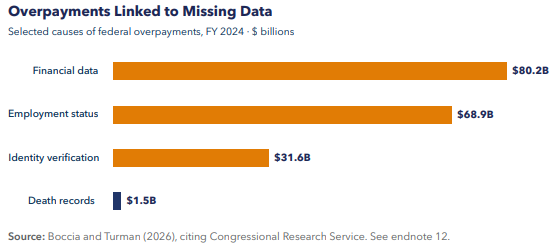
However, access alone does not ensure that DNP will, in fact, be incorporated into existing benefit systems or that their administrators will routinely use DNP infrastructure. Nor will the federal safety net get the most use out of this almost-universal access if only roughly a third of more than 100 potentially useful federal databases have been incorporated into or designated for inclusion in DNP.11 As Romina Boccia and Tyler Turman at the Cato Institute point out, “DNP lacks access to important databases. The system screens well for deceased enrollees, but only $1.5 billion in [fiscal year] 2024 overpayments were death-related. Far larger drivers of overpayments—income and financial data ($80.2 billion), employment status ($68.9 billion), and identity ($31.6 billion)—are not fully accounted for in DNP’s current databases.”12 Thus, bringing additional payment-integrity data into DNP where existing law permits and, where legal restrictions prevent transferring certain data to DNP, allowing DNP to send verification requests directly to the agencies that hold them should become a clear and immediate objective for the administration.
A Prerequisite:
Standardize the Underlying Data
Poorly standardized data remain a substantial hurdle to these reforms. Of more than 100 federal data sources available to agencies for eligibility verification, many were built for individual programs, not for use across government. In the nine sources GAO examined, all contained missing, invalid, or duplicate data, and seven contained inconsistencies with other datasets. Even basic information such as names and addresses lacks a government-wide standard. These differences can be remarkably mundane: one database may record a country label as “United States,” another as “USA,” and another as “US.” Or one may truncate a middle name that another records in full. To a system relying on exact matches, however, the same person or entity might therefore appear facially to be two different individuals.13 Inconsistency of records and poor interoperability of data hinder efficient eligibility checks and cross-program data matching.
Implementation
In 2026, Executive Order 1439514 required each benefit agency to identify the “transactions and processes” most susceptible to fraud and submit a “measurable implementation plan.” The previous year, Executive Order 1424315 separately required agencies to report to the Office of Management and Budget (OMB) regulations that impede data access or sharing. As these orders are implemented, the Task Force to Eliminate Fraud should compile the agency submissions into one table showing, for each high-risk process, the data needed to check it, whether those data are available through DNP, and, if not, what must be changed.
The Treasury, in turn, should use that table to expand and standardize DNP, reducing barriers to using data where possible. It should rank useful federal data sources still outside DNP and, where law permits, work first with the agencies holding those sources on adding them to DNP or making them available through a direct electronic query. The Treasury should also develop common standards for data used in DNP checks. It should decide what each data field means, how it must be written, what information must be present, and what values are invalid. Names, addresses, Social Security and tax-identification numbers, provider identifiers, and other information used for matching should follow the same definitions and formats when sent to DNP. The Task Force should then require each benefit agency to update its implementation plan to state which DNP checks it will automate, what changes its systems need, and a feasible launch date.
OMB should require agencies seeking federal funds for major benefit-system upgrades to demonstrate in the IT investment information they submit with their budget requests that the project will automate verification and support common data standards. Federal benefit agencies should carry these changes into state-administered programs through their authority over federally funded state systems. For example, Medicaid rules provide a 90-percent federal match for qualifying state system development subject to CMS approval; where legally feasible, CMS should use that process to require DNP-compatible connections in future federally funded upgrades.
Expected Benefits:
Expanding DNP in this manner could reduce improper payments and fraud. DNP’s track record is impressive, and its potential to yield savings indisputable: it has already helped prevent or recover nearly $5 billion in improper payments and fraud in fiscal year (FY) 2025, up from more than $2 billion in FY2024.16 Moreover, in September 2026, the Treasury reported that testing 19 additional datasets had identified $28 billion in potential improper payments across the federal government.17 By detecting eligibility problems and suspicious activity before funds are disbursed, and by making agencies’ investigations more effective and efficient, including by connecting fraudulent activities across programs, DNP could save the federal government billions more dollars. In addition, integrating DNP into the safety net could lower administrative costs by eliminating duplicative verification tasks and accelerate eligibility determinations, sparing legitimate beneficiaries the burden of repeatedly collecting and submitting information the government already possesses.
Endnotes
- Matt Weidinger, “Assessing Duplicative Federal Benefit Programs and Preventing Abuse,” American Enterprise Institute, Center on Opportunity and Social Mobility, March 23, 2026, https://cosm.aei.org/assessing-duplicative-federal-benefit-programs-and-preventing-abuse/.
- U.S. Government Accountability Office (GAO), Federal Low-Income Programs: Eligibility and Benefits Differ for Selected Programs Due to Complex and Varied Rules, GAO-17-558 (June 29, 2017), https://www.gao.gov/products/gao-17-558.
- GAO, Combating Fraud: Challenges in Managing Fraud Risks in Federally Funded, State-Administered Programs, GAO-26-109093 (April 15, 2026), 11, https://www.gao.gov/products/gao-26-109093.
- U.S. Department of the Treasury, Bureau of the Fiscal Service, “Do Not Pay: Products,” https://fiscal.treasury.gov/payment-integrity/do-not-pay-dnp/products.
- U.S. Department of the Treasury, Bureau of the Fiscal Service, “Do Not Pay: Data,” https://fiscal.treasury.gov/payment-integrity/do-not-pay-dnp/data.
- GAO, Combating Fraud: Managing Risks in Federally Funded, State-Administered Programs, GAO-26-109100 (July 23, 2026; revised August 7, 2026), https://www.gao.gov/products/gao-26-109100.
- U.S. Department of the Treasury, Bureau of the Fiscal Service, “Do Not Pay: Step 1—Get Acquainted,” https://fiscal.treasury.gov/payment-integrity/do-not-pay-dnp/step-1-get-acquainted.
- Centers for Medicare & Medicaid Services (CMS), “Security of the Marketplace Data Services Hub,” September 11, 2013, https://www.cms.gov/newsroom/fact-sheets/security-marketplace-data-services-hub.
- CMS, “Center for Medicaid and CHIP Services Informational Bulletin,” November 20, 2024, https://www.medicaid.gov/sites/default/files/2024-12/cib11202024.pdf.
- U.S. Department of the Treasury, “Treasury Reports Major Progress in Preventing Fraud and Improper Payments,” October 6, 2026, https://home.treasury.gov/news/press-releases/sb0651.
- GAO, Federal Data: Congressional Action Needed to Improve Interoperability of Award and Payment Eligibility Data, GAO-26-107466 (June 16, 2026), https://www.gao.gov/products/gao-26-107466.
- Romina Boccia and Tyler Turman, “Expanding Treasury’s Do Not Pay System Would Strengthen Welfare Program Integrity,” Cato at Liberty (blog), May 26, 2026, https://www.cato.org/blog/expanding-treasurys-do-not-pay-system-would-strengthen-welfare-program-integrity.
- GAO, Federal Data, GAO-26-107466.
- Executive Order 14395, “Establishing the Task Force to Eliminate Fraud,” March 16, 2026, https://www.whitehouse.gov/presidential-actions/2026/03/establishing-the-task-force-to-eliminate-fraud/.
- Executive Order 14243, “Stopping Waste, Fraud, and Abuse by Eliminating Information Silos,” March 20, 2025, https://www.whitehouse.gov/presidential-actions/2025/03/stopping-waste-fraud-and-abuse-by-eliminating-information-silos/.
- GAO, Federal Data, GAO-26-107466.
- U.S. Department of the Treasury, Bureau of the Fiscal Service, “Treasury Teams Honored for Safeguarding Public Funds and Expanding Data Transparency,” September 23, 2026, https://fiscal.treasury.gov/about-us/news/treasury-teams-honored-for-safeguarding-public-funds-and-expanding-data-transparency.
Stop Collecting Data that Enables Racial Discrimination
John Early, Cato Institute
Recommendation:
The Office of Management and Budget (OMB) and the Census Bureau should eliminate the regulations and procedures that require racial and ethnic categories to be applied to data collected by the federal government. OMB should also forbid any data collection by race and ethnicity that is not explicitly required by statute. Classifying people by race or ethnicity is contrary to constitutional law and underlying American values of equality. The regulation and procedures to produce racial data also violate the facts of reason and history.
The Problem
America has a long and painful journey from slavery and relocation of native populations to abolition, to Jim Crow, to the 1964 Civil Rights Act. More than 50 years of experience since that act have clearly established the principles of no racial discrimination in both law and culture. Like all moral and legal standards, this principle also is sometimes violated. But today the principle is so strongly and widely held that 20% of newly married couples cross racial lines.1
Unfortunately, one of the enablers of continuing discrimination is the federal government. Chief Justice Roberts has clearly laid out the simple principle to eliminate this threat: “The way to stop discrimination on the basis of race is to stop discriminating on the basis of race.”2 Government collecting and acting on individuals’ beliefs about their race or ethnicity is inherently antithetical to this foundational American value.
We are the country of “created equal” and “e pluribus unum.” Contrary to these values, the Office of Management and Budget (OMB) Statistical Policy Directive 15 (SPD 15) in 2024 that directed and enabled the Census Bureau to create a total of 6,676 racial and ethnic classes by which people are to be divided, separated, discriminated against, or given special favors. 3 When government collects and classifies individual data by personal racial and ethnic characteristics, it is laying the foundation for discrimination and oppression. These threats are not hypothetical. Racial data has been used for decades to discriminate among and harm Americans.4
OMB’s justification for the new SPD 15 tried to evade the constitutional demand for nondiscrimination by asserting that the racial data “are not to be used for determining the eligibility of population groups for participation in any Federal programs.” 5 But it also said they will be used to “allocate program or initiative benefits,” 6 “used on …benefit applications,” 7 “allocate needed resources,”8 and “program administration and assessment, and enforcement.”9 When government collects, processes, analyzes, and publishes classifications by race and ethnicity, it is discriminating by race and facilitating still more discrimination.
Within our living memory, we have seen and continue to see multiple examples of massive racial and ethnic genocide: Jews by Nazis; Greeks, Armenians, and Kurds by Turkey; Tutsi by Rwanda; Uyghurs and Tibetans by China. France learned a lesson when the Vichy government used racial records to betray French Jews. French law now forbids most government collection of data by race. America should do no less.
Some data collection by race is also illegal under explicit statutory provisions, violating 13 US Code § 221(c): “Notwithstanding any other provision of this title, no person shall be compelled to disclose information relative to his religious beliefs or to membership in a religious body.” Serbs, Croats, and Bosniaks are each identified and coded differently in the Census racial classification. Yet, before the ninth century, the ancestors of all three were undifferentiated. Even today they speak the same language, and native speakers typically cannot distinguish the different “native” tongue of their interlocutor from the broader population. Their different religions (Orthodox Christian, Roman Catholic, Muslim) are the only differentiators. A race question to a person from one of these ethnicities is equivalent to asking them to declare their religious affiliation or heritage and a violation of the law.
Even if it did not fail on constitutional, legal, or ethical grounds, SPD 15 is, by its own admission, anti-scientific, illogical, and unhistorical: “The categories in these standards are understood to be socio-political constructs and are not an attempt to define race and ethnicity biologically or genetically.” 10
The “standards” are only the respondents’ personal opinion as to which of the 6,676 categories their ancestors belonged to, and they can change that opinion at any time. There is no way to validate these opinions because, by OMB’S own words, that is all they are—opinions. Nevertheless, there are cases where Census has stepped in to override the respondents’ opinions with its own opinion. Although 67% of Brazilians claim “Hispanic or Latino” heritage, the Census Bureau reclassifies them all as “Some Other Race and/or Ethnicity.” So, citizens of the largest country in Latin America are not “Latino.” In fact, they are just “some other” race.
The OMB definitions of races are inherently wrong. They are of the form: “[A race]. Individuals with origins in any of the original peoples of [a geographic area], including, for example, [some races].” OMB defines: “White. Individuals with origins in any of the original peoples of Europe, including, for example, English…” 11 The example of “English” is absurd. The word “English” comes from the “Angles,” who with the Saxons and Jutes conquered the island of Britannia in the fifth century following the withdrawal of Rome after its 500-year occupation of the Celtic Britons, who in turn were one of the Celtic tribes which had migrated there from Iberia, which is now Spain. So, are the “original” people of the island Britannia some conquerors from Espana, and hence Hispanics? Or are the originals the Anatolian soldiers in the Roman army who left their genetic imprints on inhabitants of “English” villages even to this day? Certainly, they are not the English descendants of the Angles who didn’t even arrive before 450. How about the Vikings or Norsemen from the ninth century or the Norman French from 1066? Not to mention the paleolithic hunter-gatherers who were driven from the island by the last ice age.
Census also labels Turks as White, which by the OMB definition, means they are original people of Europe. But only 15% of Turkey’s population and 3% of its land mass are on the western (European) shore of the Bosporus. The 97% of Turkey that lies in Asia has greater land mass than any European country. Reference books, the UN, and the Turkish government itself identify Turkey as primarily lying in Anatolia, Asia Minor, or Western Asia. Furthermore, Turks are not even close to being “original” people. They conquered and settled in eastern Anatolia only in the late eleventh century, coming from a part of Central Asia area now constituting Turkmenistan. For more than 300 years they systematically annihilated, exiled, enslaved, or absorbed Greeks, Armenians, Kurds and dozens of other ethnicities as they slowly marched westward through Anatolia until they finally completed their conquest of what is now Turkey with the fall of Constantinople in 1453.
And what about Spaniards? This definition makes them European and White. But OMB has snatched them from all other Europeans and made them “Hispanic or Latino.” Spanish is a European language of the Romance family. Creating a separate race of “Hispanic or Latino,” makes no more sense than creating a separate race for “Anglophones” from Great Britain, US, Canada, Australia, New Zealand, Singapore, the Falkland Islands, and some others.
The Census Bureau recently filed a proposed rule in the Federal Register that would eliminate questions on race and ethnicity from the 2030 decennial census. But this timid initial step is inadequate and even explicitly states that the proposed rule would not preclude collection of race and ethnicity data in other surveys conducted by the Census Bureau.12 Census and other agencies still collect and intend to collect more data on race and ethnicity.
The Supreme Court has been making it increasingly clear that any discrimination by race or ethnicity is unconstitutional.13 Under these recent decisions, any of the OMB-listed purposes would likely be unconstitutional. The current administration has also been clear in its intention to root out government administrative activity based on racial discrimination, including the perverse use of racial profiling based on disparate outcomes as a means to implement such discrimination.14
An immediate end to racial and ethnic discrimination in data collection like the solution described below would proactively and rapidly advance both judicial and executive objectives.
Expected Benefits of Fixing the Problem
The proposed fix will reverse and eliminate policies and procedures used to generate false racial data. It will, thereby, eliminate a resource that deceives the country about its population and facilitates racial profiling and discrimination. It will restore the rule of law and aid in protecting our liberty.
Administrative Fix For Excessive Racial Data
The obvious, necessary, and easy fix is to revise and reissue SPD 15. Revised wording would read something like:
No agency of the federal government shall collect, process, or publish any data related to the race or ethnicity of any individual or group of individuals, except for data explicitly required by law, and then only to the minimum extent necessary to comply with the law.
Endnotes
- Gretchen Livingston and Anna Brown, “Intermarriage in the U.S. 50 Years After Loving v. Virginia,” Pew research, May 18, 2017, https://www.pewresearch.org/social-trends/2017/05/18/intermarriage-in-the-u-s-50-years-after-loving-v-virginia/.
- Supreme Court, 2007 “Parents Involved, 551 U.S. 701, 748 (2007) (plurality opinion)”. (https://www.supremecourt.gov/opinions/boundvolumes/551bv.pdf),
- Office of Management and Budget, “Statistical Policy Directive 15 on Race and Ethnicity Data Standards,” https://spd15revision.gov/content/spd15revision/en/2024-spd15.html. Department of Commerce, Census Bureau, “The Census Bureau’s Proposed Race/Ethnicity Code List for the American Community Survey and the 2030 Census, Vol. 89/ No. 222, Monday November 18, 2024, pp. 90663-64.
- David E. Bernstein, Classified: The Untold Story of Racial Classification in America, ( Nashville, TN: Post Hill Press), 2022.
- Federal Register / Vol. 88, No. 18/ Friday, January 27, 2023/Notices, “Initial Proposals For Updating OMB’s Race and Ethnicity Statistical Standards, , https://www.federalregister.gov/documents/2023/01/27/2023-01635/initial-proposals-for-updating-ombs-race-and-ethnicity-statistical-standards, p. 5377.
- Federal Register, Vol. 88, No. 18/ Friday, January 27, 2023, p. 5378
- Federal Register, Vol. 88, No. 18/ Friday, January 27, 2023, p. 5376
- Federal Register, Vol. 88, No. 18/ Friday, January 27, 2023, p. 5378
- Federal Register, Vol. 88, No. 18/ Friday, January 27, 2023, p. 5379
- https://spd15revision.gov/content/spd15revision/en/2024-spd15.html.
- https://www.govinfo.gov/content/pkg/FR-2024-03-29/pdf/2024-06469.pdf
- Federal Register, / Vol. 91, No. 174 / Thursday, September 10, 2026 /, “Decennial Census of the Population of Americans; Proposed Residence Criteria and Proposed Regulations for Demographic Questions,” Proposed Rules, pp. 57524-57531.
- Most recently, in Louisiana v. Callais it narrowed Section 2 of the Voting Rights Act to prohibit intentional Congressional districting to create so-called majority-minority districts.
- https://www.whitehouse.gov/presidential-actions/2025/01/ending-radical-and-wasteful-government-dei-programs-and-preferencing/ and https://www.whitehouse.gov/presidential-actions/2025/01/ending-illegal-discrimination-and-restoring-merit-based-opportunity/.
Rescind the Biden Administration’s Rule on the Community Eligibility Provision for School Meal Programs
by Romina Boccia & Tyler Turman, Cato Institute
Recommendation:
The National School Breakfast and Lunch Programs are meant to provide free and reduced-price meals to low-income students. The Community Eligibility Provision, created in 2010, allows schools to serve free meals to all students, regardless of income, when enough students qualify through other welfare programs. A 2023 rule lowered the qualifying threshold from 40 percent of students to 25 percent. This rule led to approximately three million students, of whom 1.5 million would not otherwise qualify, receiving subsidized meals in the 2025-2026 school year, while allowing primarily Democratic states with universal free-meal programs to shift more of the costs of those policy choices onto federal taxpayers. The Food and Nutrition Administration should rescind the 2023 rule and restore the 40 percent threshold, saving approximately $1 billion over the next decade.
Introduction:
The federal government spent approximately $25 billion1 on the National School Breakfast and Lunch Programs in fiscal year 2025. These two programs, administered by the US Department of Agriculture (USDA), subsidize meals2 for nearly 30 million children in more than 90,000 schools each year. Under both programs’ eligibility rules, a child qualifies for free or reduced-price meals if their household’s income falls within federal eligibility limits3 or if they are directly certified for free meals through participation in public assistance programs like the Supplemental Nutrition Assistance Program, Temporary Assistance for Needy Families, or, in 44 states4, Medicaid.5
The share of school-lunch-eating children who received free or reduced-price lunches rose from 52 percent in 2016 to 69 percent in 2025. This share rose from 93 percent to 95 percent among children in households in the lowest income quintile. In the highest-income quintile, however, the share more than tripled, from 13 percent in 2016 to 42 percent in 2025. This suggests that federally subsidized meals are increasingly reaching beyond the low-income families that these programs were originally meant to serve.6
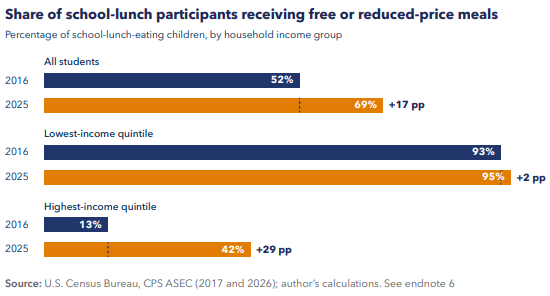
Part of this trend can be explained by the Community Eligibility Provision7 (CEP), created in 2010, which allows qualifying schools to serve breakfast and lunch at no charge to every enrolled student, regardless of income. This policy, ostensibly, was meant to help combat child hunger in high-poverty areas8 while reducing administrative burden on schools. Today, CEP is increasingly used by states that offer subsidized school meals to all students to shift part of the cost of those programs onto federal taxpayers, who now pay for meals that state taxpayers would otherwise fund.
Eligibility for participating in CEP depends on a school’s identified student percentage (ISP). ISP is the share of enrolled students directly certified for free meals because their households participate in qualifying welfare programs. A local educational agency (LEA), usually a school district, may elect to implement CEP for all schools that the LEA oversees, a smaller group of schools, or a single school, provided that the school(s) met the minimum ISP as of April 1 of the previous school year. Participating schools then serve meals to all students at no charge for a four-year period, which districts can renew.
The Problem:
Federal law originally required9 schools to have an ISP of 40 percent or higher to qualify for CEP. In 2023, the Food and Nutrition Service (FNS, since renamed the Food and Nutrition Administration, or FNA) reduced the qualifying ISP threshold to 25 percent,10 which took full effect in the 2024–2025 school year. Consequently, a provision originally intended for “high poverty areas” now covers schools where only one in four enrolled students is directly certified for free meals through a qualifying welfare program.
The 2023 rule mainly benefits the nine states with universal free school meal programs, eight of which voted Democratic in the 2024 election.11 In most states, an LEA that elects CEP for a school forgoes the payments families would otherwise make for some students’ meals. LEAs must instead cover the shortfall in federal reimbursement with nonfederal funds, such as12 state and local tax revenue, so that all students receive meals at no charge. In other words, taxpayers pay for meals that families would otherwise have helped pay for. In states with universal free meal programs, however, all school meals are already subsidized by state taxpayers. By enrolling in CEP, schools in those states can draw federal taxpayer subsidies for meals that state taxpayers would otherwise fund.
Federal taxpayers subsidize each school lunch by a fixed amount that depends on the student’s eligibility. For the 2026-2027 school year, schools participating in the National School Breakfast Program receive federal subsidies worth $2.54 for a free breakfast, $2.24 for a reduced-price breakfast, and 42 cents for a student who does not qualify and pays full price for meals. Schools where at least 40 percent of lunches served two years earlier were free or reduced price are designated as “severe need,” and receive an enhanced subsidy of $3.05 for free and $2.75 for reduced-price breakfasts, and 42 cents for non-qualifying students.13 Schools participating in the National School Lunch Program have a similar reimbursement structure. For the 2026–2027 school year, federal taxpayers pay14 schools $4.76 for a free lunch, $4.36 for a reduced-price lunch, and 45 cents for a student who does not qualify for either.15
LEAs not participating in CEP establish each student’s eligibility for subsidized breakfast and lunch, either by directly certifying students based on their household’s participation in other welfare programs, or by approving a household application that meets the program’s statutory income requirements. CEP schools must participate in both the School Breakfast and National School Lunch Programs and serve both meals at no charge to all students. CEP schools skip applications and instead receive $3.05 per breakfast and $4.76 per lunch, for a share of school meals equal to the ISP multiplied by 1.6, a formula16 meant to estimate the share of students who would qualify if families applied, and 42 cents per breakfast and 45 cents per lunch, for the rest. Schools with ISPs between 25 and 39 percent that would not otherwise qualify as “severe need” have an added incentive to adopt CEP. Because federal taxpayers reimburse 40 percent or more of schools’ meals at the free rate (25 times 1.6 equals 40, the minimum threshold), these schools are classified as “severe need” and are eligible for the enhanced federal subsidy of $3.05 per free breakfast instead of $2.54.
Consider a school with an ISP of 30 percent that serves 185 breakfasts and 350 lunches a day over a 180-day school year in a state that, like Vermont, supplements federal funding with state funding so that all students eat free meals.17 Under the original 40 percent threshold, the school could not adopt CEP, so federal subsidies would follow each student’s eligibility, and the state paid the rest.18 In addition to the 30 percent of students who are directly certified, some students qualify for free meals through household applications.19 Under the 2023 rule, the school can adopt CEP and receive $3.05 per breakfast and $4.76 per lunch for 48 percent of its meals (30 percent multiplied by 1.6). Federal reimbursement rises from about $197,200 to $214,700 per year while state spending falls by $16,100, shifting about $64,400 from state to federal taxpayers over a four-year CEP cycle.20
Several states have built their school meal programs around the goal of adopting CEP to maximize federal breakfast and lunch subsidies while reducing state expenditures. For example, Maine21 requires schools eligible for CEP to enroll or forgo state meal funding and directs schools to “maximize the amount of federal reimbursement funds that the school receives.” California, similarly, requires22 eligible schools to adopt CEP or a similar federal option, which the state assembly’s budget subcommittee described23 as a way “to increase federal reimbursements.”
Approximately 4,000 of the 5,600 schools with ISPs between 25 and 39 percent that adopted CEP in 2025–2026, or 72 percent, were in the nine primarily Democratic states with universal free-meal programs. Within those states, 76 percent of eligible schools in that range adopted CEP. In all other states, only 15 percent did.24
The number of CEP schools rose from 14,184 in 2014–2015, the first year CEP was available nationwide, to 40,235 in 2022–2023, the last full school year before the rule took effect. Since then, the number has increased to 55,362 schools serving 27.6 million students25 in 2025–2026. The rule also led to an additional three million students, of whom approximately 1.5 million would not have qualified under the pre-2023 CEP threshold, to receive subsidized breakfasts and lunches paid, in part, by federal taxpayers in the 2025-2026 school year.26
The Solution:
As Cato Institute scholar Chris Edwards has noted,27 “the CEP process has opened the door to millions of children from middle- and higher-income households receiving free meals at taxpayer expense.”
The 2023 CEP expansion further exacerbates this trend and undermines the school food programs’ focus on targeting meal subsidies to low-income students by having taxpayers pay for subsidized meals to students who would not otherwise qualify. To address this and restrict states’ ability to offload the cost of state-funded school meal programs onto federal taxpayers, FNA should restore the CEP eligibility threshold to 40 percent, the maximum ISP permitted by federal statute. FNA can do this by rescinding the agency’s prior 2023 amendment to Title 7 of the Code of Federal Regulations (CFR) § 245.9(f), which reduced the threshold to 25 percent.28
To improve transparency between the federal government and taxpayers, FNA should also publish an estimate of the cost of the 2023 rule to federal taxpayers. When FNS issued the rule, the Office of Management and Budget classified the change29 as not significant, and USDA did not estimate the change’s effect on federal reimbursements. As part of the reversal, FNA should provide a comprehensive report on how many schools below the 40 percent threshold use CEP, how much federal reimbursement those schools receive, and how much restoring the pre-2023 CEP eligibility threshold would save federal taxpayers by reducing school meal program spending.
Expected Benefits:
Restoring the original 40 percent threshold for CEP would save federal taxpayers approximately $1 billion in reduced breakfast and lunch subsidies over the next decade.30 Ending the de facto enhanced federal subsidy for universal-meal programs created by the 2023 rule would also weaken incentives for other states to adopt costly universal school meal programs, with the expectation that federal reimbursements will cover much of the associated costs.
In schools that leave CEP, federal reimbursement would again follow each student’s eligibility. Children from families who are directly certified through enrollment in other welfare programs would still receive fully subsidized meals. Other eligible families in those schools could still apply for benefits individually, as is standard in most other federal welfare programs.
If federal taxpayers are going to subsidize students’ meals, those subsidies should reach low-income families who would otherwise likely be unable to pay for their children’s school meals. States that want to provide free meals to all students, regardless of family income, could still do so, but state taxpayers, not federal taxpayers, should bear the cost of that policy choice.
The 2023 rule compromised on this principle by letting schools with ISPs as low as 25 percent receive federal reimbursement at the free-meal rate for a formula-determined share of lunches, which allowed states that fund universal meals to shift more of that cost onto federal taxpayers. By rescinding the rule, FNA would help tie federal reimbursement in those schools back to individual students’ eligibility, help ensure federal subsidies are targeted to low-income students, and strengthen financial responsibility for states that choose to run universal meal programs.
Endnotes
- US Department of Agriculture, Food and Nutrition Service, “Program Information Report (Keydata): US Summary, FY 2025–FY 2026,” February 2026.
- Kara Clifford Billings, School Meals and Other Child Nutrition Programs: Background and Funding, CRS Report R46234 (Congressional Research Service, July 16, 2025).
- Children in households with incomes at or below 130 percent of the federal poverty level qualify for free meals, and those with incomes between 130 and 185 percent qualify for reduced-price meals. For the 2026–2027 school year, those limits are $42,900 and $61,050 for a family of four in the contiguous states. “Child Nutrition Programs: Income Eligibility Guidelines,” 91 Fed. Reg. 17932 (April 9, 2026).
- Erin Kennedy Hysom, Community Eligibility: The Key to Hunger-Free Schools, School Year 2025–2026 (Food Research & Action Center, July 2026).
- This only applies when Medicaid records show household income at or below 130 percent of the federal poverty level. See 7 CFR § 245.2.
- Author’s calculations using US Census Bureau, “Current Population Survey Annual Social and Economic Supplement (ASEC),” 2017 and 2026 data.
- 7 CFR § 245.9.
- “National School Lunch Program and School Breakfast Program: Eliminating Applications Through Community Eligibility as Required by the Healthy, Hunger-Free Kids Act of 2010,” 81 Fed. Reg. 50194 (July 29, 2016).
- Healthy, Hunger-Free Kids Act of 2010, Pub. L. No. 111-296, § 104(a), 124 Stat. 3183, 3193 (2010).
- The Healthy, Hunger-Free Kids Act of 2010, which created the Community Eligibility Provision, gave USDA the authority to “use a threshold that is less than 40 percent,” beginning in the 2014–2015 school year. Healthy, Hunger-Free Kids Act of 2010, Pub. L. No. 111-296, § 104(a), 124 Stat. 3183, 3195–96 (2010).
- The nine states with universal free meal programs are California, Colorado, Maine, Massachusetts, Michigan, Minnesota, New Mexico, New York, and Vermont. All states except Michigan voted Democratic in the 2024 election, with Maine splitting between Democratic and Republican.
- “Public School Revenue Sources,” Condition of Education, National Center for Education Statistics, May 2024.
- “National School Lunch, Special Milk, and School Breakfast Programs, National Average Payments/Maximum Reimbursement Rate,” 91 Fed. Reg. 43597 (July 16, 2026).
- “National School Lunch, Special Milk, and School Breakfast Programs, National Average Payments/Maximum Reimbursement Rate,” 91 Fed. Reg. 43597 (July 16, 2026).
- Schools participating in the National School Lunch Program receive a 45 cent payment for every lunch that meets federal nutrition standards, including lunches that students pay for themselves. Lunches served to students who qualify for free or reduced-price meals earn an additional $4.31 or $3.91, which produces the $4.76 and $4.36 above. See 7 CFR pt. 210, subpt. B.
- 7 CFR § 245.9(f).
- US Department of Agriculture, Food and Nutrition Service, “Program Information Report (Keydata), US Summary, FY 2025–FY 2026,” April 2026, table 3.
- Some states have also grouped lower-ISP schools with higher ISP-schools, such that all schools in that area could qualify for CEP if they had an average ISP that qualifies for the provision, even if some schools had ISPs that would not qualify them individually.
- The example assumes the school certifies 43.5 percent of students for free meals, 30 percent through direct certification, and 13.5 percent through applications, reflecting the roughly one-quarter decline in application-based certifications that Vermont experienced after meals became free for all students. See Julia Richter, “Report on Possible Revenue Sources for Universal School Meals,” Vermont Legislative Joint Fiscal Office, February 8, 2023; Daniel M. French, “AOE Testimony: S.100 – Universal/Local School Meals,” Vermont Agency of Education, March 9, 2021.
- Author’s calculations based on 63,000 lunches and 33,000 breakfasts a year at rates described in notes 13 through 15, treating all certified students as qualifying for free rather than reduced-price meals, holding rates at 2026–2027 levels. The 350 lunches per day equal about 65 percent of the average enrollment of approximately 540 students in the 5,600 CEP schools with ISPs between 25 and 39 percent, in line with national lunch participation of about 60 percent of enrolled students and the higher participation USDA found in CEP schools. See US Department of Agriculture, Food and Nutrition Service, “National School Lunch Program: Participation and Lunches Served,” data as of January 23, 2026; Brett Eiffes et al., Household Application Collection: A Research Brief about School Year 2022–2023 (US Department of Agriculture, Food and Nutrition Service, 2025); “Child Nutrition Programs: Community Eligibility Provision—Increasing Options for Schools,” 88 Fed. Reg. 65778 (September 26, 2023).
- Me. Rev. Stat. tit. 20-A, § 6602-A.
- “California Universal Meals,” School Nutrition, California Department of Education, last reviewed September 16, 2026.
- Assembly Budget Subcommittee No. 3 on Education Finance, “Agenda,” California State Assembly, March 20, 2024, p. 4.
- Erin Kennedy Hysom, Community Eligibility: The Key to Hunger-Free Schools, School Year 2025–2026 (Food Research & Action Center, July 2026).
- Erin Kennedy Hysom, Community Eligibility: The Key to Hunger-Free Schools, School Year 2025–2026 (Food Research & Action Center, July 2026).
- Author’s calculations using data from Food Research & Action Center, “Community Eligibility Database,” 2025–2026 school year. Enrollment was summed for the 5,600 CEP-participating schools with ISPs between 25 and 39 percent, for a total of about 3.01 million students. Enrollment for the 19 schools with no reported data was estimated using the median enrollment of other CEP schools in the same district with ISPs between 25 and 39 percent. For the three schools with no such schools in their district, the state median for that range was used instead. To estimate how many students would qualify for free or reduced-price meals, each school’s ISP was multiplied by USDA’s 1.6 multiplier and then by the school’s enrollment, which yields about 1.53 million students, or 51 percent of the total. The remaining 1.48 million students would not qualify under that formula.
- Chris Edwards, “Cutting School Food Subsidies,” Cato Institute Policy Analysis no. 993, March 25, 2025, p. 4.
- 7 CFR § 245.9(f).
- “Child Nutrition Programs: Community Eligibility Provision—Increasing Options for Schools,” 88 Fed. Reg. 65778, 65785 (September 26, 2023).
- Author’s calculations using school-level enrollment and ISP data from Food Research & Action Center’s Community Eligibility Database, USDA participation data, and 2026–2027 federal reimbursement rates. The estimate compares federal breakfast and lunch reimbursement for the 5,600 CEP schools with ISPs between 25 and 39 percent against what those schools would receive if reimbursement depended on each student’s eligibility, accounting for higher meal participation, as USDA’s CEP Characteristics Study found in CEP schools. The difference is about $97 million per year, or about $1.1 billion over 10 years with annual inflation adjustments to reimbursement rates. See Food Research & Action Center, “Community Eligibility Database,” 2025–2026 school year; US Department of Agriculture, Food and Nutrition Service, “Program Information Report (Keydata), US Summary, FY 2025–FY 2026,” April 2026; “National School Lunch, Special Milk, and School Breakfast Programs, National Average Payments/Maximum Reimbursement Rate,” 91 Fed. Reg. 43597 (July 16, 2026); J. Murdoch et al., USDA Community Eligibility Provision Characteristics Study, School Year 2016–2017 (Summary) (US Department of Agriculture, Food and Nutrition Service, 2022).
Replace the Incorrect Census Bureau Measures of Income Inequality and Poverty
by John Early, Cato Institute
Recommendation:
The official measures of income inequality and poverty are seriously flawed, overstating poverty by about a factor of ten and income inequality by a factor of four. These flaws can be fixed by revising an OMB directive and related Census Bureau procedures to account for income that Census ignores, adjusting income for taxes, and using more accurate Consumer Price Indexes.
The Problem:
The official poverty rate is not defined by statute. There is general guidance on its calculation in OMB Statistical Policy Directive 14 (SPD 14),1 but much of the effective definition has been decided by Census Bureau staff. The result has been an overstatement of poverty because it fails to count 88% of the government welfare payments that poor families receive as income. It also fails to reduce income by taxes taken by government. And it calculates the poverty thresholds that identify the income levels below which poverty exists using an outdated Consumer Price Index that overstates price increases and, thereby, overstates the current income levels used to determine poverty.
The Census Bureau’s official poverty incidence for 2025 is 10.2% of the population.2 At least four rigorous studies using a variety of different methods have shown that the official poverty measure should be in the neighborhood of 1%, about one-tenth of the official number.3 The same data set is used to support the claim that income inequality is high and rising, with the top quintile of household income being 16.7 times higher than the bottom quintile. But if transfer payments and taxes are treated correctly, the difference is only 4.0 times as large.4
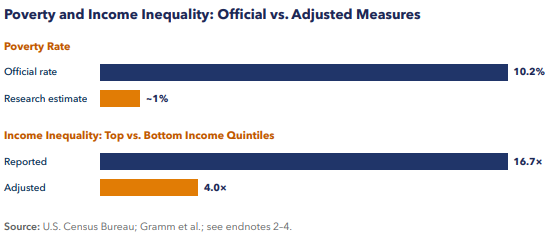
The exaggerated poverty level and overstated income inequality have been excuses for greatly increasing government spending that goes far beyond what is needed to eliminate poverty. In 2024, $240 billion would have been enough to lift every poor family out of poverty, even by the overstated official measure. An additional $322 billion might be justified to phase-out payments to poor and near-poor families to avoid benefit cliffs that create disincentives for working.
The federal government alone spent $1.437 trillion in means-tested transfer payments putatively to fight poverty. But only 12% of these payments that went to poor families were counted by Census as income for the families. The misleadingly high official poverty rate and measures of inequality have been used as an excuse to justify giving the additional $909 billion to families with incomes more than twice the official poverty rate and raising the actual income of low-income families to middle-class levels without anyone in the family working a single day.
Expected Benefits:
More accurate measures of household income and poverty will clarify that as a nation we are overspending substantially on giving money to households that choose not to work. Better measures will clarify the need to spend far less money to fund high-cost government transfer programs.
Today, federal government means-tested transfer payments per poor person adjusted for inflation are more than 15 times larger than when the War on Poverty began, creating an average offer of more than $65,000 per annum in government funds to households where prime work-age adults chose not to work. More than 64% of prime work-age adults in the bottom quintile of household income accepted the government’s increased offer. As a result, the percentage of prime work-age adults in the bottom income quintile who worked even just a single day in the last year has fallen by three-quarters, from 47% in 1967 to 11.2% in 2025.
Today, the federal government spends nearly $1 trillion beyond what is necessary for lifting families out of poverty with benefits that slowly phase out at twice the official poverty level. This excess spending creates multiple deleterious effects, including (1) lost production from people who chose idleness over productivity, (2) lost upward mobility for those who choose idleness, (3) lost well-being for everyone from slower growth, and (4) higher inflation from the flood of government bonds that expand the money supply to fund the deficit, more than half of which is caused by these excessive transfer payments.
Under the current regime, we are pumping a trillion dollars each year into households that are classified as poor only because we measure them wrong and, as a result, incentivize them to withdraw from the workforce. The 1% who remain poor are poor not because they lack money but because they lack the capability to care for themselves; the shortage of money is a symptom, not the cause. The 1% need small, focused programs available from local charitable groups, not large, ponderous, bureaucracies with incentives to perpetuate and enrich themselves.
Administrative Fix Outline for The Overstated Measures of Poverty and Inequality
A revised and strengthened SPD 14 accompanied by strong executive direction at the Census Bureau can fix the misleading and overstated measurement of poverty and income inequality. The spending on government transfer payments to households is mostly created by statute. The measurement problem, however, was created administratively, so an administrative fix is appropriate, although legislation would make the fix more enduring.
To ensure complete and accurate replacement of the current erroneous measures of poverty and income inequality, the revised or replacement SPD 14 will require considerable technical detail, which is available in the appendix of this handbook. The principal features of this directive are:
- Replace the old CPI-U with the improved and less biased Chained Consumer Price Index for All Urban Consumers to adjust poverty thresholds for inflation.
- Update earned income to include employer-paid benefits such as health insurance.
- Include all saving and investment income such as annuities and retirement plans.
- Include private transfers from charitable organizations, family, etc. as income.
- Add all federal, state, and local government transfer payments to income, including food stamps, Medicaid, refundable tax credits, and public housing that have been excluded previously.
- Subtract all federal, state, and local taxes from income.
Endnotes
- https://www.census.gov/topics/income-poverty/poverty/about/history-of-the-poverty-measure/omb-stat-policy-14.html.
- Christina Bijou and Emily A. Shrider, Poverty in the United States: 2025: Current Population Reports, P60-290, September 2025, U.S. Bureau of Census, p. 1.
- Phil Gramm, Robert Ekelund, John Early, The Myth of American Inequality: How Government Biases Policy Debate, (Lanham, MD: Roman & Littlefield, 2022). Richard Burkhauser, Kevin Corinth, James Elwell, and Jeff Larrimore, “Evaluating the Success of the War on Poverty since 1963 Using an Absolute Full-Income Poverty. Measure,” Journal of Political Economy, Volume 132, Number 1, January 2024, pp. 1-47. Bruce D. Meyer and James X. Sullivan, “Winning the War on Poverty: Poverty from the Great Society to the Great Recession,”
- Phil Gramm, et al., p.30.
How HHS Could Deter Welfare Payments to Households Headed by Illegal Aliens
by Matt Weidinger, American Enterprise Institute
Recommendation:
As part of its efforts to improve program integrity and direct more federal benefits to deserving Americans, the Trump administration has focused on ending costly spending1 and welfare benefit payments2 to illegal aliens. That focus is consistent with the longstanding intent of US immigration law, including the immigration enforcement provisions of the 1996 welfare reform law, which stated that “[i]t is a compelling government interest to remove the incentive for illegal immigration provided by the availability of public benefits.”3
Despite that intent, the Temporary Assistance for Needy Families (TANF) program for decades has provided welfare checks to households headed by illegal alien adults. That pattern of benefit collection is not unique to the TANF program4 and is especially common in California.5
To rectify this problem, the Department of Health and Human Services (HHS) should clarify that state TANF agencies must report to federal officials on illegal alien members of TANF households, and especially household heads receiving TANF checks. This clarifies current data reporting requirements and is likely to better prevent illegal aliens from accessing major federal public benefits. States that fail to provide the required information would experience a four percent reduction in their annual TANF block grant, also consistent with current law.
The Problem:
TANF is a major means-tested benefit program that was created in the 1996 welfare reform law as a replacement for the former Aid to Families with Dependent Children program.6 TANF provides more than $16 billion in annual federal block grants to states to support welfare checks and other types of aid to low-income families with children. Since its creation, TANF’s results include remarkable declines in welfare dependence and poverty alongside significant increases in work and earnings among low-income single parents most likely to depend on welfare.7
States have broad flexibility in using federal TANF funds to provide assistance to needy families, including determining who is eligible, what assistance is provided, and what conditions apply to benefit recipients. Over time, a growing share of TANF assistance has been in the form of monthly “child-only” benefit checks, for which one or more children is eligible but not an adult. In many cases, the households in question are headed by illegal alien adults, who receive benefit checks on behalf of their typically US-born citizen child or children.
That provision of benefits to illegal alien adults violates the intent of national immigration law. Title IV of the 1996 welfare reform law stated that “It continues to be the immigration policy of the United States that…aliens within the Nation’s borders not depend on public resources to meet their needs” and that “the availability of public benefits not constitute an incentive for immigration to the United States.” Specifically regarding illegal aliens, the law added that “It is a compelling government interest to remove the incentive for illegal immigration provided by the availability of public benefits.”8
Despite that intent, HHS data indicate that in 2024 over 85,000 TANF recipient families nationwide were headed by adults who were personally ineligible for assistance due to their alien status (which includes, but is not limited to, illegal alien parents). California leads the nation with almost 60,000 households in this category, or about 70 percent of the national total.9 These cases constitute over 20 percent of California’s entire TANF caseload. The next closest state was New York, with approximately 7,000 child-only cases headed by an adult ineligible due to his or her alien status. Nationwide, TANF cash assistance paid to households headed by one or more adults ineligible due to alien status totaled $759 million in 2024, or an annual average of $8,904 per such household. Households often receive additional benefits from other programs, including the Supplemental Nutrition Assistance Program (SNAP, formerly called food stamps) and Medicaid.10
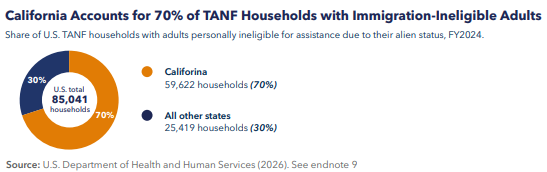
Beyond the significant number of such cases and their large cost for taxpayers, two important policy concerns proceed from the fact that TANF pays welfare checks to households headed by illegal alien parents.
First, despite receiving the TANF payment for eligible children in the household, the ineligible parent is not considered “on” TANF. As a result, work requirements that otherwise apply to citizen or qualified alien parents do not apply to illegal alien adults in these cases. That contributes to the fact that TANF includes a greater percentage of nonworking recipients (46 percent in 2023) than SNAP (41 percent), whose work requirements the One Big Beautiful Bill Act strengthened.11
Second, the payment of child-only TANF benefits to households headed by illegal alien adults undermines other policies meant to reduce dependence on welfare checks. The five-year lifetime limit that otherwise applies to adults collecting federal TANF assistance does not apply in child-only cases.12 HHS data show that almost half of families on TANF in 2024 were exempt from the five-year limit—most often because the adult head was provided child-only benefits.13
That reflects how, even as the TANF caseload has declined sharply, a significant share of remaining cases is exempt from TANF policies designed to limit dependence, including work requirements and time limits.14 That dynamic has had predictable effects. While it did not break out benefit duration by type of household head, a 2024 report from the Chapin Hall Center at the University of Chicago found that “TANF cases with only child recipients have longer periods of TANF participation compared to TANF cases with adult recipients.”15
The Solution:
The Trump administration in a February 2025 presidential action titled “Ending Taxpayer Subsidization of Open Borders” spelled out its goal to “ensure, to the maximum extent permitted by law, that no taxpayer-funded benefits go to unqualified aliens.”16 That action noted that the payment of welfare benefits to illegal alien adults was “acting as a magnet and fueling illegal immigration to the United States,”17 undermining the intent of the 1996 welfare reform law to “remove the incentive for illegal immigration provided by the availability of public benefits.”18 Consistent with that interest, the presidential action called on executive branch agencies to identify federally funded programs that “permit illegal aliens to obtain any cash or non-cash public benefit” and “take all appropriate actions to align such programs with the purposes of this order,” which include ensuring that programs “do not, by design or effect, facilitate the subsidization or promotion of illegal immigration.”19
One action HHS might take is anticipated in their June 2026 issue brief on “The Prevalence of TANF Child-Only Cases Involving Immigration-Status-Ineligible Parents.” In that brief, HHS admitted that current reporting is insufficient to identify whether parents receiving TANF child-only benefits are ineligible due specifically to their status as illegal aliens:
The excluded-parent population therefore can include both non-qualified aliens, including illegal aliens, and some qualified aliens who are still barred from federally funded assistance. ACF’s reporting can distinguish citizens, qualified aliens, non-qualified aliens, and unknown status, but it does not identify illegal aliens as a separate reportable category. It therefore cannot show exactly how many excluded parents are illegal aliens specifically.20
This uncertainty violates the intent of longstanding reporting requirements for households receiving TANF assistance. As part of the new TANF program created in 1996, section 411 of the Social Security Act provides that states must report to the Secretary of HHS the citizenship status of all members of households collecting TANF assistance, including illegal alien parents who receive TANF checks. Specifically, states must collect on a monthly basis, and report to the Secretary on a quarterly basis, disaggregated case record information on “families receiving assistance,” including specifically on the “citizenship of the members of the family.”21 Section 409(a)(2) of the Social Security Act, also created in the 1996 law, provides that if a state fails to provide the required report, the Secretary “shall reduce” the state’s block grant for the succeeding fiscal year by 4 percent.22
As the June 2026 HHS issue brief indicates, current state reporting is insufficient to identify illegal alien parents, as distinct from other ineligible adults, in households receiving TANF assistance—even when illegal alien parents receive the TANF check for the household.23
At a minimum, and in keeping with current Section 411 reporting requirements, HHS should require states (1) to determine the reason why all adults in child-only recipient households are ineligible for TANF assistance, including specifically whether due to an adult being illegally present, and (2) to share that information with HHS and other federal officials.
By failing to satisfy the statutory requirements, current policy permits states to effectively look the other way on collecting and reporting this key data, which in turn facilitates the “availability of public benefits” for illegal aliens that the 1996 welfare reform law sought to prevent and the administration rightly opposes.
States that fail to satisfy this reporting requirement would be subject to the four percent reduction in their annual federal TANF block grant payments that applies under current law. If California failed this reporting requirement, the four percent penalty would mean an annual reduction in federal funding of about $150 million.24 That penalty would be less than California’s majority share of the $759 million currently paid nationwide to child-only households receiving TANF assistance in which an adult is ineligible due to alienage, but it would result in at least some savings for federal taxpayers. Other measures should follow if states repeatedly fail to comply.
Expected Benefits:
If faithfully implemented by states, this change would at a minimum result in greater transparency in the number of households headed specifically by illegal aliens who receive TANF welfare checks. It is reasonable to expect that it also would reduce the number of such households, as the new requirement to identify illegal alien adults would likely cause some families headed by such adults to forgo applying for TANF benefits. Other families might seek out different adults to claim benefits.
This change would likely focus more TANF assistance on households that include only US citizens and eligible noncitizens—instead of “mixed status” households with illegal alien adults, including those who today receive TANF checks. As the Trump administration’s February 2025 presidential action summarizes, that change would better “protect benefits for American citizens in need, including individuals with disabilities and veterans.”25 And it would be consistent with the longstanding intent of US immigration policy to end the availability of public benefits for illegal aliens.
States that fail to comply would lose federal funds, resulting in savings for federal taxpayers and prompting further attention and federal action in those states.
Other benefits include more equity among TANF-receiving households when it comes to the application of work requirements and time limits. Under current law, tens of thousands of households headed by illegal aliens are not subject to those restrictions, while households headed by citizen or eligible non-citizen adults are.
If faithfully implemented by states, the changes could result in some citizen children no longer receiving TANF benefits. That result would be downstream of the fact that their parents are among millions of adults who have illegally entered the United States and often stayed here for many years. Complicated related legal issues, including whether to confer birthright citizenship in such cases, extend well beyond the scope of welfare policy. But federal policymakers can and should effectively enforce the longstanding intent of immigration law to prevent the payment of welfare benefits to illegal alien adults, which TANF and other programs currently allow. Additional options may be available in some cases, such as identifying citizen or legally-present adults, known as representative payees in other programs,26 to dispense benefits for such citizen children.
Endnotes
- The White House, “President Trump Takes Historic Action to Eliminate Wasteful and Harmful Spending,” September 25, 2026, https://www.whitehouse.gov/briefings-statements/2026/09/president-trump-takes-historic-action-to-eliminate-wasteful-and-harmful-spending/.
- Exec. Order No. 14218, “Ending Taxpayer Subsidization of Open Borders,” 90 Fed. Reg. 10581 (Feb. 19, 2025), https://www.federalregister.gov/documents/2025/02/25/2025-03137/ending-taxpayer-subsidization-of-open-borders.
- Personal Responsibility and Work Opportunity Reconciliation Act of 1996, Pub. L. No. 104-193, 110 Stat. 2105 (1996), https://www.govinfo.gov/content/pkg/PLAW-104publ193/pdf/PLAW-104publ193.pdf.
- Steven A. Camarota and Karen Zeigler, “Welfare Use by Immigrants and the U.S.-Born, 2024,” Center for Immigration Studies, February 4, 2026, https://cis.org/Report/Welfare-Use-Immigrants-and-USBorn-2024.
- Christopher F. Rufo, Kenneth Schrupp, and Austen Hufford, “California’s Shadow Welfare System for Illegal Immigrants,” City Journal, September 23, 2026, https://www.city-journal.org/article/california-illegal-immigrants-shadow-welfare.
- Staff of the House Committee on Ways and Means, Summary of Welfare Reforms Made by Public Law 104–193, the Personal Responsibility and Work Opportunity Reconciliation Act, and Associated Legislation, 104th Cong., 2d Sess., Comm. Print WMCP 104-15 (1996), https://www.govinfo.gov/content/pkg/CPRT-104WPRT27305/pdf/CPRT-104WPRT27305.pdf.
- Matt Weidinger, “Welfare Reform at 30: Major Effects and Lessons for Additional Reform,” testimony before the Subcommittee on Work and Welfare, Committee on Ways and Means, US House of Representatives, September 1, 2026, https://www.aei.org/research-products/testimony/welfare-reform-at-30-major-effects-and-lessons-for-additional-reform/.
- Personal Responsibility and Work Opportunity Reconciliation Act of 1996.
- David Swegle and Alex J. Adams, “The Prevalence of TANF Child-Only Cases Involving Immigration-Status-Ineligible Parents,” Administration for Children and Families, US Department of Health and Human Services, https://acf.gov/ofa/policy-guidance/prevalence-tanf-child-only-cases-involving-immigration-status-ineligible.
- Administration for Children and Families, “Characteristics and Financial Circumstances of TANF Recipients, Fiscal Year 2024,” US Department of Health and Human Services, https://acf.gov/ofa/data/characteristics-and-financial-circumstances-tanf-recipients-fiscal-year-2024.
- Office of Human Services Policy, Office of the Assistant Secretary for Planning and Evaluation, Welfare Indicators and Risk Factors, Twenty-Fifth Report to Congress — Appendix Tables, US Department of Health and Human Services, June 5, 2026, https://aspe.hhs.gov/sites/default/files/documents/dbfa8a8b1349c527db830903a57b8867/25th%20Welfare%20Indicators%20Report%20to%20Congress%20-%20Appendix%20Tables.pdf.
- Matt Weidinger, “Welfare Dependence, Revisited,” AEIdeas, April 6, 2023, https://www.aei.org/domestic-policy/opportunity-social-mobility/welfare-dependence-revisited/.
- Office of Family Assistance, “TANF Federal Five-Year Time Limit, Fiscal Year 2024,” Table 3A, Administration for Children and Families, US Department of Health and Human Services, data as of July 1, 2025, https://acf.gov/sites/default/files/documents/ofa/fy2024-timelimit.xlsx.
- Matt Weidinger, “How Liberals Learned to Love Welfare Caseload Reduction,” AEIdeas, June 27, 2023, https://www.aei.org/domestic-policy/opportunity-social-mobility/how-liberals-learned-to-love-welfare-caseload-reduction/.
- Emma Monahan et al., Patterns and Trends in Temporary Assistance for Needy Families (TANF) Participation: Analysis of Longitudinal Federal TANF Participation in 28 States, Chapin Hall at the University of Chicago, June 2024, https://www.chapinhall.org/wp-content/uploads/Chapin-Hall_TANF-Caseload-Dynamics_Brief_June-2024.pdf.
- Exec. Order No. 14218, “Ending Taxpayer Subsidization of Open Borders.”
- Exec. Order No. 14218, “Ending Taxpayer Subsidization of Open Borders.”
- Personal Responsibility and Work Opportunity Reconciliation Act of 1996.
- Exec. Order No. 14218, “Ending Taxpayer Subsidization of Open Borders.”
- Swegle and Adams, “The Prevalence of TANF Child-Only Cases Involving Immigration-Status-Ineligible Parents.”
- Social Security Act § 411, 42 U.S.C. § 611, https://www.ssa.gov/OP_Home/ssact/title04/0411.htm.
- Social Security Act § 409(a)(2), 42 U.S.C. § 609(a)(2), https://www.ssa.gov/OP_Home/ssact/title04/0409.htm.
- Swegle and Adams, “The Prevalence of TANF Child-Only Cases Involving Immigration-Status-Ineligible Parents.”
- Matt Weidinger, “Testimony for the Record, House Committee on Ways and Means Hearing on Misuse of TANF Funds,” October 8, 2024, https://www.aei.org/wp-content/uploads/2024/10/TANF-Testimony-100824-2.pdf.
- Exec. Order No. 14218, “Ending Taxpayer Subsidization of Open Borders.”
- Amy Shuart et al., Issue Brief: Representative Payee Trends, Social Security Advisory Board, September 2026, https://s3-us-gov-west-1.amazonaws.com/cg-778536a2-e58c-44f1-9173-29749804ec54/uploads/2026/09/SSA_Representative-Payee-Trends-Issue-Brief-.pdf.
Appendix to Replace the Incorrect Census Bureau Measures of Income Inequality and Poverty
Full Administrative Fix for The Misleading Measures of Poverty and Inequality
A revised and strengthened SPD 14 accompanied by strong executive direction at the Census Bureau can fix the misleading and overstated measurement of poverty and income inequality. The spending on government transfer payments to households is mostly created by statute. The measurement problem, however, was created administratively, so an administrative fix is appropriate, although legislation would make the fix more enduring.
An OMB SPD replacing or modifying SPD 14 should include the following provisions.
- The Census Bureau shall calculate the number of people, families, and households in poverty each year by comparing the family or household income with the poverty threshold that is appropriate for its size and composition from among the existing 48 poverty thresholds.
- The 1963 original poverty thresholds will be adjusted for price change from the year 1963 to the reference year for the income.
- From the year 1963 to 2000, the adjustment shall be made using the Personal Consumption Expenditures Price Index (PCEPI) prepared by the Bureau of Economic Analysis, U.S. Department of Commerce.5
- From the year 2000 to the reference year, the adjustment shall be made using the Chained Consumer Price Index for All Urban Consumers (C-CPI-U)6 prepared by the Bureau of Labor Statistics, U.S. Department of Labor.
- The 1963 original poverty thresholds will be adjusted for price change from the year 1963 to the reference year for the income.
- The income used to determine whether a family is in poverty or not shall consist of the following components.
- Earned income, including:
- Wages and salaries, including all bonuses, premium pay, incentive pay or any other payment to workers by their employers.
- Self-employment income, including farm income from self-employment.
- Employer-paid benefits, including the following:
- Employer contributions to any payroll taxes from any government entity including, but not limited to, Old Age and Survivors Insurance, Disability Insurance, Medicare, unemployment insurance, worker compensation, paid leave taxes.
- Employer contributions to health insurance, life insurance, disability insurance, private unemployment insurance, private worker compensation for injury, long-term care insurance, or any other insurance.
- Employer contributions to Health Savings Account, Health Reimbursement Arrangement, or any other account from which an employee may draw money or charge personal expenses.
- Employer contributions to defined-contribution retirement plans or disability plans.
- Benefits paid during retirement including, but not limited to, pensions, healthcare coverage, survivor benefits, or other benefits, to be counted at the time the benefit is received.
- Any veterans’ benefits paid either during working life or during retirement.
- In-kind compensation such as cost-free or reduced-cost lodging or meals, except for items required by the employer such as uniforms, personal protective equipment. Also excluded are employer payments or reimbursement for lodging, meals, and travel expenses away from home to perform work. In-kind compensation is to be valued at employer cost.
- Income from saving and investment
- Interest
- Dividends
- Rents, royalties, estates, and trusts
- Realized capital gains
- Returns on annuities
- Retirement plan distributions not captured in other categories
- Private transfer payments are counted as income
- Private transfer payments are money, services, goods, account credits, or any other financial item or item of value received by the household. They include, but are not limited to, the following:
- Money and benefits from community, religious, or other charitable organizations.
- Support or reduced fees from private educational institutions from their own resources, not the government.
- Child support.
- Alimony.
- Financial or physical support from family or friends.
- Private transfer payments are money, services, goods, account credits, or any other financial item or item of value received by the household. They include, but are not limited to, the following:
- Government Transfer Payments are counted as income
- Government transfer payments are any money, goods, services, or discounts provided to individuals, families, or households by or at the direction of federal, state, local, or other government entities, including agencies and agents thereof, or by private entities at the direction of any government entity.
- They are not payments for services performed as an employee or payments that are provided equally to all legal residents of the United States without any conditions or restrictions.
- Transfers include both “attributable” (i.e. a specific dollar amount is associated to a named individual, family, or household) and “unattributable” (i.e. although beneficiaries are often listed as recipients of a government program, the varying dollar amounts are not—for example, support from the Legal Services Corporation.)
- Federal government transfer payments that deliver more than $100 million in annual benefits include, but are not limited to, all the following:
- Unemployment insurance compensation
- Workers’ compensation
- Old Age and Survivors’ Insurance benefits
- Disability Insurance benefits
- Supplemental Security Insurance benefits
- Benefits under the Railroad Retirement Act of 1974
- Any other disability benefits paid by government, except those provided to government employees as part of their compensation
- Medicare benefits under all parts of the Medicare program
- Including any reductions in premiums or reductions in cost sharing such as deductibles, copayments, coinsurance, or any other reimbursements or credits.
- All refundable tax credits from any governmental unit, which are payments to an individual, family, or household, including:
- Earned Income Tax Credit
- Any Child Tax Credit
- The refundable portion of the American Opportunity Tax Credit under section 25A of the Internal Revenue Code.
- Any other payment to an individual, family, or household as the result of such tax credit exceeding the tax otherwise owed.
- Benefit payments under the Temporary Assistance for Needy Families program, including both the cash payments and the free services delivered for training and employment.
- Benefits for health care under the Medicaid program
- Benefits from State Child Health Insurance Program
- Benefits from the Indian health program.
- Premium tax credits for purchasing marketplace health plans under section 36B of the Internal Revenue Code.
- Any reductions in cost sharing payments under section 1402 of the Patient Protection and Affordable Care Act.
- Any other payment or credit that an individual receives from a government unit that reduces the medical insurance premium or cost sharing.
- Benefits received under the Supplemental Nutrition Assistance Program (SNAP) or any other similar program, including employment and training services.
- Free or reduced price meals at school, summer programs, or other governmentally funded programs.
- Benefits and services received under the Women, Infants and Children (WIC) Nutrition Program
- Any meals or food provided to children or adults under the National School Lunch Act or similar program.
- Rental assistance under section 8 of the United States Housing Act of 1937 (42 U.S.C. 1437f), including both housing choice vouchers and project-based rental assistance.
- Any public housing
- Assistance provided by the Rural Housing Service of the Department of Agriculture, including rental assistance.
- Assistance (including services) under the Low-Income Home Energy Assistance Program, established under the Low-Income Home Energy Assistance Act.
- Federal Pell Grants or similar grants from other government units.
- Student loans subsidies from Federal, state, or local governments, calculated as the difference in the annual payments actually made and the payments under market interest rates and market conditions at the time of the loan.
- The forgiven amount of any student loan balance.
- Transitional Cash for Refugees
- Voluntary Medicare Prescription Drug Benefit—Low-Income Subsidy
- Family Planning services, medications, and other goods.
- Consolidated Health Centers
- Transitional Medical Services for Refugees
- Ryan White HIV/AIDS Program
- Breast/Cervical Cancer Early Detection
- Services and support from Maternal and Child Health Block Grant
- Commodity Supplemental Food Program
- The Emergency Food Assistance Program (TEFAP)
- Nutrition Program for the Elderly
- Indian Education
- Adult Basic Education Grants to States
- Federal Supplemental Educational Opportunity Grant
- Benefits from Education for the Disadvantaged—Grants to Local Educational Agencies
- Title I Migrant Education Program
- Higher Education—Institutional Aid and Developing Institutions
- Federal Work-Study
- Benefits from Federal TRIO Programs for advanced education
- Education for Homeless Children and Youth
- 21st Century Community Learning Centers
- Gaining Early Awareness and Readiness for Undergraduate Programs
- Reading First and Early Reading First
- Rural Education Achievement Program
- Mathematics and Science Partnerships
- Improving Teacher Quality State Grants
- Academic Competitiveness and Smart Grant Program
- Water and Waste Disposal for Rural Communities
- Benefits funded by Public Works and Economic Development grants
- Supportive Housing for the Elderly
- Supportive Housing for Persons with Disabilities
- Community Development Block Grants
- Homeless Assistance Grants
- Home Investment Partnerships Program (HOME)
- Housing Opportunities for Persons with AIDS (HOPWA)
- Benefits funded by Indian Housing Block Grants
- Benefits funded from Neighborhood Stabilization Program
- Benefits funded by Grants to States for Low-Income Housing in Lieu of Low-Income Housing Credit Allocations
- Tax Credit Assistance Program
- Indian Human Services
- Older Americans Act Grants for Supportive Services and Senior Centers
- Older Americans Act Family Caregiver Program
- Child Support Enforcement
- Community Services Block Grant
- Child Care and Development Fund
- Head Start
- Developmental Disabilities Support and Advocacy Grants
- Foster Care
- Adoption Assistance
- Social Services Block Grant
- Chafee Foster Care Independence Program
- Emergency Food and Shelter Program
- Legal Services Corporation
- Community Service Employment for Older Americans
- Workforce Investment Act (WIA) Adult Activities
- Workforce Investment Act (WIA) Youth Activities
- Social Services and Targeted Assistance for Refugees
- Temporary Assistance for Needy Families (TANF) (employment and training)
- Foster Grandparents
- Job Corps
- Weatherization Assistance Program
- Federal Communication Commission Lifeline (free telephones and services)
- Federal Fellowship Grants
- Bureau of Indian Affairs Benefits
- Federal Education Exchange Benefits
- Compensation for Survivors of Public Safety Officers
- Compensation of Victims of Crime
- Pension Guarantee Benefits
- Disaster Relief Benefits
- Radiation Exposure Compensation
- Paid leave benefits from states, for example Connecticut
- Any other benefit in money, credit, good, or service paid by federal, state, and local governments and not paid to all legal residents.
- In addition to the programs listed in ii above, also any federal transfer payments from programs with less than $100 million, any new programs funded, and all similar state and locally funded transfer payments.
- The values for transfer payment shall reflect their full economic value using the following guidelines:
- Benefits paid in money amounts by currency, check, bank direct deposit, debit card, or another financial instrument shall be valued at their dollar amount.
- Benefits such as some housing benefits and home energy benefits that pay some or all of a beneficiary’s bill shall be valued at the amount actually paid to the vendor.
- Benefits that provide goods or services from a vendor such as Lifeline phone service, some rent-subsidy programs, or food commodity programs shall be valued at the price paid to the vendor.
- Benefits such as Medicare, Medicaid, and similar programs that pay the beneficiary’s bills for uncertain events shall be valued at the actuarial cost of the benefit across the beneficiary population.
- Benefits provided directly by the government such as public housing shall be valued at the market price for similar items in the relevant market. Where that may not be practical or relevant, such as in public clinics, they shall be valued at the full cost of delivery.
- Government transfer payments are any money, goods, services, or discounts provided to individuals, families, or households by or at the direction of federal, state, local, or other government entities, including agencies and agents thereof, or by private entities at the direction of any government entity.
- All taxes by federal, state, and local governments are subtracted from income, including but not limited to:
- Personal income taxes
- Payroll taxes such as Social Security, Medicare, paid leave (some states like Connecticut)
- Excise taxes
- Customs and duties
- Gift and estate taxes
- Taxes on financial transactions
- Sales taxes
- Real estate and personal property taxes
- Income-Related Monthly Adjustment Amount (IRMAA) fees for Medicare
- Earned income, including:
- The Current Population Survey Annual Social and Economic Supplement shall continue to be the foundational source for the estimates, but it will be expanded to collect the additional data to the extent possible. Other data sources will also be used to obtain data as needed from other Census Bureau data sets, the Internal Revenue Service, Bureau of Labor Statistics, Bureau of Economic Analysis, agencies administering federal, state, and local transfer payments, and such other reliable sources as needed.
- Where possible, the aggregate totals for the components of the income measures shall be benchmarked and adjusted to reliable economic sources. These adjustments shall be made at the micro response level for both missing data and misreported data.
- The improved income, income components, and poverty measures shall replace the current income and poverty measures as official and as contents for the primary Census Bureau publications.
- The estimates using the current methods may continue so long as they are clearly labeled as “old method” or some similar designation and they do not hinder production of the improved measures.
- The Supplementary Poverty Measure (SPM) and other unofficial measures may continue to be calculated and released, but such work must not prevent full compliance with the requirements stated herein. If published, the SPM and other unofficial index must be clearly labeled as “experimental” and not released in the same documents or on the same day as the official measures.
Endnotes
5. https://www.bea.gov/data/personal-consumption-expenditures-price-index.
6. https://www.bls.gov/cpi/additional-resources/chained-cpi.htm. Gramm et al., p. 85-98.
Disclaimer
This handbook is a collection of policy proposals developed by independent researchers and policy experts to encourage informed debate and advance actionable solutions. The views, analyses, and recommendations expressed in each brief are those of the respective authors and do not necessarily reflect the positions of the Foundation for Research on Equal Opportunity (FREOPP), its leadership, or affiliated scholars. Publication does not constitute institutional endorsement of any individual proposal.