


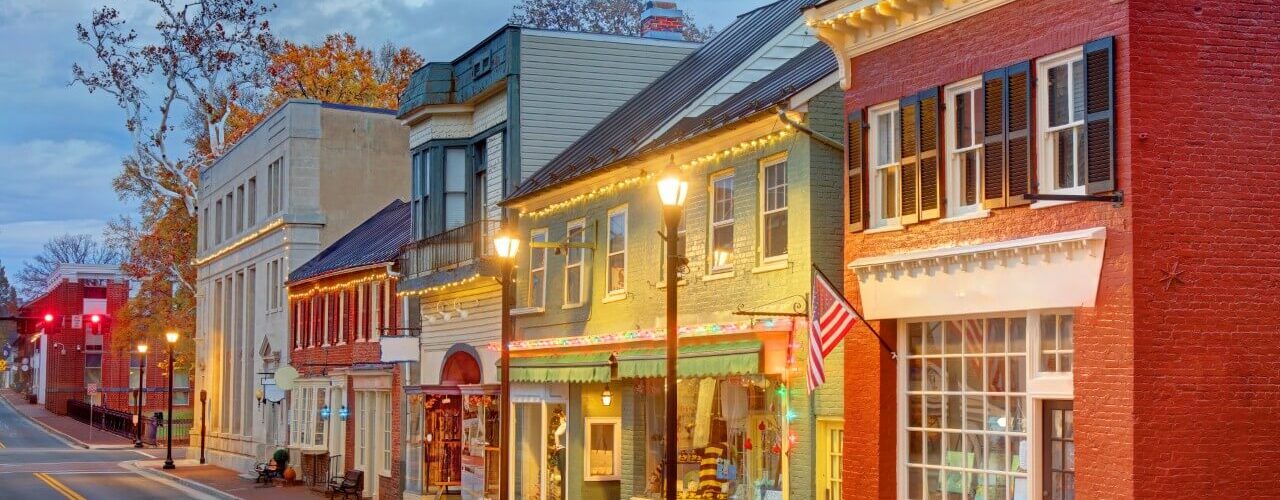
Many Americans’ ideal place to live has a “small-town feel.” It is not merely safe, but also quiet and peaceful, a pleasant place to spend strolling or sitting in true leisure. Community is the heart of this vision, with neighbors truly getting to know and care for each other. As Louis Armstrong sang, “I see friends shaking hands, saying, ‘How do you do?’ They’re really saying, ‘I love you.’”
A cultural touchstone for small-town feel is Mayberry, The Andy Griffith Show’s fictional setting. Folks in Mayberry constantly run into each other along Main Street, in businesses and public buildings a short walk away in residential neighborhoods. Sheriff Andy Taylor lives in a handsome but modest house close to the street and the adjoining houses on either side. This helps explain, for reasons detailed below, why his front porch is a social hub.
While neighborhoods in this mold survive to the present day, Americans wish for more of them, seemingly hoping to gain a stronger sense of community. Many feel they can protect vestiges of Mayberry by limiting growth, change, and variation in the built environment. Indeed, Mayberry is a rallying cry for opponents of growth and new housing in their towns, who defend restrictive zoning. The Washington Post chronicled fierce political conflict in Purcellville, Virginia, with local officials trading lawsuits as sharp divides over growth and land use wracked the small town. Growth-skeptical Purcellvillians actually dubbed themselves “Team Mayberry.”
A team or political faction needs a clearly defined goal. Mayberry is imaginary, but Andy Griffith’s hometown of Mount Airy, North Carolina, is its inspiration. The town embraces this status, driving a brisk tourist trade. Mount Airy’s housing and land use show how zoning, far from preserving Mayberry, outlawed it. Mount Airy is far from the purest urbanist ideal, which is not surprising given its small population and rural setting. Yet the physical features that are vital to its small-town feel are incompatible with zoning. Deregulating land use will end the housing shortage but also allow for more places like Mayberry, where neighbors become loving friends.
The urbanism of small-town feel
Small-town feel directly implies a certain kind of built environment. Streets are narrow, quiet, and safe for children at play. Families put down roots where sidewalks are common. Shade trees not only give birds a place to sing—signaling peace and safety—but also create a sense of enclosure that naturally slows drivers and makes them more careful. People relaxing on porches or in front yards chat with friends on the sidewalk. Homes are close to the street, but because traffic is slow, it is quiet. Passenger car tire noise exceeds engine noise around 20 miles per hour.
People can walk to local businesses like corner shops and support a vibrant main street. Supporting such commercial activity, planning and retail professionals have determined, requires around 10,000 residents per square mile. Still, this neighborhood feels like a small town. Development is compact because lots are small—the key to traditional, organic growth.
Single-family homes are close together, probably mixed with backyard cottages, multiplexes, and maybe a few rowhouses. Small lots allow for starter homes, attracting young couples and parents. The neighborhood includes renters, but no one minds or thinks much of it. Plenty of homeowners rely on income from renting out a backyard cottage or half of their own duplex. Some people live right on Main Street above first-floor businesses.
Mount Airy’s Main Street
Mount Airy’s built environment fits this description fairly well. A caveat is that tourism is the defining feature of Main Street, which seems to be retail-only and is surrounded by many visitor parking lots. There is good aerial footage of the area less than a minute into this video:
Yet this central historic district quickly turns up examples of dense housing unthinkable in conventional suburbia. A block from Main Street, on West Oak Street, sit a condo building and an apartment building, both converted from textile mills. The condo building is four stories plus a façade extension meant to make it look larger and more impressive. This was when small towns wanted tall buildings to signal importance and growth, as Addison Del Mastro writes. That spirit is still alive in Mount Airy. Comments were overwhelmingly positive—“Very excited for our little town.”—on a 2024 Facebook post by the Mount Airy Downtown business district providing an update on the Spencer’s Mill redevelopment, which created 65 market-rate apartments.
A skeptic might say that conversions do not count. So instead, consider the built form of Main Street itself. Storefronts directly abut the sidewalk, with no front setbacks, not to mention that these structures have shared side walls. Many of Main Street’s buildings are two or three stories, a few with height-enhancing façades. Most were erected in the early 20th century, before design review boards even existed, but aesthetically, they harmoniously blend together.
To create such a Main Street from scratch today, a U.S. suburb or small town would likely have to start with a special district that discarded typical zoning, including its strict height limits. The local “Team Mayberry” would harshly reject a proposal for a fairly narrow street of three- and four-story façades, calling it a “canyon” or “inhuman” and warning of traffic and shadows.
To be fair, Mount Airy’s Main Street is surrounded by parking lots; the 65 apartments were allotted 128 parking spaces. But the features that make Main Street big in the context of typical zoning are what make the town feel small. Baby boomers who grew up watching the Andy Griffith Show during its original run from 1960 to 1968 visit Mount Airy searching for Mayberry, a place most struggle to find in their daily lives or neighborhoods largely because of zoning.
The Mayberrys of the future
Mount Airy’s residential areas are also incompatible with conventional non-urban zoning. Less than a mile from Main Street sits 711 East Haymore Street. Like many houses in the town, it occupies a rather large lot, in this case, almost a third of an acre. However, similar to Main Street, 711 sits close to the street. It was probably built without an expectation that cars would drive quickly past. Houses closer to Main Street similarly have small front setbacks, but also small side setbacks because many lots are narrow, even big ones extending far behind a home.
The house at 711 East Haymore is a modest home, only 1,152 square feet, and officially valued at $181,785 on Redfin. At $158 per square foot, the home is remarkably affordable. Sidewalks are sparse, maybe because this was a blue-collar part of town. The house at 711 East Haymore is not the best example of small-town feel, but still a valuable one because Andy Griffith grew up in it.
The Mayberrys of the future will grow when property rights are restored. The political will and coalition-building required to make those changes are considerable, but demand for such neighborhoods is high. As I wrote in my hometown paper about housing reform in South Carolina: compact, walkable neighborhoods command a premium because they are artificially rare in high-demand cities. But traditional land use is more efficient and thus fundamentally more affordable than government-mandated sprawl, which forces a family to pay for a large residential lot. A few specific zoning reforms would enable traditional, compact development:
- Allow small residential lots, including splits of existing lots, down to increments of 1,500 square feet, 1,200 square feet, or less. This supports local retail and unlocks starter homes.
- Ensure local government creates and maintains sidewalks in residential and retail areas. This protects the safety of children, seniors, and people with limited mobility.
- Allow residential structures to be placed right by the sidewalk or close to the street. This helps connect private and public spaces, so that people naturally interact.
- Allow lots to be narrow and residential structures to sit near the sides of lots, and each other. Doing so promotes walkability and the population density needed for local retail.
- Permit small multifamily structures of six or eight units and rowhouses in residential areas.
- Permit accessory dwelling units such as backyard cottages in residential areas, and allow them to be rented out so that families can generate extra income.
- Permit businesses in residential areas, allowing them to operate on a small footprint with no off-street parking. Given enough customers, corner shops, barbershops, and family-owned restaurants will spring up. Retail activity will not be limited to large stores miles away.
- Relax height limits so that commercial development can cluster along a nearby main street.
- Severely limit or eliminate off-street parking requirements so that property owners and real estate professionals can determine how much parking they and their consumers need.
Mayberry represents how urban places naturally grew from small, private decisions. It is difficult to know what pleasures and innovations Americans forego due to land use regulations that have confined development and housing to a few narrow legal boxes. People love to hate 5-over-1 mid-rise, often mixed-use apartment buildings, but they fit within tightly defined regulatory constraints, not to mention commoditized financing. Mount Airy’s visitors dream of living in neighbordhoods like Mount Airy’s South of Broad, Old Town Alexandria, Virginia and Cincinnati’s Over-the-Rhine. If Americans are allowed to build pleasant, walkable neighborhoods, they will.