


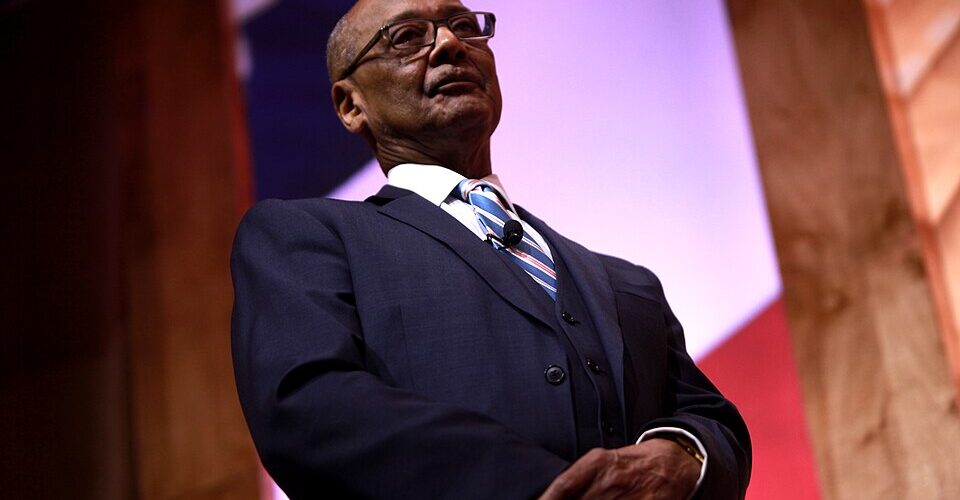
America lost a champion of civil society and economic empowerment last week with the death of Robert Woodson Sr.
Woodson, who passed away at the age of 89, was often politically pigeonholed as a “black conservative,” but that nomenclature fails to fully capture either the man or his influence. True, on issues of public policy, he often veered right: opposing affirmative action, supporting welfare reform, and often criticizing the modern civil rights leadership. He was a vocal critic of the New York Times 1619 Project, and was initially close to the Trump administration (though he later turned critic).
Woodson, whose early career included stints as a community organizer for the NAACP, the Urban League, and the Unitarian Universalist Service Committee, and who marched with Martin Luther King Jr.,never denied the history and reality of racism in America. Indeed, in 1995 he wrote a guest essay for the New York Times, entitled “The End of Racism: Not Hardly.” But he broke with many civil rights leaders, warning that too many of the race-based solutions that they favored ended up helping wealthy or middle class African Americans while leaving low-income Americans of all races behind. Just weeks ago, he wrote, “Every dollar wasted on political theater is a dollar stolen from neighborhood mentors, local entrepreneurs, faith leaders, mothers, fathers, and community builders doing the real work of restoration.”
Above all, Woodson passionately believed in the power of local communities—especially the African-American community —to solve their problems through local action, education, entrepreneurship, and a commitment to American values. In 1981, Woodson founded the Center for Neighborhood Enterprise—renamed the Woodson Center in 2016—“to empower community-based leaders to promote solutions that reduce crime and violence, restore families, revitalize underserved communities and assist in the creation of economic enterprise.”
Woodson helped design a “black history and character curriculum” that focused on African-American success stories. A second program that the Woodson Center supported was “Voices of Mothers, United” which brought together mothers of children who had died from crime or gang violence. Indeed, gang violence was a particular focus of Woodson’s work: he often volunteered himself and his offices to negotiate truces between gangs. But perhaps the most important of Woodson’s projects was the Community Affiliates Network, which provides leadership and training to more than 500 community organizations nationwide focusing on issues such as crime, unemployment, and housing in underserved communities.
Woodson understood that the key to long-term reductions in poverty lies not with spending more money or implementing yet another Washington-run program, but with vibrant communities and individual initiative. He sought to change the culture of poverty, not just paper it over.
While there were certainly areas of disagreement, Woodson’s core values were very much in line with FREOPP’s. We join all those mourning his passing.