



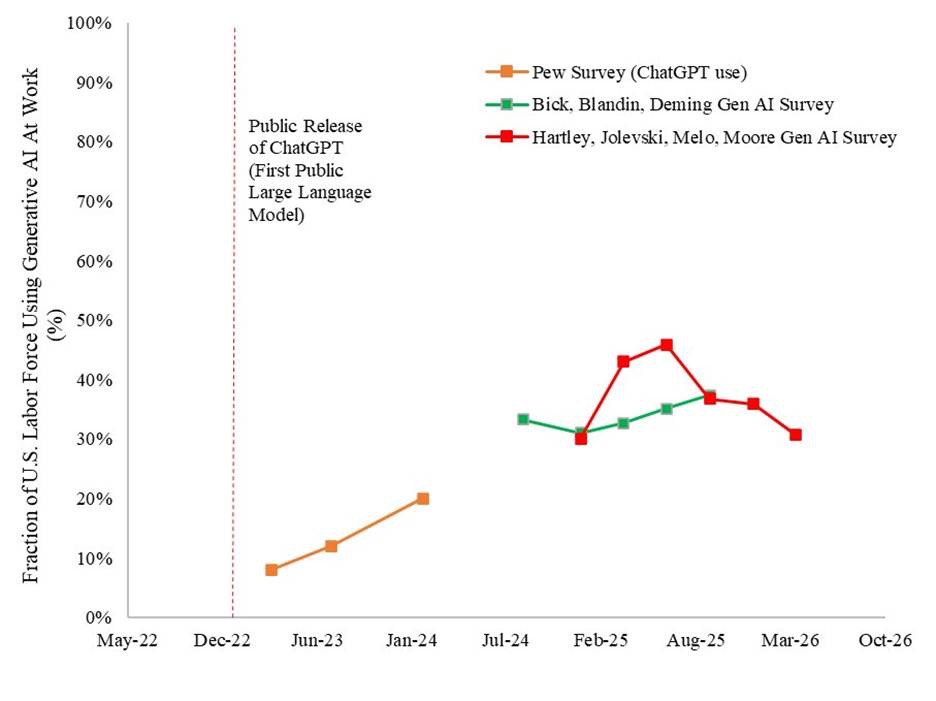
Increasingly, state legislators are raising their ire toward Generative Artificial Intelligence (GenAI). AI is not polling well amidst the general public, perhaps because of widespread confusion or misunderstanding about what the technology can do. GenAI has been adopted by a large fraction of workforces and consumers in the United States and around the world. Alongside co-authors, I estimate between 30 to 40 percent of the U.S. labor force is using GenAI tools at work in 2026 (See Hartley, Jolevski, Melo, and Moore (2025)). It’s quite possible that lower income individuals will be some of the greatest beneficiaries of GenAI in the years to come as lower skilled individuals can use such tools to complete tasks that were otherwise overly complicated. For instance, those who were unable to code before the advent of GenAI now have the capability of asking large language models (LLMs) like ChatGPT and Claude to complete tasks they were not able to complete previously. By lowering the barrier to entry for programming, LLMs allow individuals to leapfrog into the digital economy by building apps or performing freelance technical work. The scope with which anyone can now use AI agents to complete tasks is enormous. Meanwhile, high-skilled workers at many large technology firms including Amazon, Meta and Microsoft are feeling some negative local labor market consequences as these companies engage in AI-led restructuring to create efficiencies.
In other sectors, LLMs can help people, especially those below the median income, learn dominant trade languages—ike English or Mandarin—or translate complex technical manuals into local dialects, opening up global labor markets. Farmers in rural areas can also use LLMs to diagnose crop diseases from descriptions or images and get advice on soil management and climate-resilient planting.
Figure 1. Share of U.S. Labor Force Using Generative AI at Work
c
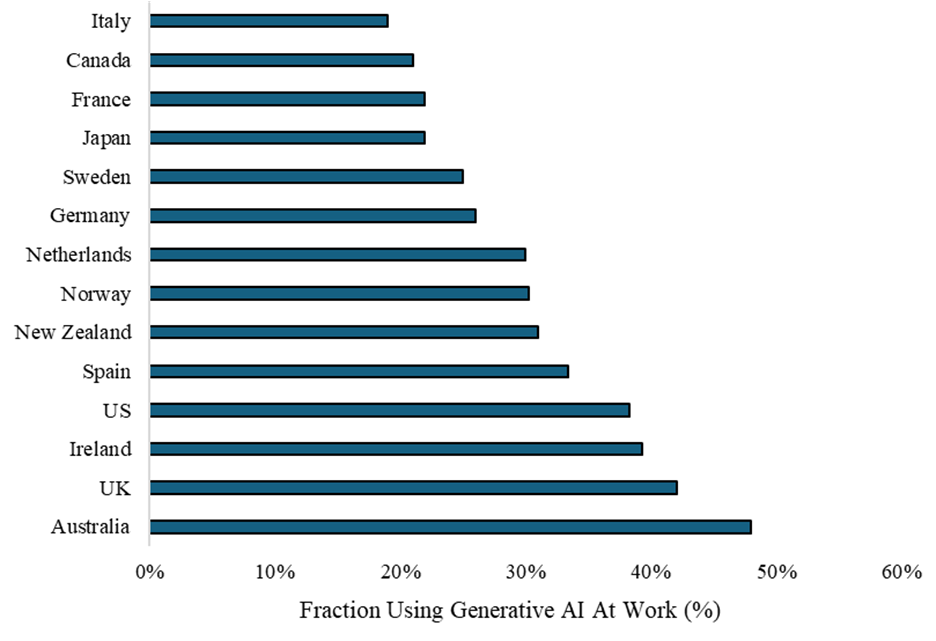
Figure 2. Share of Labor Force Using Generative AI at Work Across Countries
As of March 2026, lawmakers in 45 states had introduced 1,561 AI-related bills, a number that has already surpassed the total from all of 2024. Most of these bills will likely not make anyone safer, but instead will make building Generative AI tools in America more difficult while China develops more advanced technologies.
To understand what’s actually happening, it helps to look at the specific laws now on the books. California enacted 24 AI-related laws across its 2024 and 2025 sessions, including measures requiring frontier AI developers to publish risk frameworks, mandating disclosure of training data sources, and imposing companion chatbot regulations governing everything from mental health protocols to what a GenAI tool may say to a vulnerable user. Each of these laws carries its own definitions and penalty structure. Texas enacted the Responsible Artificial Intelligence Governance Act through HB 149, which took effect January 1, establishing its own entirely separate framework. Colorado has gone even further, mandating impact assessments, transparency disclosures, and documentation of AI decision-making processes under what is widely described as the most comprehensive state AI law in the country.
None of these states consulted one another and none of them are using the same definitions. States continue to diverge in how they define artificial intelligence, as well as categories like frontier models, generative AI, and chatbots. These definitional variations shape which technologies fall under regulatory scope. A startup trying to deploy a customer service tool doesn’t face one set of rules and it faces potentially dozens of overlapping, contradictory frameworks depending on where its users happen to live. This is an obstacle to job creation that could potentially affect low income Americans who could use AI to upskill.
These AI regulations are not a trivial compliance burden. For large companies, regulation can be a minor headache, but for small upstart firms, it can be a dealbreaker and prohibitively costly. As a result, the AI companies best equipped to navigate a 50-state compliance maze are the large incumbents who already employ armies of lawyers, creating a regulatory moat. The firms who can’t are the startups and challengers who might otherwise compete with them. Regulatory complexity, in practice, is a subsidy to incumbents.
The philosophical incoherence across this legislative landscape is striking. Some of the newest wave of proposals have moved toward hands-off approaches, adjusting existing liability regimes rather than creating new regulatory agencies, or establishing sandboxes and safe harbors to allow experimentation. That instinct is at least defensible. But it exists alongside a simultaneous push in other states toward strict private rights of action and punishing liability rules. Bills in Maryland and Michigan would impose liability on developers for harm caused by design defects or failure to warn, while Tennessee has introduced a bill that would establish criminal liability against deployers of AI systems that encourage an individual to commit suicide. Legislators are essentially making it up as they go, with real consequences for the companies trying to build in their states.
The federal government has sensed the problem, but not yet solved it. A December 2025 executive order directed the attorney general to establish an AI litigation task force to challenge state AI laws deemed inconsistent with federal policy, including for unconstitutional regulation of interstate commerce. Earlier, the House of Representatives passed a provision that would have barred states from enforcing AI-specific regulations for ten years, though the Senate stripped it out. The right instinct ran into the wrong politics, and the result is continued uncertainty for everyone trying to build or deploy AI products in the United States.
What should policymakers actually do? A few principles seem clear.
First, general-purpose technologies should be regulated by use, not by nature. Most AI harms worth worrying about are already covered by existing law: fraud is fraud, discrimination is discrimination, defamation is defamation. Before legislators layer on new AI-specific rules, they should be required to explain precisely how existing law fails to reach the conduct they’re worried about. In most cases, they can’t, because it doesn’t.
Second, where new rules genuinely are needed, the rules should be narrow, targeted, and ideally federal. Nonconsensual deepfakes are a legitimate policy problem with no clean common-law remedy. The Take It Down Act, which requires platforms to remove flagged nonconsensual intimate imagery including AI-generated deepfakes within 48 hours, is a reasonable model precisely because it is specific and national. That is very different from California’s sprawling disclosure regime or Colorado’s impact assessment mandate, which regulate AI as a category rather than targeting actual harms.
Third, policymakers should be honest about what they don’t know. Agentic AI, systems capable of autonomous planning and action that go well beyond generating text or images, is only beginning to enter the policy conversation. Locking in rigid regulatory frameworks today, for a technology that looks fundamentally different every 18 months, is a reliable way to regulate the last generation of AI while the next one escapes scrutiny entirely.
Fourth, and perhaps most important, a wait-and-see approach is not irresponsibility. It is the appropriate response to genuine uncertainty about a technology still in its infancy. Generative AI today, for all the alarm it generates in legislative chambers, is probably the least dangerous version that will ever exist. The models are less capable, the applications less embedded in critical infrastructure, and the potential failure modes less severe than they will be in five or ten years. If there is ever a moment to let the technology develop without the dead weight of premature regulation, it is now, while policymakers can still observe how the risks actually manifest rather than speculating about them. The cost of waiting a few years to regulate wisely is low. The cost of regulating badly today, and locking in frameworks that distort the technology’s development for a decade, is considerably higher. Caution about regulation is not the same as indifference to risk. It is the recognition that getting this wrong early compounds just as surely as getting it right does.
The deeper problem is political, not technical. Regulating AI is popular. It signals seriousness about a technology that genuinely unnerves people. It generates press releases and primary season credibility. But ultimately it does not reliably generate better outcomes for workers. The many bills introduced this year are not primarily a response to identified harms. They are a response to the fact that AI is in the news and legislators want to be seen doing something about it.
The laboratories of democracy work best when they are running different experiments and learning from the results. What is happening now is not experimentation. It is 45 states writing slightly different versions of the same kneejerk GenAI laws, at the expense of the companies, workers and consumers who will bear the cost.