



Executive Summary
Civil society and its institutions are uniquely suited to solving the social challenges America faces today, especially reducing poverty and helping people to become economically self-sufficient and upwardly mobile. That is why it is so troubling that civil society finds itself under unprecedented pressures threatening to undercut its effectiveness. Indeed, civil society is increasingly being hollowed out and displaced from its central role of bringing people together to pursue the common good.
Why civil society matters
Since America’s founding, civil society has been uniquely part of the national character. Standing in a third space between the government and the for-profit sector, civil society offers voluntary cooperative mechanisms for solving societal problems while providing meaning and purpose to people’s lives.
Civil society is particularly important to those aspects of human flourishing that can not be easily reduced to questions of economic growth or material prosperity. Certainly, it can help with those things, but civil society can also help individuals build a full life that includes family, community, purpose and that is infused with dignity and meaning.
Civil society is innovative in ways that the government is not. As a result, it has the potential to lift up individuals and communities, giving them the leg up to help climb the economic ladder. For these reasons, civil society has long been a cornerstone of the American Dream.
What we found
Civil society in America is increasingly under threat. The sense of community and civic involvement that has driven civil society for most of our country’s history has begun to wane in recent years and risks being lost altogether. Less than one-quarter of Americans currently volunteer in their community, the lowest level in more than two decades.
The reasons for the decline of civil society are many and varied, ranging from changes in technology to growing economic instability. At the same time, the government has grown increasingly hostile to civil society institutions. In fact, governments are expanding their reach into the areas and issues that were once the province of civil society, crowding-out many non-governmental efforts.
But the most damaging threats to civil society today stem from increased political polarization and a concomitant loss of trust in the major institutions of society. In short, civil society is withering because society suffers from a lack of civility.
What policymakers should do
A government-directed strategy to fix civil society would be both futile and undesirable. Government, by definition, stands outside of and sometimes in antithesis to civil society. The government should focus on removing obstacles to civil society rather than meddling with it.
- Policymakers should resist efforts to investigate, punish, or harass civil society organizations that have differing ideological positions or who favor policies that are contrary to the current government’s viewpoints.
- Government officials should stop using rhetoric that portrays civil society activities as illicit and conspiratorial, dehumanizing those who give to, work for, or receive assistance from those organizations.
- Governments should avoid actions that crowd-out civil society efforts. Policymakers should consider how new programs or additional social welfare spending will negatively affect existing social structures.
- Federal and state tax codes should encourage charitable giving. This includes both maximizing the value of charitable deductions and simplifying administrative burdens on both the taxpayer/donor and the recipients.
- Municipal planners and authorities should ensure there are sufficient community spaces where citizens can gather, interact, and participate in civil society.
What civil society should do
Revitalizing civil society cannot be left to the government. It will require action, adaptation, and innovation by civil society institutions.
- Civil society organizations should avoid becoming entangled with government funding. Government money always comes with strings and can undermine the independence and corrupt the missions of those organizations.
- Civil society organizations should avoid overly bureaucratic or professionalized corporate-type structures, focusing more on local, volunteer-driven, trust-based programs and people.
- Civil society organizations should model the behavior they wish to encourage, starting with inclusion and civility. There should be a willingness to work with those who have different backgrounds, religions, or political beliefs.
Introduction
Civil society—a broad and diverse network of civic organizations, religious groups, charities, unions, volunteer organizations, and involved citizens, who join together to pursue shared goals and common interests—has been a keystone of American advancement since the founding of the republic, if not before. Alexis de Tocqueville celebrated our civic institutions in Democracy in America as foundational to national success. Civil society groups have been deeply involved in almost every aspect of American life, and continue to play a particularly important role in reducing poverty and empowering those who are struggling.
That history is why it is so troubling that civil society finds itself under unprecedented pressures that threaten to undercut its effectiveness. Indeed, civil society is increasingly being hollowed out and displaced from its central role, with significant consequences for equality, democracy, economic growth, public health, and human flourishing.
The reasons for the decline of civil society are many and varied, ranging from changes in technology to growing economic instability. Simultaneously, the government has grown increasingly hostile to the civil society institutions. Governments are expanding their reach into the areas and issues that were once the province of civil society, crowding-out non-governmental efforts.
But the most damaging threats to civil society today stem from increased political polarization and a concomitant loss of trust in the major societal institutions. In short, civil society is withering because society suffers from a lack of civility.
The continued dilution of civil society will leave America weaker, less dynamic, and more divided. It will also leave more Americans trapped in poverty, dependence, and loneliness.
Policymakers, regardless of political orientation, should make preserving and revitalizing civil society and its institutions one of their highest priorities.
What is Civil Society?
While there is no single universally accepted definition of civil society, it is generally seen as encompassing those sectors of society that are outside and independent of government and, in most definitions, for-profit business. It exists, formally or informally, to improve the well-being of individuals and communities.
Early uses of the term “civil society” date back at least to ancient Greece and Rome, where both Aristotle and Cicero saw it as synonymous with the state itself. This fit with their conceptions of an ideal political community unified for the common good. By the Enlightenment of the 17th and 18th centuries, however, scholars such as John Locke and Andrew Ferguson began to distinguish between civil society and the state. They took note of the communes and guilds that arose during the Middle Ages and the Renaissance. These largely voluntary associations were independent of and often in opposition to the central state. And, perhaps even more important, history had shown that the state was neither unified nor an instrument for the common good. If the king and his ministers could not be counted on to pursue the best interests of citizens, other institutions that were separate and distinct from the state, would be required to do so. Montesquieu saw intermediary institutions as central to protecting freedom and ensuring the state didn’t become too powerful.
Civil society has been an intrinsic part of the American spirit. In 1835, Tocqueville wrote that:
“Americans of all ages, all conditions, all minds constantly unite. Not only do they have commercial and industrial associations in which all take part, but they also have a thousand other kinds: religious, moral, grave, futile, very general, and very particular, immense and very small; Americans use associations to give fêtes, to found seminaries, to build inns, to raise churches, to distribute books, to send missionaries to the antipodes; in this manner they create hospitals, prisons, schools.”
Today, these sorts of voluntary civic activities would fall under the heading of “civil society.”
Of course, many other countries have active civil societies. But as Tocqueville recognized, the United States is unique in both the variety of our civil society and the importance of the role it plays. America was simply different, he wrote, “Everywhere that…you see the government in France and a great lord in England, count on it that you perceive an association in the United States.”
Tocqueville emphasized two equally important roles that civil society played here. First, it helped solve collective problems without the resort to force that is inherent in government action. Second, civil society helped draw individuals out of their strictly private concerns and enabled them to become part of something larger and, ultimately, more satisfying than the petty concerns of day-to-day life. Moreover, in doing so, participants became better collaborators, leaders, and citizens. “The only way opinions and ideas can be renewed, hearts enlarged, and human minds developed,” Tocqueville observed, “is through the reciprocal influence of men upon each other.”
The key to civil society is that it is voluntary, self-generating, and self-organizing. It operates without coercion. At its most expansive, the concept of civil society includes a wide range of cultural, civic, religious, and charitable organizations. As Peter Berger and Richard Neuhaus describe it, civil society comprises “those institutions standing between the individual in his private life and the large institutions of public life.”
There is some debate among scholars about whether business and other for-profit entities fall with the rubric of civil society. Scholars at the Cato Institute, for instance, include business on the basis that they are non-coercive in nature, and therefore operate within the voluntary sphere, which they see as essentially synonymous with civil society. On the other hand, far more scholars see the structure and motivations of business as different from those of civil society. In particular, they emphasize the idea that civil society’s purpose is to advance the common good and address societal needs, while the purpose of business is to generate economic value for customers, employees, and shareholders.
There are also a small number of philosophers, political scientists, and economists who disagree with the inclusion of families, on the basis that they are not strictly voluntary associations, but result from kinship, birth and legally bound mutual dependency. the overwhelming majority of scholars studying civil society, however, believe that families are so intertwined with the basic health and function of civil society that they can not be excluded, even if they don’t meet the strictest definitions.
Government funding further blurs who qualifies as civil society organizations and the role they play. Federal, state, and local government grants total $250-$300 billion annually. Larger organizations are much more likely to receive government funding than smaller local groups. In fact, organizations with annual budgets in excess of $1 million per year receive roughly half of their funding from government sources. This level of government funding makes organizations vulnerable to coercion and can compromise their missions.
For purposes of this paper, we will use the standard definition—including families, but not businesses—unless otherwise stated. We also have made few distinctions based on whether an organization receives government funding, though this paper’s emphasis on local service-oriented charities makes that less of an issue.
The voluntary nature of civil society is key to both the definition of civil society and intrinsic to its effectiveness. It is both a moral and a practical issue, and the differentiator between civil society and government. George Washington is reputed to have said, “Government is not reason; it is not eloquence. It is force.” The story is likely apocryphal, but it relays an important fact: the government ultimately relies on the use of force and coercion to achieve its goals. In contrast, civil society must rely on reason and persuasion to encourage participation.
A healthy and active civil society is integral to the functioning of any culture, especially U.S. culture. As the Congressional Joint Economic Committee puts it, civil society “holds our common life together by supplying ‘extended networks of cooperation and social support, norms of reciprocity and mutual obligation, trust, and social cohesion” and by “forming our character and capacities, providing us with meaning and purpose.’”
Standing separate from both the government and business, civil society is particularly important to those aspects of human flourishing that can not be easily reduced to questions of economic growth or material prosperity. Certainly, it can help with those things, but civil society is at the center of whether people can build, as FREOPP President Akash Chougule describes, a life worth living—one that includes family, community, purpose, and a fair shot at upward mobility, one infused with dignity and meaning.
The idea of civil society is often used interchangeably with terms such as charitable organizations and philanthropic organizations. That is not wholly accurate as civil society has a broader reach. Still, though not every civil society organization is a charitable organization, virtually every charitable or philanthropic organization is a civil society organization. Therefore, we are comfortable using all such terminology.
Although the precise number fluctuates constantly, the State Department estimated that there are 1.5–1.9 million civil society organizations in the United States. These organizations employ as much as 10 percent of the American workforce and add $1.4 trillion in value to the economy each year.
Among other things, civil society helps undergird:
- Civil justice and democratic accountability: Daniel Stid, a scholar with the American Enterprise Institute, describes civil society as one leg of a three-legged stool upholding liberal democracy, along with democratic government and a free market economy. Certainly, civil society organizations play a key role in holding the government accountable for its actions. Civil society organizations have also been at the forefront of efforts to expand civil justice, individual liberties, and civil rights. These organizations operate across the entire political spectrum.
- Conservation and environmentalism: While the federal government directs and funds big environmental programs, and manages vast swaths of public land, a lot of very effective environmental efforts take place at the local level and are guided, in whole or part, by civil society organizations. There are more than 33,000 environmental and conservation groups in the United States, most operating locally.
- Humanitarian relief: Civil society provides humanitarian relief, especially in cases of natural disaster, refugee and migrant integration, and similar crises. While the government often funds long-term relief after disasters, much of the immediate help for food, shelter, and emotional support is provided through civil society organizations such as the Cajun Navy and the American Red Cross.
- Arts and sports: From Little League Baseball to YMCA programs, civil society plays an important role in organizing community sports. Civil society is also a driving force behind local arts and cultural organizations such as community theater, local museums, and choirs.
- Faith, worship, and the search for meaning: Tens of millions of Americans find meaning and community through churches, synagogues, mosques, and other faith-based groups. There are roughly 370,000 houses of worship in the United States, as well as thousands of faith-based charities, schools, and community groups. These organizations are not just of enormous importance to the lives of the people participating in them, but provide an opportunity for them to serve and uplift others.
- Social safety nets and poverty relief: Finally, civil society plays a vital role in providing a social safety net and alleviating poverty. Most visibly, it provides both monetary assistance and volunteer manpower. Americans donate roughly $100 billion annually to anti-poverty, hunger relief, and human service charities annually, roughly 14 percent of the $592 billion in total yearly U.S. charitable giving. It also provides millions of volunteer manhours to fight poverty. Civil society also enables struggling Americans to avoid or escape from poverty and helps them provide and protect their children.
Consider organizations as wildly diverse as Parent-Teacher Associations, the Rotary, “friends” of a local park, the Girl Scouts, Catholic Charities, USA, Restore Hope, or FREOPP itself. These are all examples of civil society in practice.
In short, civil society provides an invaluable and irreplaceable foundation for the functioning of a society both free and virtuous. As the Brookings Institution puts it, civil society is “an important source of information for both citizens and government. They monitor government policies and actions and hold the government accountable. They engage in advocacy and offer alternative policies for government, the private sector, and other institutions. They deliver services, especially to the poor and underserved.”
Civil society and the fight against poverty
Civil society plays a vital role in fighting poverty both directly and indirectly.
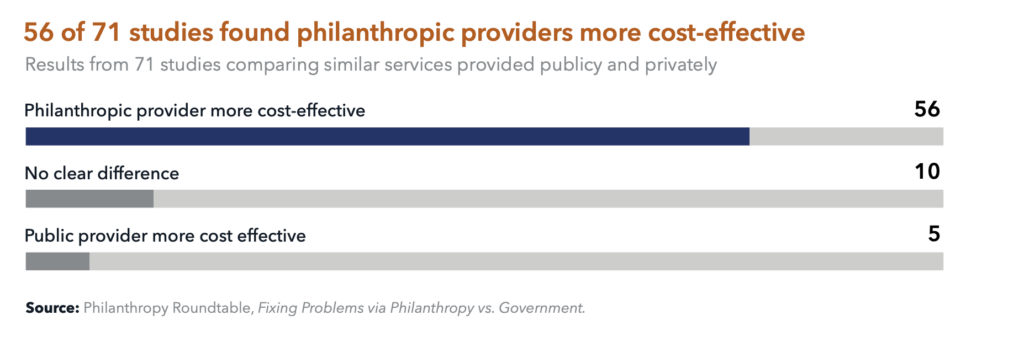
First, civil society is a significant source of social welfare funding. But the importance of civil society in alleviating poverty lies not just in the dollars spent, but in the way in which those dollars are spent. In many cases, private philanthropic organizations are more efficient and more effective than government social welfare programs, notably when it comes to helping people avoid or escape poverty. The Philanthropy Roundtable, for instance, reviewed 71 studies comparing the efficiencies of public agencies and private institutions. They found that in 56 cases, where the same basic services were available from both public and private sources, private charity was judged more efficient, while government performed best in five cases. There was no appreciable difference in performance in the remaining 10 cases.
For one thing, civil society can individualize its approach to the circumstances of poverty and the poor in ways that a government program rarely can. For reasons both legal and bureaucratic, government programs are designed in ways that treat similarly situated recipients alike. And while recent reforms—such as One Door to Work—have improved the ability of some government programs to respond to individual circumstances, civil society organizations remain much better situated to meet the specific needs and circumstances of those being helped. Civil society organizations often possess a local knowledge and firsthand understanding of circumstances that cannot be equaled by a government agency, no matter how well intentioned.
In addition, civil society organizations have a flexibility to innovate that government does not. Civil society can move past one-size-fits-all solutions to adapt their efforts to the specific needs of those they help. They can experiment, learn from failures, and scale up those approaches that work. They’re nimble. Government programs, on the other hand, are often hampered by rigid rules, public sector unions, distant decisionmakers, and a bias toward maintaining the status quo, regardless of outcomes.
Perhaps the best explanation of the difference between government welfare programs and the interventions of civil society came from Pope John Paul II in his encyclical Centesimus Annus:
By intervening directly and depriving society of its responsibility, the welfare state leads to a loss of human energies and an inordinate increase in public agencies, which are dominated more by bureaucratic ways of thinking than by concern for serving their clients. And which are accompanied by an enormous increase in spending. In fact, it appears that needs are best understood and satisfied by people who are closest to them and who act as neighbors to those in need.
Significantly, civil society’s role in reducing poverty goes far beyond philanthropy. A growing body of academic literature demonstrates the connection between a robust civil society and the American Dream. For instance, Raj Chetty and colleagues found that the presence of civic associations, religious institutions, and nonprofit organizations is closely associated with higher rates of upward social mobility.
Civil society offers people access to three types of social capital: bonding capital, bridging capital, and linked capital. Bonding capital is the formation of close relationships between similar people, that is, within the same peer group. In other words, people within one’s friends, family, and personal networks. Bonding capital provides emotional support and a basic safety net.
Bridging capital describes relationships with a more diverse population. These are people from different neighborhoods, socioeconomic classes, or professions. Bridging capital brings new ideas, employment opportunities, and increased social tolerance. For the poor, exposure to higher-income peers expands their worldview, opening career paths and educational opportunities that they might otherwise have not considered.
Chetty believes that bridging capital is the single strongest predictive factor leading to upward economic advancement. As he points out:
“It shapes your aspirations. It shapes the things that you think about, the career paths you think about pursuing. If you’ve never met anybody who’s gone to college, you probably don’t think about applying to college.”
Chetty sees “friending bias,” the natural tendency of people to only make friends sharing their own socioeconomic status, as a significant barrier to accumulating bridging capital. Civil society, however, encourages people to interact on the basis of shared identity, faith, or purpose, rather than economic status. This significantly reduces friending bias and increases the likelihood of opening up new avenues of relationships, and the increased opportunities that they bring. As the Joint Economic Committee’s Social Capital Project notes, “Because civic and religious groups are highly effective at forging these specific cross-class friendships, areas dense with these institutions show much higher rates of upward mobility.”
And finally, the third type is linked capital, connections with people in authority who operate greater systemic power. This enables those from disadvantaged or marginalized backgrounds to access resources, support, and mentorship they wouldn’t otherwise have access to. Similar to bridging capital, civil society expands the availability of linked capital by bringing together people of very different backgrounds and socioeconomic positioning.
“Participation in civil society cultivates pro-social and pro-opportunity behaviors such as “honesty and reliability, perseverance and prudence, responsibility, and reciprocity.” These are habits and behaviors that the American economy and society values and rewards. They are indispensable tools for avoiding and escaping poverty. By cultivating them, in ways that the government cannot, civil society increases social mobility.
Writing for the American Enterprise Institute, Berger and Neuhaus suggest that “[t]he neighborhood should be seen as a key mediating structure in the reordering of our national life.” Someone directly connected with a person struggling to escape poverty, can speak to issues of meaning and purpose in ways the government simply cannot. Friends and neighbors can model virtue, make useful introductions, and coach people along the road out of poverty. They can engage people’s individual capacity and talents. That is why, for instance, AEI’s Tim Carney writes that a church closing its doors is more harmful to a community than a factory doing so.
None of this implies that there is not a role for workplaces or the government in providing for the social welfare of those in need. But evidence suggests that there are limits to the effectiveness of jobs and programs, and that far fewer people will find their way out of poverty in the absence of a robust civil society.
Civil Society Under Threat
There’s a reason why people who understand the stakes are gravely concerned that civil society is increasingly being hollowed out.
The sense of community and civic involvement that has driven civil society for most of the country’s history has begun to wane in recent years. Less than one-quarter of Americans currently volunteer in their community, the lowest level in more than two decades. This is not necessarily a question of declining generosity or lack of charity. Rather, increasingly, the outlet for that charitable impulse is to outsource it by writing a check, not to personally get involved in the community. Of course, volunteering took a major hit during the COVID pandemic, but that merely accelerated a decline that had already been going on for far longer.
Of particular concern, the weakening of civil society is happening more broadly and rapidly in low-income communities. A study by the American Enterprise Institute shows that civil society remains strong and accessible in wealthy neighborhoods, but far less so in lower-income ones. The civil society organizations that do exist in low-income areas tend to be religious in nature—small churches predominate—or are built around or adjacent to government programs. There are fewer locally organized grassroots organizations. The study’s author, Howard Husock, worries that civil society may be becoming a “luxury good” accessible only to the wealthy.
While a robust civil society helps create economic prosperity and stability, it is also true that it is difficult for civil society to thrive amidst widespread economic uncertainty and instability. Thus, at the very times when an effective civil society is most needed, it is likely to find itself weakened. Volunteerism and charitable giving are lower in economically disadvantaged communities with higher poverty rates than it is in communities with higher and more equitable economic activity.
This is in some ways counterintuitive: there is a general belief that communities come together in hard times, but that appears to be more likely in cases of natural disasters or other one-off emergencies, rather than long-term economic conditions. In fact, when material deprivation becomes both deep and entrenched, social trust can fracture as people abandon solidarity and public value, turning instead towards self-preservation. Both individual and corporate philanthropy pull back. At the same time, the government may reduce funding for local organizations that rely on it. While crises sometimes mobilize short-term political action, prolonged economic hardship typically depresses civic engagement. Moreover, when ensuring basic necessities takes priority, people have less time and fewer resources to dedicate to volunteering and associational life. Ironically, the decline in the ability of civil society to act comes at a time when the demand for its services increases.
Social scientists such as Robert Putnam and Robert Sampson of Harvard and AEI’s Husock have expressed concern that a decline in civil society in low-income and working-class neighborhoods can exacerbate many social problems. Yet, a study by Husock and Laura Oleson, using postal data, showed that there were fewer civil society organizations in working class and low-income communities, and that the types of organizations in those communities were less diversified.
Given the importance of civil society to poverty reduction, social stability, and human flourishing, the growing wealth-based gap between communities with dynamic civil societies and those without is likely to increase inequality across a range of social outcomes. For example, there is evidence of an inverse relationship between widespread flourishing civil society groups and crime rates. Likewise, failing schools appear to have fewer parent-teacher organizations. And as discussed above, civil society organizations play a key role in reducing poverty. Advocates for the disadvantaged, on both left and right, should take notice.
Moreover, the impact of economic hardship on civil society is not limited to strained budgets and reduced manpower. Tribalism increases during times of economic dislocation as people seek to protect their group, even—or especially—at the expense of outsiders. This can be seen in the current political debates over issues such as immigration and women in the labor force. As social trust between groups breaks down, the ability of people to find common ground and to cooperate for the greater good quickly erodes.
The reasons for the decline of civil society are many and varied. Among the most prominent are:
Civic disengagement and social isolation
As I wrote in Vicious Circles: Social Isolation and Poverty, Americans are becoming increasingly isolated and disconnected socially more generally.
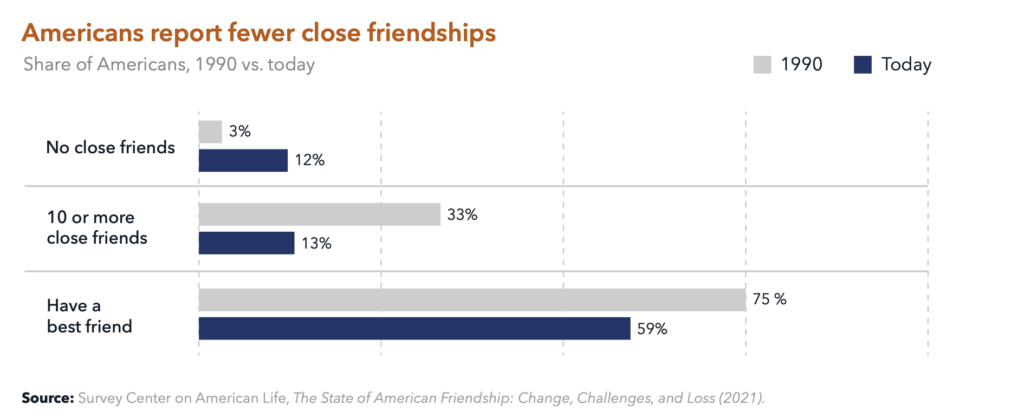
According to the Kaiser Family Foundation, slightly more than half (53 percent) of U.S. adults say they have a lot or a fair amount of friends and family members living nearby who they can ask for help or support. But that still leaves 47 percent that say they have just a few or no friends or family in their nearby support network, a number that has been slowly but steadily increasing. The Survey Center on American Life reports that there has been a four fold increase (from 3 to 12 percent) since 1990 in the number of Americans who say they have no close friends. The number saying they had 10 or more close friends declined from a third to just 13 percent. And the number of Americans who say they have a “best friend” declined from 75 percent in 1990 to just 59 percent today. Similarly, researchers at Harvard estimate that from 2014–2019, the average number of hours Americans spend with a “close friend” fell from about six hours per week to just four. Levels of social isolation are even higher among low-income Americans.
Fewer than half of Americans now say they belong to a church, mosque, or synagogue, down from 70 percent in 1999. Fraternal organizations such as the Masons, Odd Fellows, Knights of Columbus, and Moose Lodges—once ubiquitous features of American community life—have seen drastic decreases in memberships. Union membership has dropped precipitously, even as unions maintain uniquely coercive powers in nearly half the states. And, in the aftermath of forced isolation during the COVID pandemic, social interaction of all types has declined.
Vicious Circles warned that the decline in civil society was one cause of social isolation, but the influence works the other way as well. As isolation increases, participation in voluntary associations, religious institutions, and community groups declines, resulting in lower overall civic health and public engagement. Increasing social isolation and declining civil society form a negative feedback loop, where isolation deprives citizens of the social trust needed for community engagement, while the decline of civil society removes the third spaces and associations that help to prevent isolation in the first place.
As Robert Putnam so well described in Bowling Alone: The Collapse and Revival of the American Community, the ongoing decline in community has led to a loss of social capital, which ultimately leads to a hollowing out of civil society.
Among the many forces driving the rise in social isolation and civic disconnection are:
- Increased use of social media and technology: According to a Pew survey, 85 percent of Americans say that they are online daily, including 31 percent who are online “almost constantly.” However, for all its advantages, being online is not a substitute for human connection. This is true even when AI gives the online experience a verisimilitude of reality. To the degree that people now substitute online experience for direct interpersonal contact, it makes it more difficult for civil society to organize and recruit. For all the benefits that they provide, online communities are simply not the same as, and are often objectively less beneficial and less healthy than, in-person civil society engagement.
- The changing workplace: While businesses themselves are not generally considered part of civil society, the workplace has long offered a locus for shared experience and communication and a space where outside civil society can build. It is troubling, therefore, that work-related social interaction is declining. Today, at least 43 percent of workers say that they don’t feel connected to others at work. And, while there has been some return to the office since the COVID pandemic bottomed out, more than one in five U.S. workers still work remotely. This is unlikely to change significantly in the future. Roughly three quarters of those working from home claim they would quit if they no longer could do so. Even if most of the respondents would, in fact, return to office, the desire to go back is largely absent.
- The aftermath of COVID-19: There is no doubt that the recent pandemic and the social restriction policies that accompanied it accelerated social isolation and the decline of participation in civil society. At least 9 of 12 major post-pandemic studies have found a significant increase in social isolation, not just during the pandemic itself, but in its aftermath.
- Government crowd-out: As the Congressional Joint Economic Committee has noted, the decline of civil society “is at least partially attributable to the expansion of government, which evolved to serve specific needs that civil society used to fulfill.” Such “crowd-out” is discussed in much more detail below. But one can not expect a thriving civil society if that civil society is deprived of a reason for existence.
Partisanship and polarization
The growth of partisanship and political polarization significantly undermines civil society in many ways. Of course not all partisanship or ideological disagreement is bad. Partisan competition can help hold organizations and institutions accountable, and ideological differences can lead to new approaches and innovations. But taken to extremes, it can override social bonds and drive a number of destructive outcomes. And recent history has shown any number of unfortunate examples.
Civil society depends on mutual trust, cooperation, and an ability for diverse groups of people to work together for common goals. But when partisan or ideological identification becomes more important than shared goals and civic norms, the system breaks down. The conflation of personal and political spheres began primarily on the progressive left—the slogan that “the personal is political,” after all, originated with second wave feminism—but has spread across the ideological spectrum.
At its most obvious, this can take the form of directly targeting civil society organizations that governments disdain. However, things need not rise to that level for partisanship and polarization to damage civil society. For example, the more people see politics as an existential question, the more they are likely to view every interaction and institution through a political and partisan lens. Even nonpolitical institutions of civil society can become a source of partisan conflict.
Highly partisan environments reward emotionally powerful narratives over accurate information, especially those with a negative bias or those designed to generate anger or fear. This is compounded by a social media environment that encourages conspiratorial thinking and outrageous claims. Those claims can, in turn, lead to the harassment of organizational staff, physical threats, and even violence. Campaigns that vilify disfavored organizations can inflict reputational damage that impacts fundraising, membership, and operations. Over time, citizens may stop believing neutral institutions exist at all.
At times like this, everything—including civil society—becomes tainted by politics. When the decision of whether one’s children play Pee Wee Football, Little League Baseball, or youth soccer becomes a political statement, it cannot help but reduce the space for apolitical consensus.
In addition, as politics becomes both omnipresent and increasingly toxic and hostile, many citizens withdraw from public life altogether. When people see politics as “us versus them,” disagreement often turns into hostility. Citizens may begin to distrust neighbors, coworkers, or even family members who have different viewpoints. That weakens the social trust that civil society relies on. People may stop attending meetings, volunteering, or participating in local organizations because they feel exhausted or alienated.
Perhaps the most long-term damage stemming from political polarization is the loss of the “civil” in “civil society.” As Tom Palmer of the Atlas Network explains, “civil” refers not only to the legal and political orders that characterized cities but to the standard—civility—that was required in voluntary and contractual relationships in order for them to function. Civil behavior applies not just to one’s family, friends, neighbors, co-religionists, and allies, but needs to be equally applied to strangers, foreigners, and others. As Palmer points out, “Civility does not require an embracing loyalty to a leader, clan, party, religion, or even city or country. It entails respect for persons, for property (meaning their rights generally, including but not limited to their possessions), and for promises.”
This is all true and good as far as it goes, a necessary if not fully sufficient requirement. But civility also includes a deeper meaning that incorporates mutual understanding and shared aspirations.
A 2025 survey of 3,000 adults found that a majority of Americans believe that civility is breaking down. More than half (53 percent) of Americans described this country as “uncivil,” while barely one-quarter said it as “civil.” Roughly 17 percent pointed to a general decline in basic kindness. Fully 58 percent said that civility had declined in the past five years. When asked what was responsible for declining civility, they blamed social media and “digital aggression,” and political polarization as the top causes.
Loss of social and institutional trust
Trust is an invaluable and irreplaceable asset for civil society. It is also hard to earn and easily lost. Trust is, after all, not a natural state of affairs. As the German economist Guido Mollering points out, trust ultimately requires “a leap of faith.”
Unfortunately, that leap is becoming longer and more difficult to take.
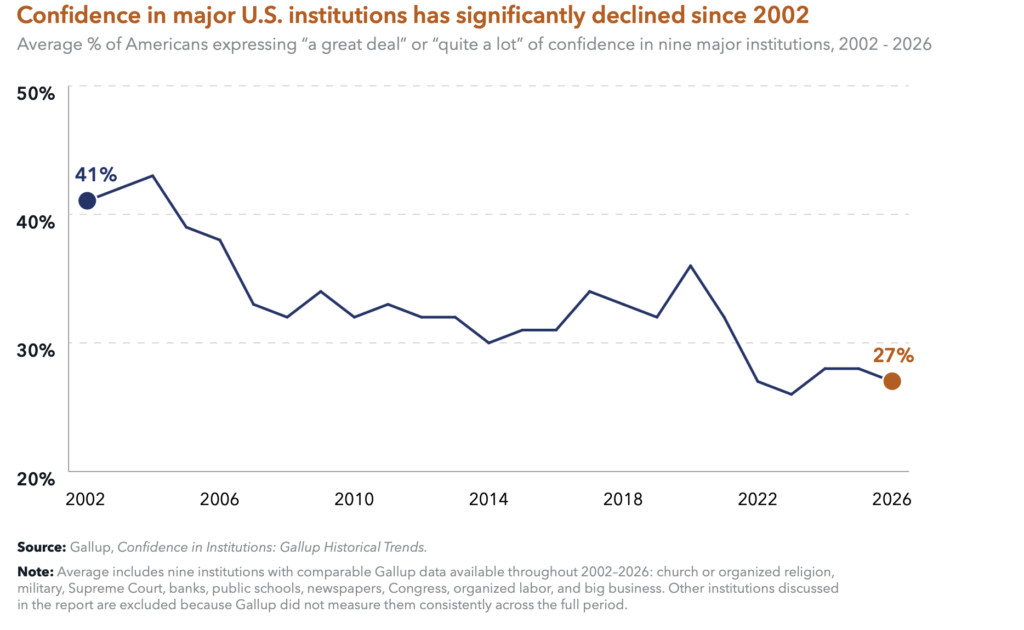
Driven in large part by the aforementioned partisanship and polarization, Americans have grown increasingly distrustful of almost all civic institutions. Gallup has been tracking “confidence in institutions” since at least 2002. Confidence has declined in virtually every institution that they polled: banks, big business, Congress, colleges and universities, the internet, the medical system, the military, newspapers, the presidency, police, public schools, science, and tech companies. Only organized labor—from a very low starting point—and small business have shown an increase in trust. And only small business, the military, and science are currently trusted “a great deal” or “quite a lot” by more than half of respondents, though even in these instances trust has declined in recent years.
Civil society has not escaped institutional suspicion and lack of faith. The latest survey by the Independent Sector shows that barely half (53 percent) of Americans have trust in nonprofits, NGOs, community organizations, and advocacy groups. What is more, only 34 percent of Americans express high confidence in philanthropies. While this means that Americans still trust civil society more than many institutions, both numbers show a statistically significant decline in trust since 2021.
It is not just declining faith in the institutions of civil society that is problematic. Institutional distrust is a subset of a broader loss of social trust. In 1965, for instance, more than half of Americans agreed with the statement “most people can be trusted.” Today, only one-third do. Similarly, according to a Pew survey, roughly half of Americans say Americans have lost confidence in each other “because people are not as reliable as they used to be,” while just 21 percent believe that Americans have lost confidence in each other, “even though,” according to Pew, “people are as reliable as they have always been.”
Americans also disagree on the nature and meaning of trust, often splitting along political lines. For instance, Republicans are more likely than Democrats (75 to 63 percent) to believe that people can be counted on to help those in need voluntarily. Democrats are much more likely (57 to 7 percent) to believe that a loss of trust in the government makes it more difficult to solve the country’s problems.
Declining public trust undermines civil society by eroding social cohesion, diminishing civic participation, and hindering collective action. Trust is the social lubricant that enables very diverse communities and individuals to cooperate effectively. When it is lost, people naturally retreat from an outward facing, more generous and self-sacrificing posture to one that is more insular and self-interested, hindering collective goals. As people turn inward, their group identity is strengthened, leading, in turn, to still greater polarization, and a further decline in trust of those outside the group.
Civil society institutions cannot fulfill their missions if they have lost legitimacy in the eyes of the populations they serve. Declining trust poses serious problems for institutional fundraising. That’s one reason that roughly 35 percent of civil society organizations are running an operating deficit. In addition, only one-quarter of organizations have at least six months of cash on hand. This leaves many organizations vulnerable to any disruption in their funding stream.
But the effect of declining trust goes well-beyond finances. A loss of trust makes it harder to mobilize volunteers and build collective solutions. Those who do not trust their neighbors or institutions are less likely to join volunteer groups, neighborhood associations, local charities, or other civil society organizations. This results in further social isolation.
In addition, when institutions lose public confidence that they will “do the right thing,” they lose the ability to provide moral leadership. People begin to doubt the entire idea of neutral institutions. But without such institutions, moral behavior becomes increasingly subjective. Restraints weaken. Individuals are more likely to opt-out of larger communities and separate into narrow ideological silos.
This loss of trust even leads to increased violence. As civil society becomes less effective and people become less trusting of institutions, a vacuum is created that is too often filled by voices that tolerate violence as a means of political or social redress. And, on an individual level, the breakdown in social restraints and the loss of trusted voices on moral action can make violence seem like an acceptable alternative.
Tribalism increases as people seek to protect their group, even at the expense of outsiders. This can be seen in the current political debates over issues such as immigration and women in the labor force. As social trust between groups breaks down, the ability of people to find common ground and to cooperate for the common good quickly erodes.
Regulation and retribution
Civil society finds itself operating in an increasingly hostile regulatory environment. Some of this stems from the natural bureaucratic impulse of politicians and government agencies to regulate and otherwise control the spheres in which they operate. Often this impulse is driven by good intentions, but it can still choke-off the freedom and innovation that makes civil society function.
More threatening is the deliberate targeting that stems from political polarization and partisanship. Government pressure on civil society has long been a feature of authoritarian regimes around the globe. Hungary under then-President Victor Orban and Russia under Vladimir Putin provide vivid examples of civil society under direct attack. Other strongmen who have sought to restrict civil society include Turkish President Recep Tayyip Erdoğan, Indian Prime Minister Narendra Modi, and former President Jair Bolsonaro in Brazil.
The tactics employed by authoritarian regimes from Ethiopia and Nicaragua to El Salvador and Uganda have been remarkably similar. The push against civil society was not abrupt and violent, but rather slow and relentless. The Carnegie Endowment for International Peace describes it as being akin to the “garbage compactor in Star Wars…systemically and inexorably tighten[ing] the space for civil society to do its work.”
First came restrictions on foreign funding. Later, civil society organizations were subjected to a bombardment of petty legal cases, fines, investigations, and raids, designed to wear down their membership and dry up their funding. All of this was accompanied by relentless vilification campaigns. The space for civil society gradually gave way to the increased power of the state.
It is extremely troubling, therefore, that we are now seeing such tactics in the United States. Indeed, the Civicus Monitor, an organization that tracks civil society and civic freedom worldwide, has downgraded the United States to an “obstructed” rating, which places us roughly in the middle of international rankings.
Congressional hearings with titles such as “Public Funds, Private Agendas: Nonprofits Gone Wild,” suggest how at least some policy makers view civil society. Congress is currently investigating at least 32 nonprofit organizations. In 2025, 43 such groups were investigated. No doubt many of these investigations are legitimate—civil society groups are hardly immune from fraud, waste, or abuse—but the sheer number of groups being looked at is both unusual and concerning. And, lawmakers have threatened to investigate Catholic Charities, Lutheran Immigration and Refugee Services, and other faith-based organizations for allegations that they provided food and clothing to undocumented migrants.
In addition, President Donald Trump has repeatedly taken steps to punish charitable groups with which he disagrees. The IRS, for example, has launched numerous investigations, audits, and even asset seizures against civil society groups whose policies have clashed with those of the administration. For example the administration has explicitly threatened to revoke the tax status of Citizens for Responsible Ethics in Washington and the Vera Institute of Justice, among others.
There has also been an increase in rhetoric that portrays even the most innocuous civil society activities as illicit and conspiratorial, dehumanizing those who give to, work for, or receive assistance from those organizations.
This is hardly an exclusively Trump problem. While the Trump administration and its congressional allies have been especially aggressive, the Biden administration also targeted organizations that advocated for policies that were contrary to the administration’s goals, such as Turning Point USA. The Obama administration was also hostile to some civil society organizations. Lois Lerner, a senior IRS official under President Obama admitted that the government deliberately discriminated against conservative-leaning organizations between 2010 and 2012, for instance, denying or delaying applications for 501(c)(3) tax status.
Such harassment could get worse. Both Congress and a number of states have considered legislation giving government new powers to regulate private charitable activities.
In 2024, for instance, the House of Representatives passed the anodyne sounding Stop Terrorism Financing and Tax Penalties on American Hostages Act, which would have given the secretary of the Treasury the power to unilaterally revoke the charitable status of organizations that run afoul of an administration. While ostensibly targeted at groups supporting terrorist organizations, the lack of due process protections and broad discretion afforded the Treasury secretary would have made it easy to weaponize against any nonprofits that “promotes conduct that is contrary to public policy.” Fortunately, the bill stalled in the Senate, but charitable organizations remain concerned.
Even without explicit legislation, the federal government has ramped up enforcement of the Foreign Agents Registration Act (FARA), a law with sweeping and vague provisions that can cover a range of activities that can even tangentially be tied to a foreign actor. Recently a number of organizations from across the political spectrum, including the ACLU and Americans for Prosperity, signed an open letter to Congress warning “FARA’s overbreadth and vagueness can undermine and chill First Amendment rights to speech and association and the statute has a history of being used to target undesirable expressive conduct.”
The law’s vagueness gives the Justice Department wide discretion to apply it, discretion that can be used to prosecute disfavored voices. In recent years, for instance, members of Congress have repeatedly accused prominent U.S. environmental and human rights groups of violating the law.
At the state level, threats to civil society emanate equally from both red states and blue. According to the 50-State Index of Charitable Regulations, the states that regulate charities most heavily are Connecticut, Florida, Mississippi, New Jersey, and Pennsylvania. There is no discernible left/right trend there.
Obviously, a certain amount of regulation is required to maintain accountability and trust. But, as with other areas of regulation, if the burden becomes too high relative to the benefits of those regulations, they can become counterproductive. Moreover, a study from the Philanthropy Roundtable suggests that over-regulation can reduce the number of charities in a state and reduce the overall “vibrancy” of the charitable sector.
Traditionally, regulations have been focused on areas such as registration, annual reporting, solicitation, audits, and governance. However, states governed by both parties have increasingly expanded the scope of their regulatory efforts in ways that appear designed to restrict civil society organizations that the state government disapproves of. The Alliance for Justice warns that this legislation is often designed to limit how nonprofits speak, organize, fundraise, and participate in civic life.
For example, Maryland nearly passed legislation allowing the state to impose heavy fines or strip an organization of its tax-exempt status if it is judged to have crossed the line into political action. State officials in New York pressured banks and insurers to cut ties with the National Rifle Association, while officials in Texas have launched investigations of organizations providing aid to undocumented migrants, supporting LGTBQ+ families, and engaged in voter registration efforts.
The most pressing regulatory threats to civil society include:
Privacy and donor disclosure In 2021, the U.S. Supreme Court affirmed the right to donor privacy in the case of Americans for Prosperity Foundation v. Bonta, holding that donor disclosure laws must satisfy “exacting scrutiny,” meaning the state must demonstrate a “substantial relation” between the disclosure requirement and a “sufficiently important” governmental interest. This decision followed precedent established in the 1959 case NAACP v Alabama ex rel. Patterson, upholding donor privacy in the face of Alabama’s efforts to seize the NAACP’s donor list, with the obvious intention of harassing and silencing them.
Despite this, both Democratic and Republican legislators continue to push for legislation requiring disclosure of sensitive donor information. This year alone, for example, 11 states considered more than 30 bills mandating additional donor information from nonprofit organizations.
This legislation is often portrayed as a necessary transparency measure, but it can easily chill speech, raise compliance costs, and discourage advocacy. All too often, compelled disclosure can expose donors to harassment, retaliation, or political targeting.
“Foreign influence” restrictions Several states have recently enacted legislation to ban or restrict contributions from foreign sources. No doubt there are legitimate concerns. Terrorism is a genuine threat and foreign governments undoubtedly attempt to influence what happens in the United States.
But many of the laws are drafted in extremely broad or vague terms that could threaten benign conduct. For instance, in February 2026, 19 state attorneys general sent a letter to the U.S. Justice Department calling for a federal investigation of more than 150 climate change and green energy organizations that received some of their funding from overseas. DOJ has refused to comment on whether they have opened a formal probe of any of these organizations, but if they haven’t yet, it is likely they will.
Restrictions on giving pathways Recently, many states have turned critical attention to new and innovative mechanisms for giving, particularly Donor Advised Funds (DAF). DAF donors can claim an immediate tax deduction on contributions as well as avoid capital gains taxes, while the assets remain in the account. The interest or investment returns accumulate tax free as well. The donor can then direct the fund to make contributions to charities of the donor’s choice. Donor Advised Funds are particularly beneficial to middle-range donors, providing them with some of the benefits enjoyed by large foundations, such as the Ford Foundation. There are at least 3.6 million Donor Advised Funds currently active, holding a total of $326 billion in assets.
Both state and federal authorities have sought to restrict the activities of Donor Advised Funds in ways that would likely reduce their effectiveness. In addition to onerous disclosure requirements , many states have sought to impose minimum payout rates. Among other concerns, minimum payouts can make it more difficult for donors to support institutions over a long or even multigenerational horizon. In addition, minimum payouts limit the return on investments that funds can earn by making it harder to take full advantage of the compounding effect of long-term investments. And the Philanthropy Roundtable has warned that too often the minimum payout transforms into a de facto maximum payout as well.
Crowd-out
Finally, the government increasingly crowds out civil society. As the Congressional Joint Economic Committee noted, the decline of civil society “is at least partially attributable to the expansion of government, which evolved to serve specific needs that civil society used to fulfill.”
Tim Carney warns of the dangers of the growing reliance on government: “The more power the central state takes away from civil society and local community, the more people have to spend their time on the central state. The more everyone’s attention shifts toward the central state, the more local communities and civil society are neglected.”
Although there are academic disagreements about how much crowding out there is, evidence suggests that government social welfare interventions reduce private charitable efforts. For example, as far back as 1899, Frederick Almy, secretary of the Buffalo Charity Organization Society, found an inverse relationship between private charitable giving and government social welfare programs. Those cities that had the highest levels of government spending also had the lowest levels of private charity, and vice versa. Almy concluded that “a correspondence or balance between the amounts of public and private relief appears to be established.”
Modern scholarship shows a similar pattern. Private charitable giving, measured as a percentage of personal income, declined significantly in the wake of President Johnson’s Great Society. That decline leveled out in the 1980s as the increase in welfare spending slowed, then spiked following the passage of welfare reform in 1996. Moreover, the proportion of charitable giving devoted to human services and poverty alleviation followed a similar path, declining as the welfare state grew and assumed more and more responsibility, only to increase again when the public perceived that welfare was being cut.
Other studies have shown that when private charities receive government funds, there is a decrease in private donations, with the crowd-out ranging from as little as two cents to as much as 53 cents in lost contributions for every dollar of government funding received. Donors respond to need—or perceived need—making them less likely to give if they believe the government has already intervened.
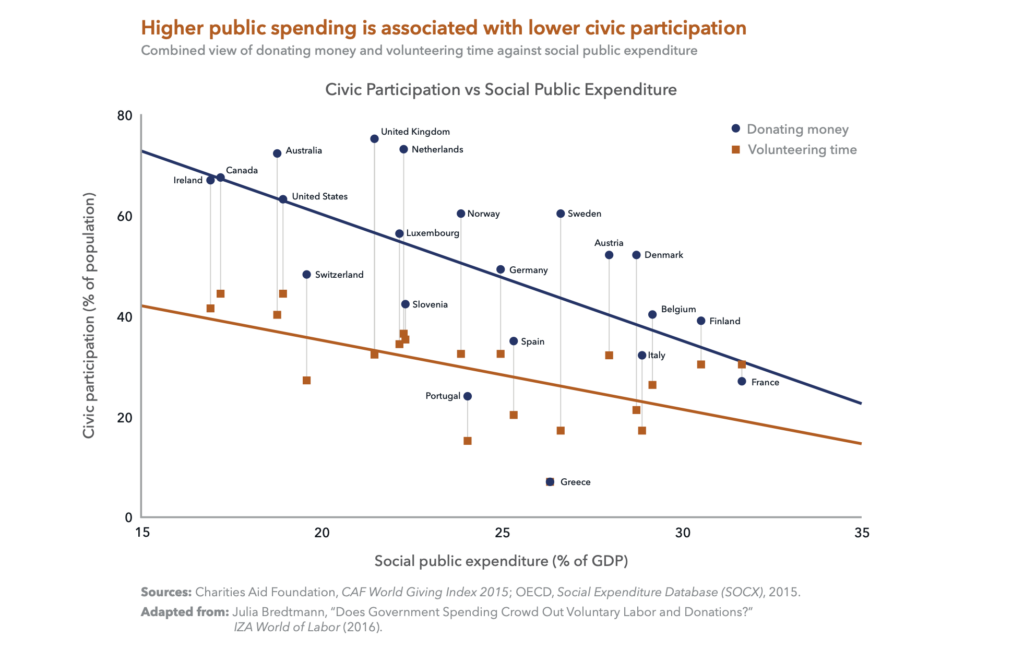
International comparisons show that countries with higher levels of government social expenditures have a lower proportion of their populations who donate to charity or volunteer. People generally behave rationally in their charitable impulses, responding with increased giving when they perceive a need, and cutting back when they believe that need has been met.
As Nathan Glazer wrote in The Limits of Social Policy, “The simple reality [is] that every piece of social policy substitutes for some traditional arrangement, whether good or bad, a new arrangement in which public authorities take over, at least in part, the role of the family, of the ethnic or neighborhood group, of voluntary associations.”
Even when government agencies do not directly compete with civil society, they too often provide a substantial portion of the funding for civil society organizations. The Manhattan Institute estimates that, in 2020, the government entered into at least 350,000 contracts with at least 56,000 civil society organizations. In doing so, they can subtly alter the organization’s mission or independence.
One newspaper described organizations that are heavily reliant on government funding as transformed “into government vendors—big businesses wielding jobs and amassing clout to further their own agendas.” Kimberly Dennis, former executive director of the Philanthropy Roundtable, notes that those organizations are “more interested in expanding government’s responsibilities than in strengthening private institutions to address social concerns.”
Even organizations acting with the best intentions may subtly shift the emphasis of their missions to qualify for funding. Some faith-based charities may become increasingly secular in orientation; others may simply adopt new missions and services that distract from the church’s original goal. It is one thing for a church to open a soup kitchen because its congregation feels God has called on them to do so, it is another to open that kitchen because someone dangles grant money in front of them. Stanley Carlson-Thies, director of social policy studies at the Center for Public Justice, refers to this mission creep as “vendorism,” a process whereby government grants end up directing the activities of private charities, changing their direction and turning them into mere vendors of government service.
Worse, the government can use the threat of reducing future funding to force organizations to change their behavior, programs, and even their mission. The Trump administration has frequently used the threat of withdrawing funding to demand changes from organizations that he disapproved of. For example, a number of educational institutions and civil society organizations have faced funding cuts because they have maintained diversity, equity, and inclusion initiatives, which the Trump administration argues violate federal civil rights law. Indeed, the more reliant an institution becomes on government, the more they may be subject to the whims of politicians.
This is not a call for mindlessly slashing social welfare programs and hoping that civil society can and will pick up the difference. But it does suggest that often the best thing for a community might be for the government to do less and the community to do more. At the very least, policymakers should be aware of the ways in which actions they are proposing will impact the institutions of civil society in their community.
The over-professionalization of charity
It is not just the government that threatens to crowd-out local, community-based charities. Many civil society organizations, especially those involved in social services, have become increasingly professionalized. They have shifted from broad-based member-driven operations to ones managed by professional, college-educated staff. Not only does this reduce opportunities for average citizens to participate, it often moves the organizational focus from local community needs to broader national issues.
This transformation can be traced back to the start of the 20th century. During that time, the belief in “experts” began to dominate large swaths of the American cultural landscape. This was true of philanthropy as well. Large philanthropic institutions like the Carnegie Corporation, the Ford Foundation, and the Rockefeller Foundation began to hire professional social scientists to “maximize charitable giving for social improvement.”
Today, large national charities continue to squeeze-out many local grassroots efforts. These mega-philanthropies are able to better attract the attention of donors, especially institutional funding, because they can provide the type of standardized, high-volume metrics donors prefer. Smaller local charities that excel at building trust-based relationships often lack the data infrastructure to compete. This dynamic shifts power away from those community-led groups that best understand neighborhood needs.
In addition, the role of the volunteer is increasingly overtaken by paid, professional staff. As a result, some charities can begin to resemble government agencies or large corporations rather than the civil society vehicles that Tocqueville wrote about. As one U.K. expert put it, the charitable sector has “lost its soul.”
How to Revitalize Civil Society
Revitalizing civil society requires actively strengthening the institutions of voluntary association that sit at the core of civil society and enable it to function. A government-directed strategy to fix civil society would be both futile and undesirable. Government, by definition, stands outside of—and even in antithesis to—civil society. Instead, the government should focus on removing obstacles to civil society.
- First and foremost, the government should cease efforts to harass or intimidate civil society organizations. Obviously, fraud and other forms of dishonesty need to be policed, but organizations should not be targeted for their viewpoints. There can be no effective civil society unless the government respects freedom of speech, freedom of association, and the rights of donors to give freely. Civil society organizations, regardless of their role or ideological orientation, must be ready and willing to stand up against populist interests that seek to erode these fundamental freedoms.
- Second, the government should avoid actions that crowd out civil society efforts. This is not a call for mindlessly slashing social welfare programs in the hope or expectation that private charities can pick up the difference. Rather, policymakers should consider how new programs or additional social welfare spending will negatively effect existing social structures. Too often, government programs don’t complement civil society but displace it. Given that far away bureaucratic government is worse at delivering services and meeting the needs of individuals than civil society—organizations on the ground run and staffed by people who live in the communities they serve—this sort of crowd-out will almost certainly produce worse results.
- Third, governments can encourage civil society activities and to make it easier for civil society to operate. State and local governments can review regulations to reduce conflict with civil society organizations and activities, even when those regulations seem ancillary to civil society. For example, restrictive occupational licensing laws can limit the ability of civil society to provide such services as child care, home repair, and tutoring.
For example, licensing for child care often requires strict staff-to-child ratios, specific education degree requirements for staff, minimum square footage requirements, and other expensive facility upgrades that can disqualify small community-based operations. Likewise many localities require anyone performing structural, electrical, or plumbing work to hold a formal contractor’s license. This often blocks volunteer groups from doing charitable work. And some states have used teacher certification requirements to try to shut down informal or online tutoring programs.
Residential and business zoning ordinances can also make civil society more difficult to operate, sometimes pushing organizations out of communities where they are needed. In many cities, churches and other houses of worship are prohibited from operating shelters or soup kitchens on their property.
When civil society and the needs of the poor run into the impulse of bureaucracies to regulate and control, the charities and those they serve are too often the losers.
The government can also take proactive steps. For instance, both the federal and state tax codes should encourage charitable giving. This includes both maximizing the value of charitable deductions and simplifying administrative burdens on both donors and the recipients. Currently only about 10 percent of households claim a charitable deduction on their federal income taxes. Howard Husock has suggested, for example, an “above the line” charitable tax deduction which would make it easier for lower-income households, who are less likely to itemize their tax returns, to get a break for charitable giving. He also supports a special tax incentive for charitable donors to target giving to organizations in lower-income areas, perhaps an enhanced tax deduction or even a tax credit for those who provide financial support for nonprofit groups in high-poverty areas.
A bipartisan group of U.S. senators, led by James Lankford (R.,Okla.) and Amy Klobuchar (D., Minn.) is backing a draft bill to allow an expanded charitable deduction of $4,000 for single taxpayers and $8,000 for married couples, available even to those who don’t otherwise itemize.
More locally, municipalities should consider the need for spaces where citizens can gather, interact, and participate in civil society. That is, towns and cities should attempt to incorporate locations where residents may easily congregate such as parks, hiking trails, community and civic centers, libraries, performance spaces, dog parks, community gardens, and so on. Currently, too many Americans face “civic deserts.” More than one-in-five Americans currently says that they live in neighborhoods with no access to public or commercial spaces that form the basis for community activity. Another third say that they have minimal access to such spaces. People living in these areas say that they find it much more difficult to meet or talk with their neighbors. Reversing this will make it easier for civil society associations to form.
It is also important that amenities such as libraries and parks, especially to the degree that they are government-funded, be open and welcoming to everyone without regard to viewpoint. Public libraries, for example, are generally considered limited public forums. They cannot deny space based on the content of a group’s speech, religious beliefs, or political affiliations.
Finally, the government has a responsibility to ensure economic stability, indeed to promote economic growth. As discussed above, people are far less likely to participate in civil society if they are struggling to make ends meet. To the degree that policymakers are able to ensure economic stability, it will be easier to engage in civic life that is not directly tied to their short-term economic well-being.
Ultimately though, civil society is not about government. Revitalizing it will require action, adaptation, and innovation by civil society itself. This means renewal from the ground up.
Civil society organizations must model the behavior they wish to encourage. That starts with inclusion and civility. There should be a willingness to work with those with a different background, religion, or political beliefs. Sure, no one is suggesting that the Democratic Socialists of America must invite the Hayek Society to join—although both organizations would undoubtedly benefit from talking, listening, and learning—but the same cannot be said about one’s daughter’s sports league.
In a country of 330 million people, it is impossible to interact only with those who are in complete agreement on everything.
Moreover, anyone who values civil society should themselves practice civility. The goal of every interaction, whether online or at a community meeting, should not be to “make the libs cry” or punish microaggressions, but to persuade, learn, and find common ground. Adam Smith wrote in The Theory of Moral Sentiments, that hatred or “deep seated animosity and resentment” is incompatible with the health of civil society and should be “hunted out of all civil society.”
Conclusion
Civil society in the United States is diverse and dynamic, with thousands of organizations working to address a wide range of issues. Organizations range from long-established philanthropic national or even transnational mega-operations to small, community-based organizations, and everything in between.
Civil society and its institutions are uniquely suited to solve the social challenges facing America today, especially when it comes to reducing poverty and helping people to become self-sufficient and economically mobile. Civil society is innovative and entrepreneurial in ways that the government is not. As a result, it has the potential to lift up individuals and communities, giving them the tools necessary to climb the economic ladder.
That is why it is so troubling that civil society finds itself under pressures threatening to undercut its effectiveness. Indeed, in many ways civil society is increasingly being hollowed out and displaced from its central societal role.
Civil society is not just valuable for the work it does, though that work is irreplaceable. In many ways, civil society is a good unto itself. Simply by existing, civil society organizations help “civilize” society and make all of us a little bit better.
Policymakers therefore, regardless of political orientation, should make preserving and revitalizing civil society and its institutions one of their highest priorities.