



Occupational licensing is often framed as a neutral tool for protecting consumers. In reality, it is one of the most direct ways governments limit who can work, and those limits fall hardest on the poor. When entry into a job requires time, money, exams, and bureaucratic approval, the burden is not evenly shared. It is often the poor whose occupations who are disproportionately licensed and therefore are hindered from working in jobs they are otherwise qualified to do.
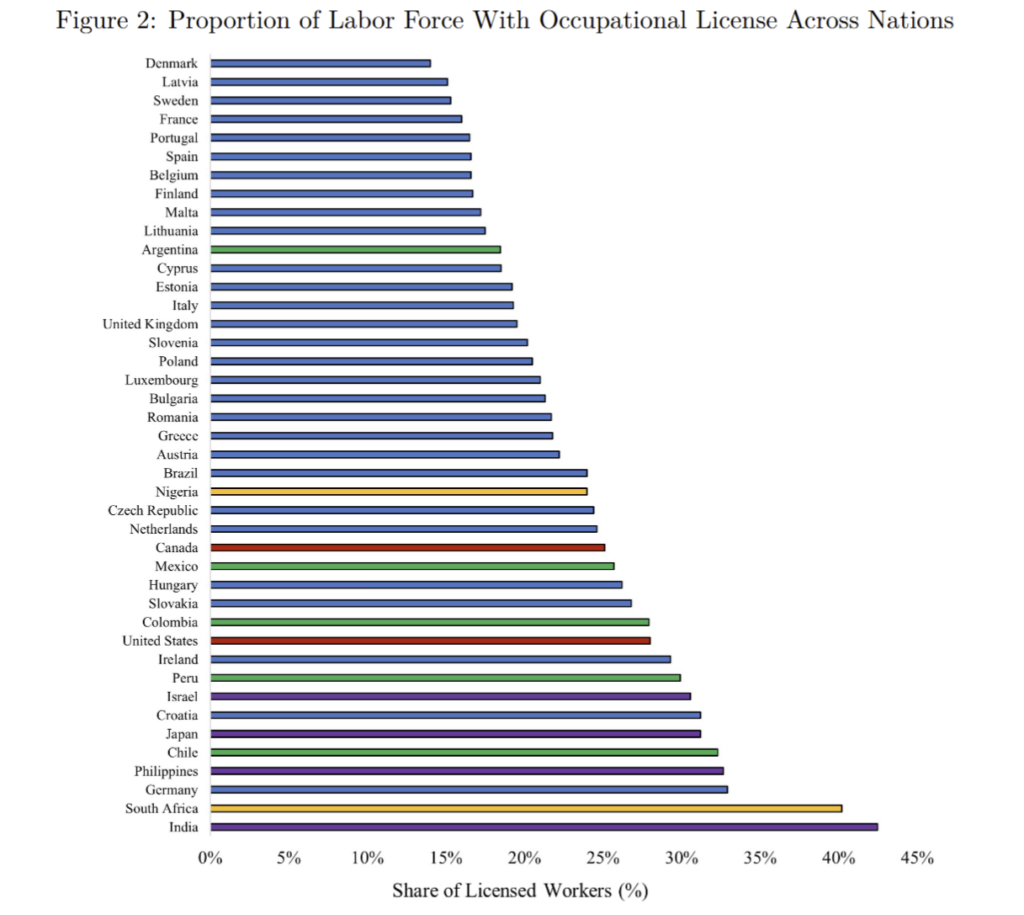
A new cross country study I wrote with Morris Kleiner, “Analyzing Occupational Licensing Across Nations” (now in the NBER Working Papers Series), shows just how widespread this problem has become internationally. Using surveys across many countries, we found that roughly one-fifth to one-quarter of workers are in jobs that require a government license. That is not just an advanced economy phenomenon; it’s global and arguably prevents many poorer countries and their inhabitants from rising.
The negative consequences of occupational licensing for the poor follow directly from basic economics. Licensing restricts entry. When fewer people can legally perform a job, wages rise for those inside the profession while prices rise for consumers. We found the wage premia for licensed workers in the range of 8 to 15 percent, consistent with a large literature showing that licensing often transfers income from consumers to incumbent workers without clear improvements in service quality. This means higher wages for those who have a license but relatively few jobs overall in a given licensed profession compared to an unlicensed regime. This can create a double-whammy for low income households, creating higher prices for necessities like child care, transportation, and basic services alongside fewer opportunities to move into better paying occupations.
The new evidence is striking because it shows how high licensing rates are in parts of the developing world. Countries such as India and South Africa have some of the highest shares of workers in licensed occupations, in some cases exceeding 40 percent of the workforce. That is comparable to or higher than many advanced economies.
This should give policymakers pause. Developing countries are often thought to suffer from too little regulation or too much informality. Yet, in key parts of their labor markets, they appear to have built systems that look very similar to—and in some cases more restrictive than—those in the United States and Europe. When large fractions of the workforce face legal barriers to entry, it becomes harder for people to move into formal employment, harder for entrepreneurs to start businesses, and harder for economies to allocate talent efficiently. High licensing rates are not the only reason some countries are poorer, but they are a plausible and underappreciated part of the story.
The mobility effects are equally important. Licensing regimes are typically jurisdiction specific. A worker who is qualified in one place may not be allowed to work in another without repeating costly requirements. That reduces migration and slows adjustment to economic shocks. In the United States, this has contributed to lower interstate mobility. Internationally, it fragments labor markets even further.
There is, however, a clear policy path forward.
One of the most promising occupational licensing reforms in the United States is universal recognition of licenses. Instead of forcing workers to start from scratch when they move, governments can accept valid credentials issued elsewhere. Research by Ed Timmons and Kihwan Bae shows that these policies increase employment in licensed occupations without reducing quality. In other words, they expand opportunity without sacrificing consumer protection.
Governments could also expand apprenticeship and alternative pathways into licensed trades, letting workers demonstrate competence through supervised work experience rather than classroom hours and fees alone. Many states and countries also require far more training hours than the job’s actual risk profile justifies—for instance, barbers in some U.S. states need more hours of training than EMTs—hence scaling requirements to match real safety stakes would cut costs without compromising quality.
A third option is sunset review: requiring licensing boards to periodically justify that a given license still serves a genuine safety purpose, rather than letting rules persist by default long after the rationale has faded.
Licensing is not inherently good or bad. It is a tool. Used narrowly and carefully, it can address genuine safety concerns. Used broadly, it becomes a barrier that protects insiders at the expense of everyone else.
If policymakers are serious about expanding opportunity, especially for those at the bottom of the income distribution, occupational licensing should be near the top of the reform agenda. The gains are not abstract. They show up as more jobs, lower prices, and a more dynamic economy. And as the new international evidence makes clear, those gains are available not just in the United States, but around the world.